by Agbonmagbe Kazeem
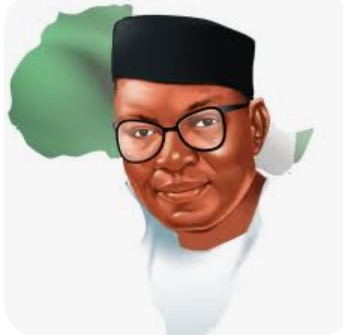
Dr. Nnamdi Benjamin Azikiwe, born on November 16, 1904, and passed on to the land beyond on May 11, 1996, represented many things not only for Nigeria, but Africa. No wonder while he was alive, he was referred to as ‘Zik of Africa’.
Zik was a politician, statesman and revolutionary leader who was the first indigenous governor-general of Nigeria from 1960 to 1963, and first president of Nigeria from 1963 to 1966.
Because of the role he played towards liberating Nigeria and, indeed, most black nations from the clutches of colonialism, he was regarded as the father of Nigerian nationalism.

He was a man of many parts. He was principally Igbo born in a rural settlement called Zungeru in Niger state and raised, but he spent a greater part of his life in Lagos. As a result of this, he spoke the three major languages – Hausa, Igbo and Yoruba fluently.
Aside being a nationalist, he was someone that was well travelled. For instance, at a relatively young adult age, he moved to the United States and attended Storer College, Columbia University, the University of Pennsylvania and Howard University, respectively, all in search of knowledge.
While there, he requested the colonial government to allow him represent Nigeria at the 1932 Los Angeles Olympics since he was also an athlete, but that request was turned down for reasons best known to the colonial government in London.
He, however, returned to Africa in 1934 and started working as a journalist in Ghana through which he used his profession to advocate for political activism on the continent.
At the start of his career, Azikiwe was good at sports. That was why he featured in boxing, swimming, football and tennis. As a matter of fact, through him, football was brought to Nigeria by the British.
The story goes that in 1934, Zik was denied the right to compete in a track and field event organised by the colonial government because Nigeria was not allowed to participate. This was for him the last straw that broke the camel’s back.
In a most dramatic response, he went ahead and created his own club named, ‘Zik’s Athletic Club’ (ZAC) which opened its doors to sportsmen and women of all classes of the country. In 1942, the club went on to win both the Lagos League and the War Memorial Cup.
In 1949, some ZAC players participated in a tour of England. On returning from the tour, they stopped in Freetown for a friendly and defeated the locals by two goals. This was before Nigeria’s independence, but it marked the birth of Nigeria’s National Team. Finally, after years of struggle, in 1959 the last British official left the NFA and on August 22, 1960, Nigeria joined the world football body (FIFA).
This would not have happened if not for Zik. He therefore united Nigeria through sports and brought about a sense of nationalism that was found only in sports, especially football.
His career in journalism can largely be ascribed to the women’s resistance against British taxation in 1929, which witnessed an extraordinary massacre of women in Opobo by the British. Hearing about the ugly incident while in the US, he wrote an article condemning the incident entitled, ‘Murdering Women in Nigeria.’
By 1934, when he returned to Lagos, he was well-known and viewed as a notable Nigerian whose writings reached Nigeria while in America. He therefore wanted to obtain a position commensurate with his education in the civil service, but after several unsuccessful applications.
He would later accept an offer from a Ghanaian businessman, Alfred Ocansey, to become the founding editor of African Morning Post, a daily newspaper based in Accra, where he was given a free hand to run the newspaper as the CEO.
As the editor, he propagated African nationalist agenda with denunciatory articles and public statements that condemned the colonial order, which restricted Africans’ right to express themselves against the backdrop of the biting racial discriminations.
In Ghana, Azikiwe did not shy away from Gold Coast politics as his paper supported the local Mambii Party. The paper published a May 15, 1936, article with the title, ‘Has the African a God?’
As the editor, he was tried for sedition, found guilty and sentenced to six months imprisonment. Upon his conviction, he declared, “If because I am an instrument of destiny through which imperialism in West Africa is to be challenged and liquidated, and if in this mission, I am compelled to pay the supreme penalty, then there is no need for me to quake or to quiver.
“I am becoming convinced day by day that New Africa is destined to become a reality. No force under the heavens can stem it. Even my death cannot postpone its crystallisation.” He was however later acquitted by the Supreme West African Court of Appeal.
He returned to Lagos in 1937 and founded the West African Pilot with which to promote nationalism in Nigeria. The newspaper emphasised sensationalism and human-interest stories. It introduced sports coverage and a women’s section, increasing coverage of Nigerian events compared with Daily Times which emphasised expatriate and foreign-news-service stories.
The paper’s editorials and political coverage focused on injustice to Africans, criticism of the colonial administration and support for the ideas of the educated elites in Lagos. By 1940, a gradual change occurred.
Azikiwe began writing a column entitled ‘Inside Stuff’ with which he tried to raise political consciousness by calling for African independence, particularly after the rise of the Indian independence movement.
After independence, the paper became influential in the East. No wonder, at his death in 1996, The New York Times said, “Azikiwe towered over the affairs of Africa’s most populous nation, attaining the rare status of a truly national hero who came to be admired across the regional and ethnic lines dividing his country.”
Azikiwe became the premier of the Eastern Region in 1954 after a new constitution was put into effect. The region’s economic commission collaborated with Europe and North America to promote investment for developments in textile, vegetable oil refineries, steel and chemicals.
He built the famous Nigeria Cement Company at Nkalagu in today’s Ebonyi state and Niger gas. He also established Nigeria’s first steel company, Niger Steel; Nigeria’s first indigenous bank, African Continental Bank (ACB), which was instrumental to the emergence of a big entrepreneurial class in the East.
The bank also played a critical part in the rise of Igbo citizens at the cessation of Civil War in 1970. Aside from these, he instituted an education programme that enabled Nigerians to become the leading exporter of studying abroad in Africa.
He did not end there as he also set up the Eastern Nigerian Development Corporation, which played a critical role in the building of the University of Nigeria at Nsukka, the first full-fledged indigenous university in 1960.
From this time onward into the Second Republic, Zik was still prominent in the affairs of the country, although age was no longer on his side as he often took ill.
On November 8, 1989, news filtered in about his death, but he eventually resurfaced, saying, “I am not in a hurry to leave this world because it is the only planet I know.” In 1991, he travelled to Zungeru, his birthplace where the then military President General Ibrahim Babangida was to launch Nnamdi Azikiwe Centre.
He eventually died on May 11, 1996, at the University of Nigeria Teaching Hospital in Enugu after a prolonged illness. He was given a state funeral by the regime of General Sani Abacha, following nearly two weeks of national ceremonies.
His body was taken to various important cities in the country for mourning and tributes, including the University of Nigeria Nsukka and Abuja, before he was finally buried in his country home in Onitsha.
Azikiwe’s place in Nigeria’s cosmology goes far beyond the positions he held. He gave nationalism and the independence struggle a new meaning. At the Hope Waddel Institute, he was conversant with the ideas of Marcus Garvey on Pan-Africanism, emphasising the empowerment of Africans, and the redemption of Africa by Africans. This made him question the legitimacy of colonialism in Africa.
For these and many more, he is one of Nigeria’s unforgettable heroes whose exemplary life still remains an inspiration to many in the current dispensation.
“THE HISTORIAN”
AGBONMAGBE REMILEKUN KAZEEM
+2348036472826