
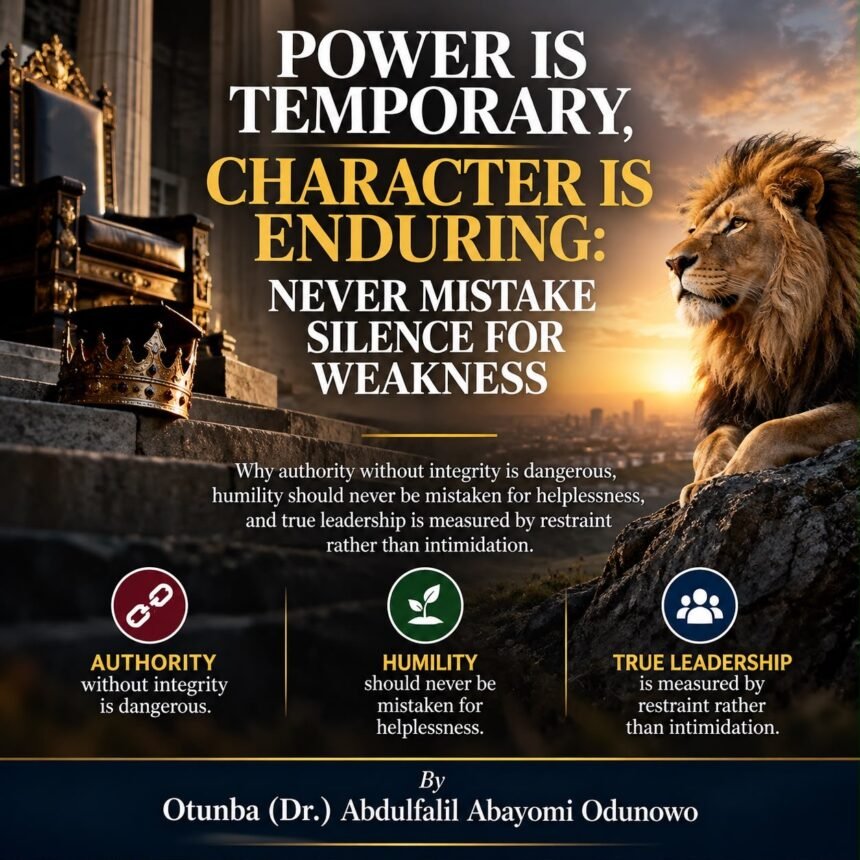
by Otunba (Dr.) Abdulfalil Abayomi Odunowo
Why authority without integrity becomes dangerous, why humility should not be confused with helplessness, and why real leadership is defined more by restraint than by intimidation.
By Otunba (Dr.) Abdulfalil Abayomi Odunowo
There is a basic truth about power that many people recognise only after it is gone: office may grant authority, but character determines how that authority is used.

In political institutions, traditional establishments, corporate organisations, religious communities, and even social clubs, we often see people confuse the privilege of holding office with personal superiority. Because they have been entrusted with authority, they begin to believe they are entitled to intimidate, humiliate, dismiss, or silence others.
What they forget is that every office is temporary, while the effects of a person’s character can last for generations. Even more troubling is the habit among some influential people of reading others’ silence as weakness, patience as ignorance, and humility as proof that they are incapable of responding. That interpretation is profoundly mistaken.
Authority is not proof of superiority
One of the most persistent misunderstandings about leadership is the assumption that holding office automatically means a person possesses wisdom, integrity, or moral authority.
It does not.
A governor may hold constitutional power without showing exceptional judgment. A chairman may lead an organisation without understanding the obligations of stewardship. A traditional titleholder may receive ceremonial honour without having earned real respect. A corporate executive may control vast resources while lacking the emotional intelligence needed to manage people.
Titles indicate position. They do not validate character.
History offers ample evidence. After the American Revolutionary War, George Washington stood at the height of military prestige, yet in 1783 he voluntarily resigned his commission as commander of the Continental Army. Later, he restricted himself to two terms as president. King George III reportedly said that if Washington truly surrendered power, he would be “the greatest man in the world.” By showing restraint modelled on the Roman Cincinnati, Washington helped root the American republic in institutions rather than in personality. Centuries later, his example still shapes the peaceful transfer of power.
Compare that with leaders who behaved as though public office were private property. In late-20th-century Africa, figures such as Mobutu Sese Seko in Zaire and Muammar Gaddafi in Libya amassed near-absolute power, surrounded themselves with adulation, and reduced institutions to instruments of personal will. When their rule ended, it ended quickly and often in disgrace. Power sustained only by fear disappears as soon as the machinery of intimidation is removed.
Leadership is not truly measured by how many people rise when you enter a room, but by how many continue to respect you after you leave it. It is not measured by how forcefully you issue commands, but by how justly you use discretion. It is not defined by how thoroughly you suppress dissent, but by how securely you can live with disagreement. Authority may force obedience, but only character inspires loyalty.
That distinction matters especially in Nigeria, where our political and social culture can encourage excessive deference to officeholders while giving too little attention to how they behave. We celebrate titles, bestow honours, insist on elaborate protocol, and attach unusual importance to official positions. Yet we do not always hold those in such positions to equally demanding standards of accountability. The result is a society in which the appearance of importance can outweigh the substance of leadership.
Never confuse silence with weakness
There is another lesson that calls for serious thought. Silence does not mean a person cannot speak. Avoiding confrontation does not mean fearing conflict. Enduring provocation does not mean lacking the ability to respond. Some remain silent because they understand the cost of needless confrontation. Others do so because they place relationships, institutions, and collective interests above personal ego. Still others exercise restraint because experience has taught them that not every insult deserves a reply and not every provocation requires a reaction.
Silence may be wisdom. It may reflect discipline. It may reveal maturity. At times, it is simply the choice of a strong person who refuses to descend into a pointless struggle of egos. Nelson Mandela exemplified this. During 27 years of imprisonment, he endured isolation and provocation without giving way to bitterness or reckless retaliation. In 1985, when P.W. Botha offered him conditional freedom if he would renounce violence, Mandela declined, insisting that only free men can negotiate. After his release and his eventual election as president in 1994, he chose reconciliation instead of revenge, served only one term, and put nation-building ahead of personal permanence. What some may have mistaken for weakness during the long years of struggle proved instead to be strategic strength that helped prevent civil war and laid a durable democratic foundation.
Abraham Lincoln also understood the strength in measured silence. After his election and before his inauguration, as the Union was breaking apart, he largely withheld public statements because he understood that premature words could inflame rather than calm the situation. His restraint was not inactivity; it was disciplined preparation for the enormous burden ahead. Those who routinely abuse power often fail to understand this kind of restraint. They mistake courtesy for submission. They take patience as permission to continue misconduct. They confuse civility with surrender. That is a dangerous error.
History contains countless examples of individuals and communities whose long endurance was mistaken for permanent acceptance of injustice. When they finally spoke, those who had confused restraint with helplessness were often taken by surprise. Even so, silence must not become a pretext for tolerating wrongdoing forever. There comes a point when conscience demands speech, when institutional duty requires intervention, and when preserving dignity means drawing a firm line. The challenge is to know when to remain silent, when to speak, and how to act without compromising one’s principles. The strongest response is not always the loudest. It is the one directed by wisdom, evidence, and purpose.
The dangerous psychology of temporary power
Power can change the conduct of those who wield it, especially where institutions do not provide effective checks and balances. People who were once accessible may become unreachable. Those who once demanded fairness may begin resisting scrutiny. Individuals who used to denounce arrogance may slowly begin to display the same behaviour themselves.
This often happens because an officeholder starts to mistake institutional authority for personal ownership. Public office is treated like private entitlement. An elected role becomes a tool for settling private grievances. Leadership shifts away from service and toward control over access, opportunity, and recognition.
The danger becomes greater when supporters strengthen the illusion that the officeholder is indispensable. Every leader needs people who can disagree respectfully. A leader surrounded only by praise may gradually lose the ability to tell the difference between sound judgment and personal preference.
In healthy institutions, rules, transparent procedures, and accountability place limits on authority. In unhealthy institutions, authority is shaped by personality, loyalty, and intimidation. That difference explains why some organisations survive and prosper through changes in leadership while others begin to decay the moment a dominant individual leaves. One type is built on institutions. The other is built on personalities.
Nigeria must increasingly choose institutions over personalities. The comparatively orderly transitions of the Fourth Republic, including the 2015 handover of power from an incumbent to an opposition candidate, show that institutional continuity is achievable. But the larger task of entrenching accountability, transparency, and restraint is still unfinished.
Respect cannot be forced into existence
There is a clear difference between respect for an office and respect for the person who occupies it. An office may merit recognition because of its constitutional, traditional, or institutional importance. Personal respect, however, has to be earned through conduct.
A chairman who treats members with dignity earns something more valuable than ceremonial applause. A governor who hears criticism without retaliation strengthens public trust. A traditional leader who acts fairly among competing interests reinforces the legitimacy of the institution. A community leader who protects the rights of those who disagree with him shows real maturity.
By contrast, leaders who constantly demand respect while treating others with contempt show that they do not understand leadership at all. People cannot be humiliated into respecting you. They can only be intimidated into temporary compliance. And temporary compliance must never be mistaken for lasting loyalty. Once the authority is gone, the fear that sustained it disappears as well. What remains is the memory of how people were treated.
Character is clearest when no one can challenge you
It is not difficult to appear polite when dealing with someone more powerful. Character is tested more truthfully in the way one treats those who have little influence over one’s future. How does a political leader treat an ordinary constituent who cannot provide financial support? How does a club president deal with a member who disagrees with an executive decision? How does a business owner treat junior employees? How does a public official respond to someone who lacks the connections needed to obtain preferential treatment?
Such moments reveal more about character than public speeches, visible donations, or carefully staged appearances. Integrity shows itself in consistency. A principled person should not become unjust simply because circumstances allow it. A genuinely confident leader does not need to reduce others in order to feel important. And anyone who understands the responsibility attached to authority should know that restraint is not optional; it is a necessary qualification for leadership.
Marcus Aurelius, the Roman emperor and Stoic philosopher, governed an empire while repeatedly reminding himself in his Meditations that power did not lift him above ordinary human duties. He sought to rule through self-discipline, not display. His example endures because he judged himself by character rather than by the ornaments of office.
Nigeria needs leaders who understand this difference
As Nigeria continues to develop democratically and institutionally, we must rethink the qualities we praise in those entrusted with leadership. Too often, public debate focuses on political reach, wealth, connections, titles, and the ability to command large followings. These may signal influence, but they do not necessarily show competence or integrity. We should be asking harder questions. Does this person respect established rules? Can this person tolerate criticism? Are decisions made fairly? Does the leader admit mistakes? Are institutional resources handled transparently? Can opponents participate without fear of victimisation?
These are not peripheral concerns. They lie at the centre of whether credible institutions can survive.
Nigeria cannot build a lasting culture of accountability if we keep excusing arrogance because it comes from influential people or accepting intimidation because it is exercised by holders of recognised office. Wealth, seniority, and political influence should not shield anyone from the basic duties of decent conduct.
At the same time, those outside authority must resist the temptation to answer arrogance with equally destructive behaviour. The goal should never be simply to replace one arrogant leader with another. It should be to build a culture in which authority is exercised responsibly, disagreement is handled constructively, and every person is treated with dignity.
The final judgment of leadership
Every office is temporary. Presidents serve out their terms. Governors leave office. Chairmen hand over responsibility. Executives retire. Political alliances shift. Titles may remain, but the influence attached to them often fades. In time, the official vehicle is gone, protocol officers are reassigned, the telephone rings less often, and the crowds that once gathered begin to follow new centres of influence.
At that point, the individual faces the most revealing verdict on a lifetime of leadership. Not the applause received while in power, but the respect that remains after it. Not the number of people who followed instructions, but the number whose lives were made better. Not the opponents who were silenced, but the institutions that were strengthened. Not the fear imposed, but the trust that was earned. That is why character must always come before position. It is also why anyone entrusted with authority should be especially careful in dealing with people who choose patience over confrontation.
Their silence may show respect for the institution rather than approval of the officeholder. Their restraint may reflect a deliberate commitment to peace rather than a lack of courage. Their humility may signal self-confidence rather than personal inadequacy. Never take someone’s silence as weakness. Never read patience as ignorance. And never assume that because a person has chosen not to use their strength, that strength is absent.
In the end, the greatest leaders are not those who show how much power they hold, but those who show how responsibly they can use it. Power without character produces arrogance. Authority without accountability invites abuse. Strength without restraint turns into intimidation.
But when authority is guided by integrity, humility, and wisdom, it creates something far more lasting than personal influence. It creates a legacy.
And when the office is gone, the title no longer carries influence, and the privileges have vanished, character remains the final witness to how that authority was used.
Otunba (Dr.) Abdulfalil Abayomi Odunowo
writes on leadership, governance, institutional accountability and national development.