by Otunba (Dr.) Abdulfalil Abayomi Odunowo
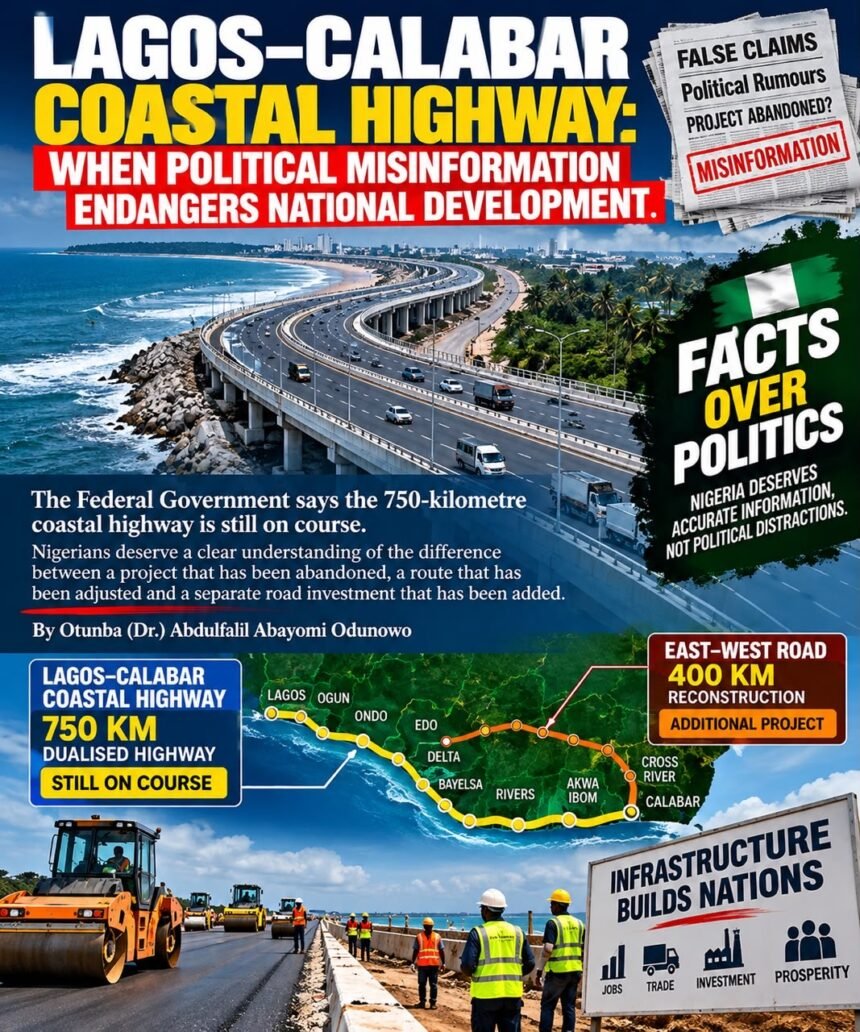
The Federal Government says the 750-kilometre coastal highway is still on course. Nigerians deserve a clear understanding of the difference between a project that has been abandoned, a route that has been adjusted and a separate road investment that has been added.
By Otunba (Dr.) Abdulfalil Abayomi Odunowo
In Nigeria, nearly every major government initiative quickly becomes entangled in political controversy, and the truth often suffers first. Infrastructure projects that ought to rally Nigerians around shared economic interests are repeatedly turned into tools of political contest. The Lagos–Calabar Coastal Highway, one of the most ambitious transport infrastructure undertakings in Nigeria, is now another case in point.

Recent claims and interpretations have suggested that the Federal Government has either abandoned or significantly modified the original 750-kilometre coastal highway in favour of the existing East–West Road. That has created confusion and raised understandable public concern. Yet a clarification dated 13 October 2026, attributed to the Presidency and issued on the instruction of the Minister of Works, gives a notably different version of events.
According to that statement, President Bola Ahmed Tinubu has not ordered the Lagos–Calabar Coastal Highway to be discontinued. Instead, the proposed reconstruction of about 400 kilometres of the East–West Road, running from Edo State toward Cross River State, is presented as an additional infrastructure project. If that explanation is consistent with the approved engineering designs, procurement records and actual construction work, then the conclusion is simple: Nigeria is not being asked to choose one project over the other. The plan is to deliver both the coastal highway and the East–West Road intervention.
That difference should not be lost in political argument. Understanding What the Government Actually Said The clarification points to three issues that Nigerians should pay close attention to.
First, the Federal Government says its objective remains the original 750-kilometre dualised Lagos–Calabar Coastal Highway.
Second, it describes the proposed reconstruction of roughly 400 kilometres of the East–West Road as a separate addition meant to address severe pavement failure and flooding risks.
Third, the government says surveying, engineering design and construction are ongoing in several sections of the coastal highway.
The statement names Sections 3A and 3B in Cross River and Akwa Ibom, Sections 4A and 4B in Ogun and Ondo, and Section 5 in Akwa Ibom as areas where work is in progress.
It also states that surveying and design for the remaining coastal route through Edo, Delta, Bayelsa and Rivers States are still continuing, and that construction is expected to begin after the required technical and procurement processes are completed.
These are specific claims made by government, and they can and should be independently checked. They are also significantly different from the claim that the coastal highway has been abandoned.
Why the Distinction Matters
To understand why this matters, consider the economic geography of southern Nigeria.
The Lagos–Calabar Coastal Highway is intended to create a strategic transport corridor linking coastal communities, commercial centres, industrial prospects and potentially important tourism destinations.
The East–West Road, by contrast, is an existing transport artery that serves major communities and economic activity across the Niger Delta.
While the two routes may cover some of the same regions, they are not automatically substitutes for one another.
A coastal highway could open up new possibilities for maritime logistics, coastal tourism, regional trade, industrial growth and better access to communities that have long experienced poor road connectivity.
Rebuilding the East–West Road addresses a different but equally urgent national need: restoring an existing economic corridor whose deterioration has imposed heavy costs on motorists, businesses and nearby communities.
There is no inherent contradiction in pursuing both projects. In fact, a coherent national transport strategy should recognise that maintaining existing infrastructure and building new strategic corridors are both necessary. The real questions are about affordability, engineering viability, environmental protection, procurement transparency and implementation priorities.
Political Opposition Must Not Turn Into Opposition to Development
Democracy gives Nigerians every right to question government choices. Opposition parties also have an essential constitutional and democratic duty to scrutinise public spending, expose waste and insist on accountability. But legitimate criticism is not the same thing as presenting an unverified interpretation as settled fact. A government can be challenged over the cost of a highway without asserting that the project has been cancelled.
Its procurement process can be examined without implying that every engineering revision amounts to deception. Concerns about environmental impact, compensation, financing and project priorities can be raised without converting technical uncertainty into a political verdict.
At the same time, government supporters should not dismiss every criticism as sabotage.
In the end, the credibility of the Lagos–Calabar Coastal Highway will rest not on political pronouncements but on publicly available, verifiable information and the delivery of functional infrastructure. Those opposed to the administration should be prepared to acknowledge progress when the evidence shows it. Those who back the administration should be just as ready to demand answers where genuine concerns remain.
National development should never depend on suspending independent judgment.
Why Nigeria Needs Both Roads
The Niger Delta occupies a central place in Nigeria’s economic history and still makes an enormous contribution to national production and commerce. Even so, many communities across the region have lived for decades with inadequate road infrastructure, flooding, environmental degradation and expensive transportation challenges. For years, the East–West Road has symbolised both the region’s strategic importance and the frustration caused by delayed infrastructure delivery.
Its rehabilitation merits serious attention.
At the same time, a well-designed coastal highway could create alternative transport links, open neglected areas to investment and strengthen connections between the South-West, South-South and other parts of the country.
But those possible gains are not guaranteed.
They depend on credible traffic projections, sound engineering, environmental safeguards, transparent financing and realistic maintenance plans. A highway does not become economically useful simply because it has been announced. Its worth must be proven by the businesses it supports, the journeys it improves, the jobs it enables and the economic opportunities it creates.
That is the standard that should be applied to both projects.
Five Questions the Federal Government Should Answer. The latest clarification is useful, but it should be followed by broader public disclosure. Nigerians deserve clear responses to five basic questions:
1. What is the approved alignment? The Federal Ministry of Works should release an updated route map showing the full 750-kilometre coastal corridor and clearly separating it from the proposed East–West Road reconstruction.
2. What is the implementation status? Every section should have a publicly accessible progress report showing design completion, procurement status, construction milestones and expected delivery dates.
3. What will both projects cost? The government should disclose the approved contract sums, funding arrangements and the implications for future public spending.
4. How will communities be protected? Environmental assessments, land acquisition procedures, compensation arrangements and flood-resilience measures should be set out transparently.
5. Who will independently verify delivery? Engineering supervision reports, procurement disclosures and measurable construction milestones should enable citizens to distinguish political announcements from completed work.
Providing answers to these questions would do far more to counter misinformation than trading accusations with political opponents.
The Responsibility of the Media and the Political Class
Nigeria’s media institutions carry a particularly serious responsibility.
Headlines should clearly separate allegation, government clarification and independently established fact.
When an official statement conflicts with an earlier report, responsible journalism requires examining the evidence, identifying the exact point of disagreement and seeking corroboration.
The public should not be left to sort through competing political narratives without access to the documents underneath them.
Political actors, too, owe the country a better standard of public communication.
There is nothing wrong with challenging the Tinubu administration. But there is everything wrong with allowing partisan competition to cloud issues that can be resolved through documents, engineering records and measurable evidence.
In the same way, public officials should understand that labelling a report misinformation does not by itself disprove it.
The strongest response to a disputed infrastructure claim is not a louder press release. It is a published plan, a transparent contract, an independently verified progress report and a completed road.
President Tinubu’s Infrastructure Vision Must Be Judged by Delivery
President Bola Ahmed Tinubu’s administration has made major transport infrastructure one of its development priorities.
The Lagos–Calabar Coastal Highway stands out as a major expression of that ambition.
If it is successfully completed, and if its economic benefits justify its costs, it could make an important contribution to Nigeria’s long-term transport network.
But the administration must also understand that greater ambition brings greater responsibility for transparency and disciplined execution.
Nigerians have seen too many infrastructure projects launched with enthusiasm only to run into delays, rising costs or incomplete delivery.
That history helps explain why many citizens are sceptical.
The answer is not to demand blind trust in government. The answer is to earn confidence through verifiable results.
For that reason, the administration should welcome rigorous scrutiny, so long as that scrutiny remains factual and constructive.
The goal should be to ensure that both the coastal highway and the East–West Road reconstruction produce real economic value instead of becoming rival political symbols.
A Message to Nigerians: Do Not Mistake Political Noise for Established Facts
The core message of the 13 October clarification is that the Federal Government says it remains committed to the original Lagos–Calabar Coastal Highway while also proposing added reconstruction of the East–West Road.
That is the content of the official statement.
Whether actual implementation fully matches that commitment can only be determined through continued independent verification.
Nigerians should therefore avoid two equally unhelpful extremes: accepting every government announcement without scrutiny, and accepting every politically convenient allegation without evidence.
A responsible citizen should ask what has been approved, what has been funded, what is under construction and what has actually been delivered.
What the country should demand is more roads, better roads and more transparent government not simply more arguments about roads.
Nigeria’s infrastructure future cannot rest on political suspicion alone. But neither can it rest on official assurances that are not backed by accountability.
It must rest on facts, sound planning, financial discipline, transparent implementation and measurable results.
Conclusion: Let the Roads Speak More Loudly Than Politics
The Lagos–Calabar Coastal Highway and the East–West Road should not be casualties of political misunderstanding or misinformation.
The Federal Government has now said that the coastal highway remains intact, and that reconstruction of the East–West Road is an additional intervention.
That clarification deserves fair consideration, just as the underlying commitments of the projects deserve independent verification.
Those who have treated the proposed East–West Road intervention as evidence that the coastal highway has been abandoned should reconsider that reading in light of the government’s statement. Anyone with documentary evidence to the contrary should place it before the public.
In the end, Nigerians are not primarily concerned with which political faction wins an argument about road alignment.
They want safe highways, shorter travel times, lower transport costs, economic opportunity and infrastructure that improves daily life.
Let political opponents debate policy. Let journalists test competing claims. Let government publish the evidence. Above all, let the roads be built.
Because, in the final analysis, Nigeria will not be transformed by how many political arguments are won, but by how many development promises are responsibly fulfilled.
Otunba (Dr.) Abdulfalil Abayomi Odunowo
National Chairman AATSG
Public Affairs Commentator and Development Advocate
Editor’s note: This commentary is based on the 13 October 2026 statement attributed to State House Digital. The authenticity of that statement, its engineering claims and the implementation status of the project have not been independently verified for this article.