
By Okoi Obono-Obla
The write-up by “Eastern Reporters” titled “THE BIG LIE IS DEAD” is itself full of lies, distortions and half-truths calculated to present falsehood as truth.
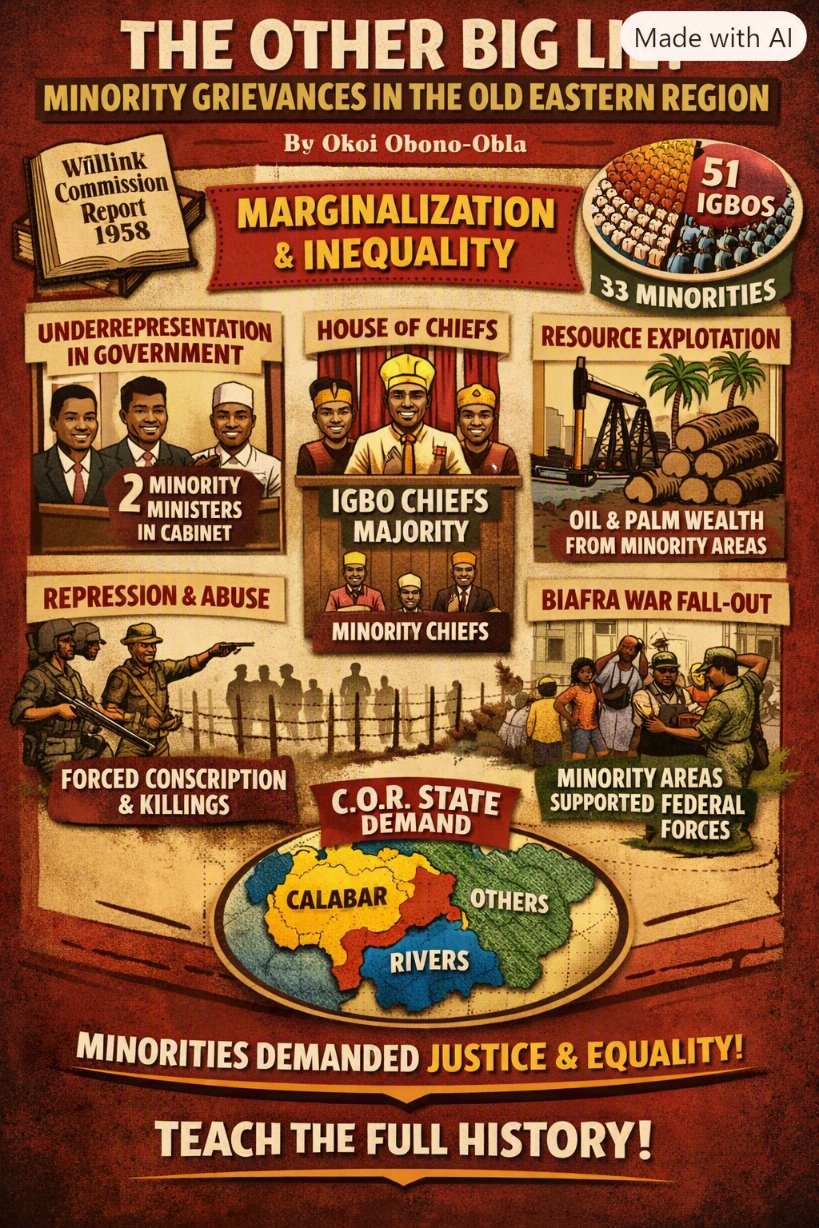
They claim Igbos never oppressed minorities and that history was removed to hide this. The opposite is true. The Willink Commission Report of 1958, the COR State Movement memoranda, and the Eastern Nigeria Gazettes are all public records. They prove minority fears were real long before Biafra.
1. THE HOUSE OF ASSEMBLY FIGURES PROVE MARGINALIZATION
They quote: 84 seats, 51 Igbo, 33 minorities. They ask “where is the oppression?”
That figure is from the COR Memorandum to Willink. It shows minorities were about 39% of the House, while they were about 40-45% of the population. On paper it looks fair. In practice:
Representation was by division. Igbo divisions like Bende (6 seats), Onitsha (5), Owerri were large and voted as a solid NCNC bloc. Minority divisions like Brass (Ijaw) 2, Degema (Ijaw) 2, Ogoni 2, Calabar (Efik) 2, Eket 3, Uyo 3, Ikot Ekpene 3, Abak 3 were small, fragmented and could never defeat the bloc.
More importantly, the House of Assembly was not the government. The Cabinet was. From the official Profiles of the Ministers of Eastern Nigeria, 1960, Premier Michael Okpara’s cabinet had 12 members including himself. Only 2 were clearly from minority areas at that time – Ibanga Udo Akpabio (Annang) and Dr. Samuel Imoke (Ekoi). Even if you count the whole period 1958-1966 with reshuffles, minority ministers never exceeded 4 out of 13 at any one time.
Willink concluded the fears were genuine. That is why COR State was demanded from 1953, not 1967.
2. THE HOUSE OF CHIEFS WAS NOT EQUITY
The Eastern House of Chiefs was created by Law No. 14 of 1959.
In the House as constituted in 1963, only eight traditional rulers were recognized as first-class chiefs. They included the Obi of Onitsha, Obi of Oguta, and a few others. Minority kings like the Obong of Calabar, Amanyanabo of Bonny and Amanyanabo of Kalabari were included but were a permanent minority.
The total House was about 80 members. The President was Chief Nyong Essien, a respected Ibibio leader from Ikot Ibiok, Uyo Division, present Akwa Ibom State. He was the great Ibibio nationalist and President of Ibibio State Union, appointed by Governor Francis Ibiam on the recommendation of Premier Okpara. An appointment to preside does not equal power.
A representative was listed for each colonial province: Abakiliki, Yenagoa, Uyo, Annang, Port Harcourt, Calabar, Owerri, Degema, Onitsha, Enugu, Ogoja. But selection was by the Premier’s government, not by the people.
3. BIAFRA AND THE 335-MEMBER ASSEMBLY
The Eastern Region Consultative Assembly that mandated Ojukwu on May 27, 1967 was indeed 335 members. The claim that 165 were non-Igbo is used to prove inclusion. But consultation is not consent.
Critical voices like Dr. Okoi Arikpo, Wenike Briggs and others from minority areas were left out. Arikpo was hunted and fled to Lagos to declare for the Federal cause.
Non-Igbo Easterners did hold positions in Biafra – Gen. Philip Effiong, Ntienyong Akpan, Ignatius Kogbara, Ekukinam Bassey, Frank Opigo, Emmanuel Aguma, Samuel Cookey, Okokon Ndem and others.
But it was a war administration. The fact that Biafra collapsed first in minority areas – Rivers and South-Eastern State people welcoming Federal troops – proves the point.
4. APPOINTMENTS DID NOT EQUAL PROTECTION
Ntienyong Akpan was appointed Secretary to the Government of the ill-fated Republic of Biafra by Colonel Ojukwu after he had declared secession from Nigeria. Also, Brigadier Philip Effiong was appointed Chief of Staff to Colonel Ojukwu as Head of State of Biafra. He was Annang from Ikot Ekpene.
But that appointment is precisely the contradiction. If inclusion was genuine, why did that same area – Ikot Ekpene, Abak, Annang – suffer some of the worst internal repression during Biafra? Contemporary petitions documented forced conscription and killings of Annang and Ibibio civilians by Biafran troops accused of being “saboteurs.” Effiong himself had to intervene to stop extrajudicial killings of his own people.
A high appointment in Enugu did not protect the village. Representation without security is not inclusion.
5. FASTEST GROWING ECONOMY BUILT WITH MINORITY RESOURCES
Yes, the Eastern Region was one of Nigeria’s fastest growing economies from 1954-1965. That growth came largely from minority areas – palm produce from Annang/Ibibio, timber and Cocoa from Cross River and Ogoja, oil from Ogoni, Ijaw, Eket.
Yet the Eastern Nigeria Marketing Board surpluses from those areas were used to build University of Nigeria Nsukka, farm settlements at Ohaji, Igbariam, Ulonna, Erei, Uzo-Uwani, Egbema – overwhelmingly in Igbo areas.
Saying “it did not last long” is an admission of failure. After 11 years in power under Azikiwe and Okpara, COR agitation had already lasted 13 years.
CONCLUSION
No one says ordinary Igbo hated minorities. But politically, the NCNC system concentrated executive power in an Igbo majority bloc. It left minorities with seats but without power, with chiefs but without first-class recognition, with oil and palm wealth but without development control.
To say Igbos never oppressed minorities is to call Eyo Ita, Ibanga Akpabio, Okoi Arikpo, Wenike Briggs and Isaac Boro liars. They were not liars.
Teach history fully, not half.