By Okoi Obono-Obla
My essay titled From Cross River Merchants to Ledu Title Holders, which I shared on my Facebook page, elicited varied reactions. Two of the most notable came from very important Yakurr personalities.
The first was from Obol Dr. Otu Abam Ubi, the eminent Yakurr historian whose work, The Yakurr of the Middle Cross River Region 1600-1950, inspired the piece in the first place. His response, which he personally sent to me via WhatsApp, was crisp and terse:
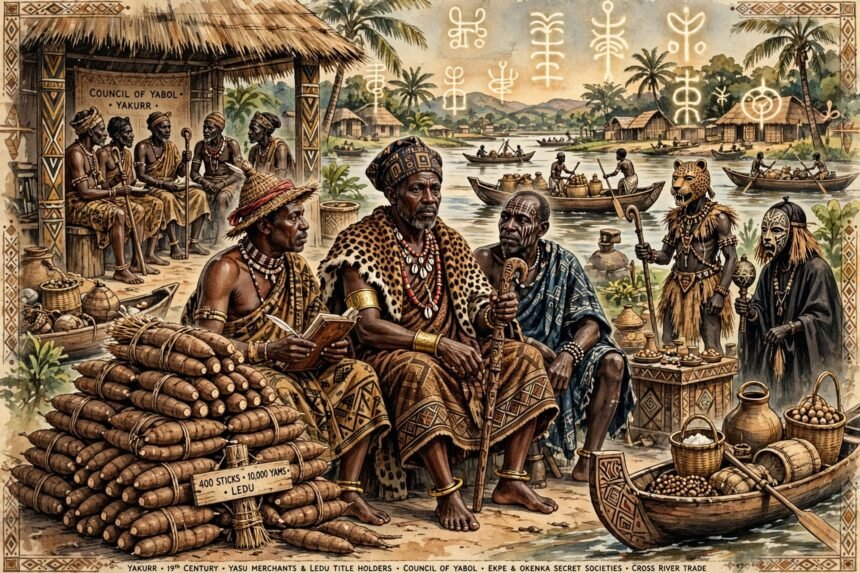
1. Ledu in Lokaa arithmetic is 400. But Ledu as a title is four hundred sticks of yams. That is 400 x 25 yams per stick. Ledu is a 10,000-yam harvest.
2. An Osu is one who not only tied the 400 sticks of yam tubers but also married into his lajimo – matrimonial family.
3. Such marriage is different from slavery, since the individuals are by custom entitled to any inheritance that a free-born is entitled to.
The second was from another eminent Yakurr son, Navy Captain Marcus Abani, PhD, who wrote:
“Thanks Ledu for sharing this knowledge. With the ancient merchandise synergy between Ugep and Ekori which has metamorphosed to Yasu in today’s Ledu, why are we still not united? Who truly is an Osu? Does it mean if a man doesn’t ascend to the Ledu title despite his achievements, he wouldn’t be seen as an Osu? Is Yasu/Osu an indigenous word? Can a non-indigene who has the wherewithal to fulfill the Ledu requirements ascend to the Ledu title and become an Osu? I have heard on several occasions people talk about Ofoli {slave}. Do slavery activities have any connection with ascension to the Ledu title? Kindly shed more light to get some of us better informed. Thanks once more, Chief.”
In light of these important interventions, it has become necessary to put the concept in proper perspective.
Yasu is the plural of Osu, which denotes more than one Osu. My central argument is that new ideas that came from trade along the Cross River by Yakurr merchants were the motivation for the evolution and development of an indigenous merchant class known as Yasu.

This wealthy merchant class evolved in Yakurr in the 19th century as a result of the activities of Yakurr traders along the Cross River. One of the hallmarks of being an Osu is the acquisition of wealth, combined with intelligence and leadership skills, and also marrying a non-Yakurr person and integrating that person into his matriclan. Such marriage, as Dr. Ubi clarifies, is different from slavery, since by custom the individuals so integrated are entitled to any inheritance that a free-born is entitled to.
The Yasu considered themselves a privileged class. As their wealth grew, they began to nurse political ambitions and felt they should be integrated into the Council of Yabol. They devised a method of expansion and incorporated their corporate interests into the Council, ensuring that their matriclans became part and parcel of it. This possibly led to the proliferation and splintering of the original matriclans into several more.
To consolidate and regulate their commercial interests, the Yasu pioneered the formation of a secret society known as Okenka. This is where its institutional role becomes clear. Okenka played the role of an institution to regulate trade along the Cross River in Yakurr, just as Efik merchants used Ekpe as an institution to regulate societal problems which emerged from the rapid expansion of trade in the 19th century.
Indeed, Ekpe was adopted as an institution to settle disputes which occurred during commercial intercourse. According to Dr. Ubi, the Aro adopted the institution of Ekpe from the Efik as a result of their trade contacts, and also adopted Ekpe as an instrument for settling trade disputes and enhancing trade. In the same vein, the Yasu in Yakurr introduced Okenka as an instrument to regulate trade in Yakurr, patterned as a variant of Ekpe.
Unlike Ekpe, whose membership is restricted to members of the patriclan, Okenka membership was restricted exclusively to members of the Yasu class. Every member of Okenka was required to marry a slave girl, and the offspring of that union automatically became a member of the matriclan to which the Osu belonged. Okenka and Ekpe are similar in that members of both societies communicate through the Nsibidi sign language, and every member is required to study and know how to use Nsibidi.
Conclusion
The Yasu, therefore, was not merely a title but an economic and political innovation. Born out of Cross River commerce, it transformed wealth into social status, social status into matriclan expansion, and matriclan expansion into political power within the Council of Yabol. With Okenka as its regulatory arm – just as Ekpe was for the Efik and Aro – the Yasu created an indigenous institution to manage the complexities of 19th-century trade. This explains why the Ledu title, with its requirement of 10,000 yams and exogamous marriage, remains the ultimate validation of Osu status, and why questions about Ofoli, indigeneity, and non-indigene ascension must be understood within this framework of trade, wealth, and institutional control.