By Otunba (Dr.) Abdulfalil Abayomi Odunowo
A narrative is being pushed across Nigeria with striking force as 2027 approaches: that President Bola Ahmed Tinubu has deliberately marginalised the North.
It’s a potent story. Emotional, too. Easy to chant at rallies, easy to forward on phones. It taps into every old regional bruise this country still carries. And because it is so politically useful to those chasing power, it has to be challenged with facts, not sentiment.
So where is the evidence?

If marginalisation means exclusion from government, the numbers simply don’t support it.
If it means neglect of roads, rail and power, the projects are still there.
If it means denial of education, agriculture or social investment, the records stand in plain, stubborn contradiction.
The North is dealing with real pain. Insecurity still robs mothers of sleep. Poverty still bites. Food prices still punish both the market woman and the farmer. Projects still move far too slowly when they ought to be racing ahead. These are genuine grievances. They warrant anger. More importantly, they demand solutions.
But hardship is not the same thing as hatred.
Disappointment is not discrimination. And political loss is not regional erasure. That distinction matters. In fact, it’s the line between honest criticism and carefully manufactured division.
The Numbers They Prefer to Ignore
The noisiest charge is that Tinubu has filled the Federal Government with southerners, particularly from the South-West, while pushing the North to the margins.
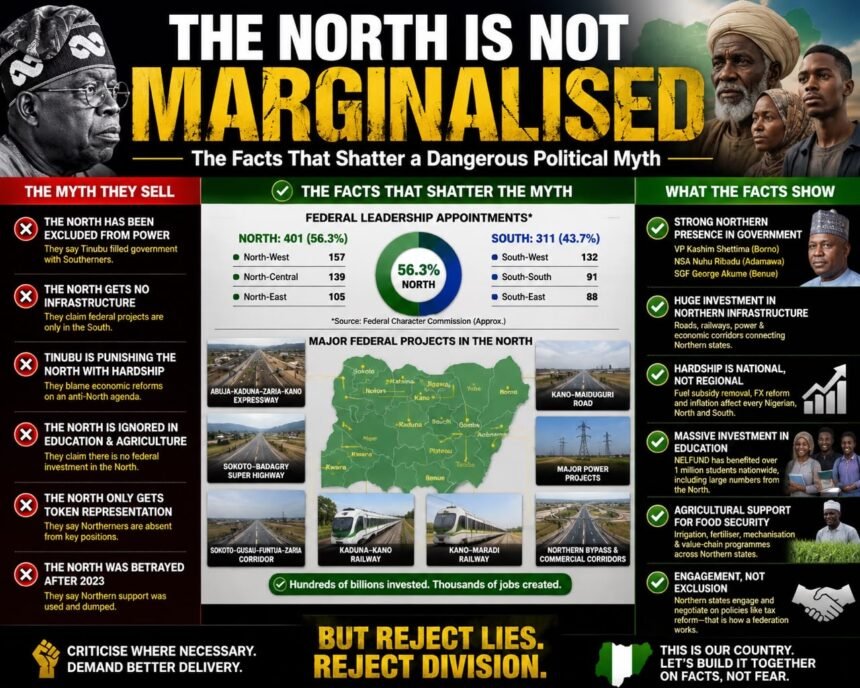
Yet the Federal Character Commission’s own leadership appointment figures tell another story:
* North-West: 157
* North-Central: 139
* North-East: 105
Northern total: approximately 401
* South-West: 132
* South-South: 91
* South-East: 88
Southern total: approximately 311
North: roughly 56.3 per cent.
South: roughly 43.7 per cent.
How exactly does a region holding the larger share of these appointments become the one supposedly “excluded”?
Nobody is saying every single post is perfectly balanced. Strategic weight matters. Influence can’t be measured by headcount alone. Still, there’s a world of difference between saying, “let’s examine the balance of power more closely,” and declaring, “the North has been shut out of government.”
One is democratic vigilance.
The other is fiction.
Look at the Power Structure Itself
The Vice President is Senator Kashim Shettima of Borno.
The National Security Adviser is Mallam Nuhu Ribadu of Adamawa.
The Secretary to the Government of the Federation is Senator George Akume of Benue.
Northerners occupy key ministries, agencies and strategic boards across the federation.
So are we really meant to believe that a region holding the Vice Presidency, the National Security Adviser and the SGF has somehow been pushed away from the centre of national power?
Critics can argue, fairly enough, about which portfolio should have gone where. That conversation is legitimate. But calling substantial participation “exclusion” stretches language beyond credibility.
Perhaps What Hurts Is Not Marginalisation But the End of Dominance
For eight years under President Muhammadu Buhari, political gravity leaned northward. That’s hardly unusual. It’s what tends to happen when a Northerner is President. It happened under Obasanjo. The balance shifted under Yar’Adua. It shifted again under Jonathan. Then once more under Buhari. Now it has shifted under Tinubu.
That’s the ordinary rhythm of a federation, not evidence of conspiracy.
The North cannot define fairness as the uninterrupted continuation of the same level of access it enjoyed while one of its own occupied Aso Rock. There’s a difference, and a major one, between losing dominance and being marginalised. Those two ideas are now being deliberately welded into one toxic slogan. Nigeria belongs to every region. The Presidency belongs to the federation. No part of the country can claim permanent supremacy and then label every redistribution of influence as betrayal.
The Infrastructure That Refuses to Vanish
Another strand of the story says this administration is funneling everything into Lagos and the South while the North is left with dust and potholes. Yet the same government is carrying out:
* the Abuja–Kaduna–Zaria–Kano Expressway
* the Sokoto–Badagry Super Highway
* the Sokoto–Gusau–Funtua–Zaria corridor
* the Kano–Maiduguri road
* the Kaduna–Kano railway
* the Kano–Maradi railway
* major power transmission and generation projects
* northern bypasses and commercial corridors
These are not fantasies invented for press statements. Some involve hundreds of billions of naira. The Abuja–Kaduna–Zaria–Kano corridor alone remains one of the country’s most important transport arteries. The Sokoto–Badagry Super Highway is meant to link the North-West to the South-West in one economic spine. Of course, government can be criticised for delays. It can be criticised for incomplete execution. Citizens don’t drive on contract awards, they drive on finished roads. That much is true. But saying a government pursuing these projects has abandoned northern infrastructure simply doesn’t hold up.
Hardship Is National. Discrimination Is Not.
Fuel subsidy removal hit Lagos and Kano alike. Exchange-rate reform affected the trader in Onitsha and the farmer in Katsina. Inflation rose in Rivers and in Borno. Transport costs climbed in Enugu and in Sokoto. These were national policies, not regional punishments. The debate around sequencing, buffers and social protection is both valid and necessary. But turning nationwide pain into proof of an anti-North agenda is political mischief, plain and simple.
Yes, the North often feels the strain more sharply, longer distances, larger rural populations, deeper dependence on agriculture. That disproportionate suffering is real. But unequal impact does not automatically prove discriminatory intent. The answer is targeted relief and better delivery, not conspiracy tales that poison the air between brothers.
Security: The One Area Where Anger Is Fully Justified
Here, the administration must listen, and listen without defensiveness. Banditry still terrorises communities. Kidnapping still hollows out villages. Farmers still leave their fields behind. Mothers still wait for sons who never come home. Too many highways still feel like death traps.
This is not something appointment figures can explain away. Security is government’s first duty. Northern Nigerians are entitled to demand results, not talking points.
But jumping from “insecurity remains severe” to “therefore the President has marginalised the North” is a leap in logic that serves only those who profit from public anger. Northern insecurity did not begin with this administration. It predates it by years. The proper question is whether conditions are improving, whether investment is increasing, whether the state is reclaiming territory. That is a performance issue, not an ethnic one.
Education and Agriculture Refuse the Abandonment Story
The Nigerian Education Loan Fund has already committed hundreds of billions of naira to fees and upkeep, reaching more than a million students. Northern students and institutions are among the major beneficiaries. For many households, that’s the difference between dropping out and graduating.
TETFund continues to channel resources into universities, polytechnics and colleges of education across the North.
Agriculture, the backbone of northern livelihoods, continues to receive irrigation projects, fertiliser interventions, mechanisation support and value-chain programmes. The outcomes are still not good enough. Food prices remain brutal. Productivity must improve. But poor results are not the same thing as zero attention.
Who Exactly Speaks for “the North”?
Whenever someone declares that “the North has been marginalised,” it’s worth asking: which North?
The farmer in Katsina whose children cannot sleep because of bandits?
The trader in Kano whose goods spoil because of bad roads?
The student in Bauchi whose school fees are now partly covered by federal loans?
The displaced family in Borno still waiting for peace?
Or the politician who no longer enjoys the same easy access in Abuja that he once did?
Ordinary northerners want security, food, jobs, schools, roads, power and opportunity.
Some political elites want appointments, access, influence and control. Those are not the same demands. A politician’s private disappointment should never be dressed up as the collective suffering of an entire region.
The 2027 Calculus Is Transparent
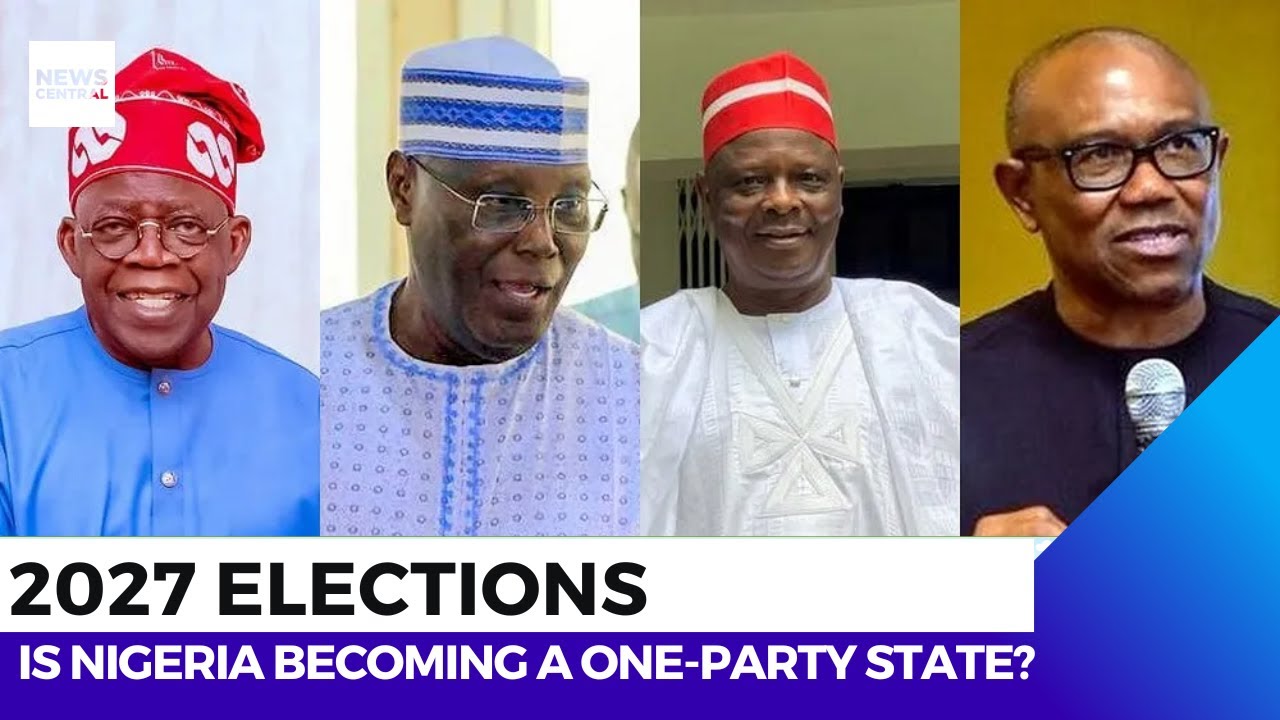
The North remains decisive. President Tinubu needs substantial northern backing. The opposition knows that. And the fastest route to power is to persuade northern voters that
“you made him President and he abandoned you.”
It’s a brilliant slogan, frankly. Emotionally charged. Politically efficient. It turns hardship into betrayal and policy disagreement into hostility. It tries to drive a wedge between the President and the region that helped elect him. Seeing the incentive behind it does not make every criticism false. But it should make citizens careful enough to separate legitimate grievance from manufactured regional accusation.
The Simple Test
If the North were truly marginalised, we would expect to see:
* a dramatically lower share of appointments
* absence from strategic positions
* negligible infrastructure allocation
* minimal education and agricultural investment
* weak presence at the centre of power
Instead, what do we see? A majority of reported federal leadership appointments, a northern Vice President, a northern National Security Adviser, a northern SGF, major road and rail corridors, power projects, education financing and agricultural programmes. That is not a region written out of the federation. It is a region still central to Nigeria, and rightly demanding faster, clearer delivery.
Delivery, Not Division
The strongest reply to the marginalisation narrative is not another speech. It is finished roads, secured farms, working trains, lower food prices, more electricity, real jobs and transparent data showing exactly where federal money is going in every state.
Let Nigerians see the map. Let them see the figures. Transparency punctures propaganda more effectively than any talking point ever could.
The opposition has every right, indeed every duty, to challenge this government on inflation, insecurity, debt, waste, unemployment and delivery. But they should also tell Nigerians what they would do differently: how they would fund restored subsidies, at what exchange rate they would stabilise the naira, how they would defeat banditry, how they would lower food prices, how they would power the country.
That is the debate a serious country deserves. Not ethnic scorekeeping. Not sectional blackmail. Not the deliberate stoking of regional resentment.
Nigeria Has Paid Too High a Price for This Politics
The most dangerous thing about the marginalisation narrative is not what it says about one man. It is what it teaches citizens to believe about one another.
Once every road becomes a regional favour, every appointment an ethnic trophy, every reform a sectional war, the federation itself becomes permanently unstable. Nigeria cannot develop on that basis.
We must be able to criticise government fiercely without manufacturing ethnic hostility.
The Verdict
Northern Nigeria has serious problems. It deserves better security, faster infrastructure, lower food prices, more jobs, greater agricultural productivity, stronger electricity and accountable governance.
But the available evidence does not support the claim that President Bola Ahmed Tinubu has systematically marginalised the North.
The appointment figures contradict it.
The composition of government contradicts it.
The infrastructure investments contradict it.
The education and agricultural programmes contradict it.
What we are actually seeing is real economic hardship, real insecurity, legitimate demands for faster results, political disappointment among some elites, and a sophisticated campaign designed to turn those grievances into a regional indictment of the President.
Those are not the same thing.
The North must hold Tinubu accountable, just as every region must. But accountability has to rest on measurable facts.
And the facts available today lead to one unavoidable conclusion:
The North has not been abandoned.
The North is not excluded.
The North is not marginalised.
What the North legitimately needs is not another manufactured grievance. It needs security, development and faster delivery.
That is the standard by which President Tinubu should be judged in 2027.
Not by propaganda.
Not by fear.
Not by the politics of regional resentment.
But by facts, by results, and by the measurable record of government.
Signed
Otunba (Dr) Abdulfalil Abayomi Odunowo
National Chairman AATSG
Asiwaju Ahmed Tinubu Support Group.