
By Okoi Obono-obla
Introduction
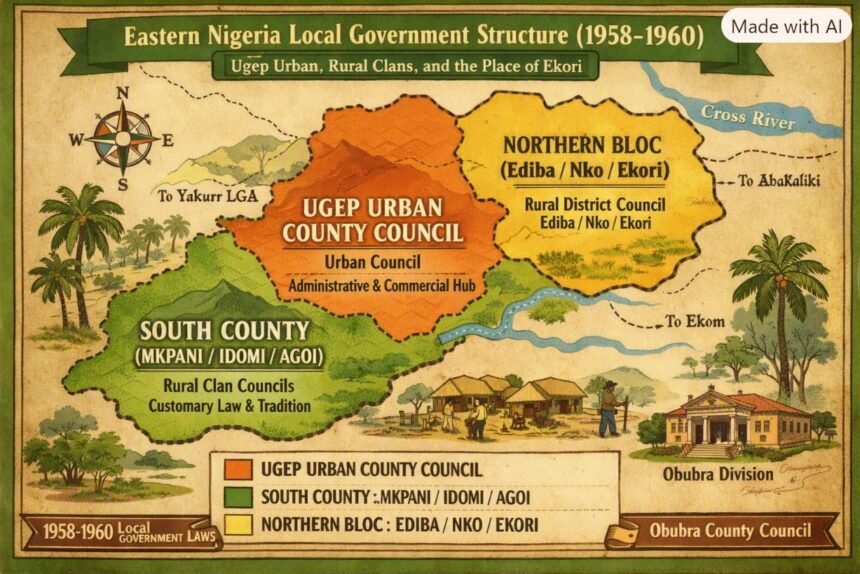
A recent comment on my essay, “The Eastern Nigeria Local Government Laws (1958-1960): Ugep Urban and the Rural Clans,” observed that “the map seems not to feature Ekori.” This observation provides an opportunity to clarify the administrative history, because Ekori is indeed featured on the map.
The passage of the Eastern Nigeria Local Government Law of 1958, followed by amendments in 1959 and 1960, marked a turning point in local governance in the Eastern Region. These laws modernized the colonial local government system by formally distinguishing between urban councils and rural clan councils.

Ugep Urban: An Urban County Council
Under Eastern Region Legal Notice of 1958, Ugep Urban was formally recognized as an Urban County Council. This status reflected Ugep’s growing importance as a commercial and administrative headquarters of what was then Obubra Division.
As an urban council, Ugep was granted:
Authority over taxation and revenue collection;
Responsibility for markets, sanitation, roads and infrastructure; and
A centralized administrative framework aligned with colonial policy of urban modernization.
The Rural Clans: Two Distinct Blocs
The rural communities around Ugep were organized into two distinct administrative blocs, clearly visible on the contemporary map of Obubra Division showing proposed agricultural estates:
1. The South County Bloc: Mkpani / Idomi / Agoi
To the south and south-east of Ugep Urban, the map shows a large area marked “MKPANI / IDOMI / AGOI” and “SOUTH COUNTY.” These communities were administered as Rural Clan Councils. They retained authority over customary law and tradition but exercised limited administrative powers.
2. The Northern Bloc: Ediba / Nko / Ekori
To the north and north-east of Ugep Urban, the same map clearly shows the inscription “EDIBA / NKO / EKORI”. This is Ekori.
Under the 1958, 1959 and 1960 Laws, Ekori was therefore not under South County. It was part of the Ediba/Nko/Ekori District Council, a rural district council within Obubra Division, under the broader Obubra County Council structure. This northern bloc later became part of what is now Yakurr Local Government Area, which was excised from Obubra LGA in 1987.
The 1959 and 1960 Amendments
The 1959 Amendment refined the 1958 framework. It retained Ugep as an Urban County Council and kept the rural councils operating independently, while emphasizing their integration into regional development programs.
The 1960 Law consolidated these amendments in preparation for independence. It continued to recognize Ugep Urban as distinct, maintained the rural clan councils, and anticipated the post-independence unification of rural and urban councils.
Conclusion
The map does feature Ekori – prominently as part of the EDIBA / NKO / EKORI group. The Eastern Nigeria Local Government Laws of 1958-1960 established a distinct and separate legal identity for Ekori, separate from both Ugep Urban and the South County clans.