


By Okoi Obono-Obla
Rejoinder: Who Owns the Alok Ikom Monoliths?
On 27 July 2026, I published an essay on my Facebook page as part of my weekly series on history and cultural anthropology, titled “From the Cross River to the Caribbean: The Atam Identity and the Agwagwune Echo in Jamaica.” One commentator, Amah Jones, digressed entirely from the theme to make three claims:
That Ikom was originally Ibibio territory before it was taken over by Ekoi-Ejagham migrants from Western Cameroon;
That the Oban Forest in present-day Cross River State also belongs to the Ibibio;
That the inscriptions on the monoliths at Alok, Ikom Local Government Area, are in Ibibio and are Ibibio cultural property.

Although Ceejay Ojong and I have refuted these claims in the comments, this essay focuses specifically on the monoliths at Alok and other places in the Bakor area of Ikom Local Government Area, Cross River State, because the facts speak for themselves.
1. What are the Alok Ikom Monoliths?
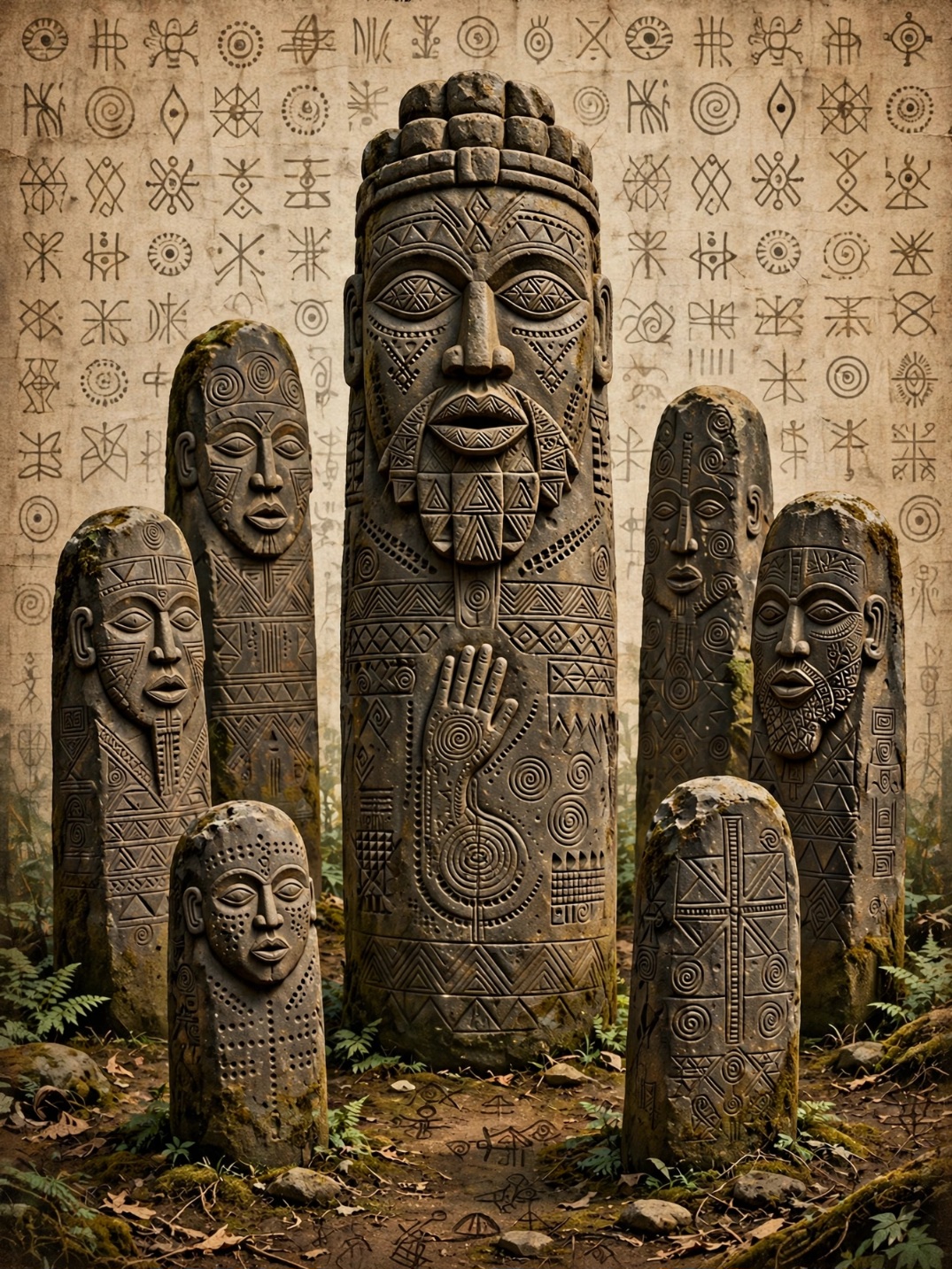
The stones called Akwanshi or Atal in Ejagham — meaning “dead person / ancestor on the ground” — are distributed in over thirty communities in Ikom. In each community they stand erect in circles, facing each other.
The linguistic connection is telling: in Lokaa, a Benue-Congo language of the Niger-Congo family spoken in Yakurr Local Government Area of Cross River State, stone is called Latal, the same root the Bakor call Atal. This further situates the monoliths within the Cross River-Ekoi linguistic and cultural continuum, not outside it.
UNESCO, in its Tentative List entry “Alok Ikom Stone Monoliths” (Ref. 5173, submitted 08/10/2007 by the National Commission for Museums and Monuments), specifically notes: “In some cases, the stones are found in the center of the village or in the central meeting place of the village elders, as in the case of Alok and Agba communities. In Etinan and Nabrokpa communities, the stones are located in an area of uncultivated forest outside the villages.”¹
The Bakor are a subgroup of the Ejagham people. Together with the Boki, Yakurr, Olulumo, Ekpache Nkome, Mbembe, Ukelle, Utugwang, Agbo, Bahumono and others, they are broadly referred to as Ekoi. Contemporary scholarship attributes the monoliths of Alok, Nkarasi and Nkrigom most directly to the Bakor Union — Abanyom, Ekajuk, Nde, Nnam, Nselle and Nta².
There are also monoliths in Okuni, but Okuni does not belong to the Bakor Union. The Okuni monoliths represent communities that belonged to the ancient Ongui Kingdom or Lekanakpakpa, which includes Olulumo, Nsofang, Ofutop, Yakurr, Epache Nkome, among others. This explains why the monolith tradition extends beyond the Bakor heartland while still remaining within the greater Ekoi cultural world.
Originally numbering about 400-450 engraved stones, about 300 are still documented today in about 30 sites around Alok, which is the central cluster and gives its name to the UNESCO listing³.
2. How old and what are they made of?
The majority of the stones are carved in hard, medium-textured basaltic rock — volcanic stone naturally shaped in nearby riverbeds — with a few in sandstone and shelly limestone. They range from about 0.3 metres to 1.8 metres, and in some surveys up to 3 metres high, hewn into a phallic form⁴.
UNESCO describes them: “decorated with carvings of geometric and stylized human features, notably two eyes, an open mouth, a head crowned with rings, a stylized pointed beard, an elaborately marked navel, two decorative hands with five fingers, a nose, various shape of facial marks”⁵.
Their age is estimated between 200 CE and 1850 CE, with some early surveys suggesting up to 1,500 years old. Each stone, “like the human finger print, is unique from every other stone in its design and execution”⁶.
3. What do the inscriptions mean? Are they Ibibio?
This is the heart of the matter.
The stones “bear a form of writing and a complex system of codified information”⁷. Researchers and linguists link the system to Nsibidi, the ideographic writing and graphic communication system of the Ejagham, Efik, and related Cross River peoples — not alphabetic Ibibio.
Their function is memorial: enduring representations of deceased ancestors, clan leaders and community heroes, with each stone individualized as an ancestral clan leader. The geometric images suggest “their makers possessed more than a basic knowledge of mathematics, not only because they are geometric, but also because of the obvious implication that there were computations and numbers on the layout of the stones”⁸.
No peer-reviewed study has attributed the language of the monoliths to Ibibio. All official records — NCMM, UNESCO, World Monuments Fund, British Museum, Factum Foundation — attribute the Ikom monoliths to the Ejagham/Bakor/Ekoi cultural complex, and the Okuni monoliths to the ancient Ongui Kingdom (Lekanakpakpa) — Olulumo, Yakurr, Nsofang, Ofutop, Epache Nkome and related Ekoi peoples.
4. Why Alok matters now
The monoliths are at risk from erosion, fire, farming and looting, and were placed on the World Monuments Fund Watch List in 2008⁹.
Since 2016, the Factum Foundation has collaborated with the National Commission for Museums and Monuments, the Trust for African Rock Art (TARA), the University of Calabar and Ahmadu Bello University, Zaria, on a project to document and preserve the Bakor monoliths. In four periods of fieldwork, approximately three hundred monoliths have been documented in 2D as well as some in 3D and geo-located in thirty sites, as a resource essential for monitoring and as a disincentive to looting, which has historically been one of the main challenges for preservation¹⁰.
This project has also identified and 3D-scanned looted monoliths in international collections, including the Metropolitan Museum of Art, Musée du Quai Branly and the Chrysler Museum, producing facsimiles for the communities while pursuing repatriation¹¹. Factum is currently working with NCMM to submit the Bakor monolith sites for full UNESCO World Heritage status.
UNESCO compares them to “West Africa’s answer to United Kingdom’s Stonehenge… similar in arrangement and ordering to the Stone circuits in the Gambia, but unique in their complexity”¹².
Conclusion
The Alok Ikom Monoliths are not migrant art. They are in situ ancestral archives of the Ejagham-Bakor people who still live around them in Ikom LGA, who call them Akwanshi / Atal — Latal in neighbouring Yakurr Lokaa — and of the wider Ongui Kingdom heritage represented at Okuni. To reassign them without evidence does injustice to both history and to the living custodians of Alok, Nkarasi, Nkrigom and Okuni.
@ Okoi Obono-Obla
Footnotes
¹ UNESCO World Heritage Centre, Alok Ikom Stone Monoliths (5173).
² Metropolitan Museum of Art, “The Akwanshi Stone Monoliths of the Cross River Region.”
³ African Rock Art / British Museum – Ikom Monoliths overview: 400-450 originally, ∼300 today.
⁴ Factum Foundation, The Bakor Monoliths.
⁵ UNESCO, ibid.
⁶ UNESCO, ibid., Authenticity.
⁷ UNESCO, ibid.
⁸ UNESCO, ibid.
⁹ World Monuments Fund Watch 2008.
¹⁰ Factum Foundation.
¹¹ Ibid. – restitution via facsimiles 2022-2023.
¹² UNESCO, Comparison.










Very interesting to read, we learn new things everyday. Thank you Chief for this impartation