By Eneojo Herbert Idakwo
A number of years ago, while discussing Nigerian ethnic cultures with a respected elder from Kogi State central Nigeria, he made a statement that stayed with me. He said, “If you want to understand the Igala people, do not begin with their numbers, their land, or even their history. Begin with their word. An Igala man’s word is his honor.”
That statement opened my eyes to one of the deepest qualities that define the Igala people: integrity.
The Igala people of Kogi State central Nigeria are widely known for a culture that places high value on truthfulness, dignity, loyalty, honor, responsibility, and respect for one’s word. Their uniqueness is not merely in language, kingship, geography, or tradition. It is rooted in character.

For the Igala, the nineth largest ethnic group in Nigeria, integrity is not just a personal virtue. It is a cultural expectation.
It is part of how a person is raised, how families are judged, how leaders are remembered, and how communities preserve trust.
INTEGRITY AS A CULTURAL FOUNDATION
Among the Igala, character has always mattered.
A person is not measured only by wealth, influence, or position, but by whether they are dependable, honest, disciplined, and worthy of trust. In many traditional settings, your name is only as strong as your conduct. A dishonest person may gain temporarily, but society does not truly respect such a person.
This is one of the things that makes the Igala unique.
Their society has long understood that a community can only stand when truth and responsibility still have meaning.
THE POWER OF ONE’S WORD
In traditional Igala society, promises were never meant to be light or careless.
A person’s spoken word carried moral weight. An agreement was not just a transaction. It was a bond. To break one’s word was not simply a private failure. It was a stain on personal honor and family reputation.
This explains why older generations among the Igala placed strong emphasis on raising children to be upright, careful in speech, respectful in conduct, and accountable for their actions.
To be trusted was to be valued.
To be known as a truthful person was to carry a form of wealth greater than money.
FAMILY AND COMMUNITY AS SCHOOLS OF CHARACTER
One of the reasons the Igala people are known for integrity is because moral formation begins early.
In many Igala homes, children are taught:
to speak the truth
to respect elders
to work hard
to keep their word
to avoid bringing shame to the family
to live in a way that reflects honor on their lineage
The family is not just a biological unit. It is a moral institution.
A child grows up knowing that conduct does not affect only the individual. It affects the entire household. It affects how the family name is spoken in the community.
This creates discipline.
It produces caution.
It builds people who understand that life is bigger than self.
THE ROLE OF TRADITIONAL AUTHORITY
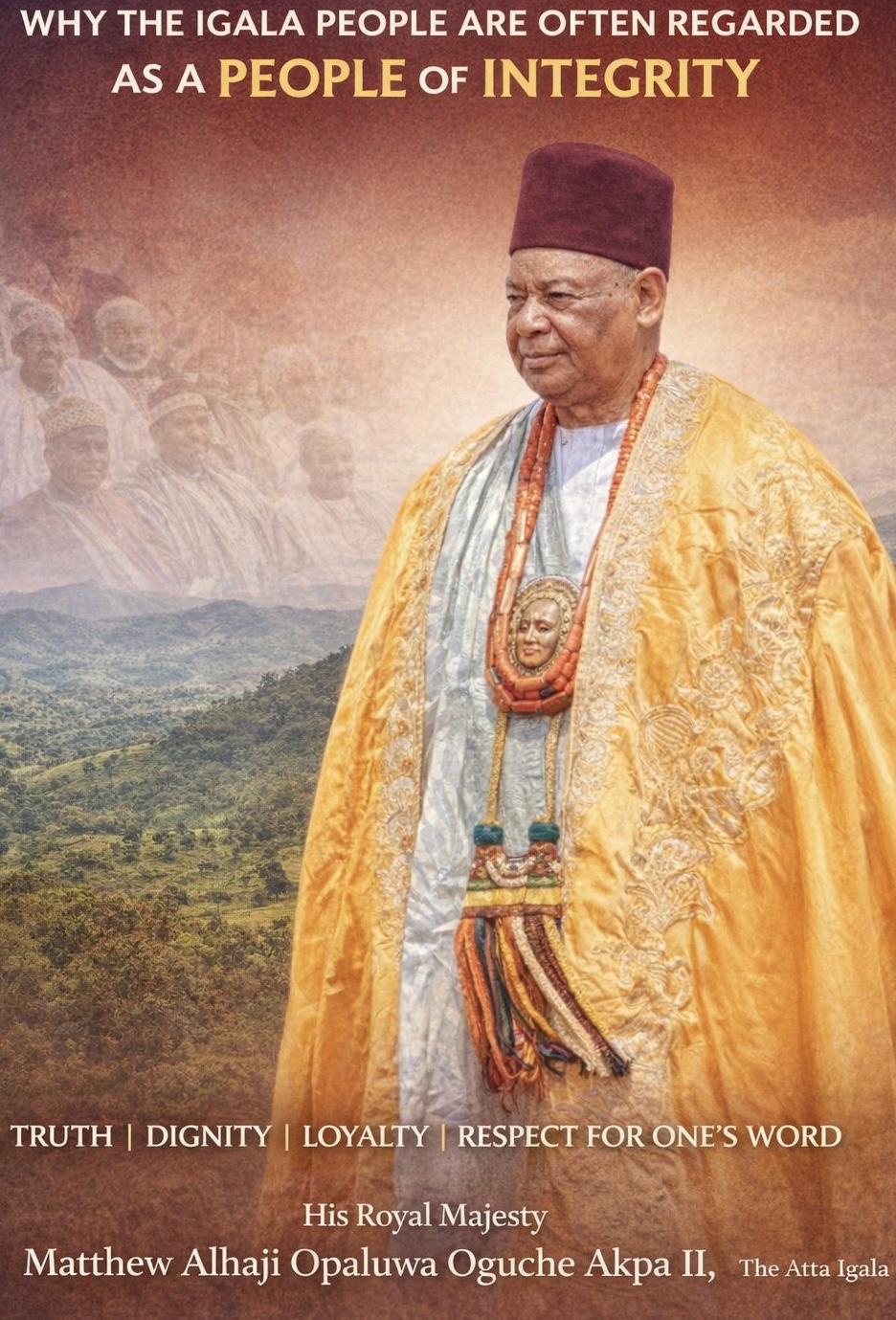
The Igala have a long and respected history of organized traditional leadership, especially under the authority of the Attah Igala and the wider structures of the old kingdom.
This traditional system did more than govern land and people. It preserved order, identity, accountability, and moral expectation.
Leadership in such a setting was never supposed to be merely ceremonial. It carried sacred responsibility.
The ruler, the elders, and the titled men were expected to embody wisdom, justice, restraint, and seriousness. In return, the people were expected to uphold discipline, loyalty, and communal honor.
When a people grow up under a system where duty, honor, and public responsibility matter, integrity becomes part of the social DNA.
DIGNITY, NOT NOISE
Another thing that makes the Igala unique is their quiet strength.
The Igala people are not generally known for unnecessary noise or excessive self-advertisement. There is often a calm dignity in how they carry themselves. They value substance over show. They respect order. They tend to esteem maturity, restraint, and self-control.
This does not mean they are weak. Far from it.
It means they often prefer steadiness to chaos, honor to recklessness, and substance to empty display.
This quiet seriousness is one reason many people who interact with the Igala come away with the impression that they are dealing with a people of depth and integrity.
HARD WORK AND SELF-RESPECT
Integrity is difficult to separate from labor.
The Igala people have long been associated with hard work, resilience, and the dignity of earning one’s place honorably. Whether in farming, fishing, trade, public service, military service, administration, or education, there is a long-standing respect for effort and responsibility.
A person who works honestly is respected.
A person who takes shortcuts through deceit may attract temporary attention, but not lasting honor.
This work ethic supports the moral system of the people. It teaches that one should build through effort, not manipulation.
LOYALTY AND TRUST IN HUMAN RELATIONSHIPS
The Igala are also known for strong communal bonds.
Relationships matter deeply. Kinship matters. Loyalty matters. Respect matters.
In such a society, betrayal is not seen as a clever survival tactic. It is seen as moral failure. Trust is treated as sacred social capital.
This is one of the foundations of integrity among the people.
Where trust is valued, truth is protected.
Where loyalty is honored, character becomes important.
Where community memory is strong, people think carefully before they act.
SPIRITUAL AND MORAL CONSCIOUSNESS
Like many African peoples, the Igala worldview has historically recognized that human life is accountable to realities greater than immediate personal desire.
This kind of worldview strengthens integrity because it teaches that actions have consequences beyond what society can immediately see.
In such a moral universe, dishonesty is never just cleverness. It is disorder.
Truthfulness, on the other hand, is not merely politeness. It is alignment with what is right, proper, and honorable.
That moral consciousness helped shape a people who traditionally saw uprightness as strength, not weakness.
WHY THE IGALA STAND OUT
What makes the Igala unique is not simply that they have a rich history or a respected traditional institution. Many peoples have that.
What makes them stand out is that they have historically attached great importance to character.
Among them, integrity is not an abstract idea used only in speeches.
It is expected in speech.
It is expected in conduct.
It is expected in leadership.
It is expected in family life.
It is expected in how one carries the family name.
That is why many people who have encountered the Igala people in public life, administration, community settings, and personal relationships often come away with one consistent impression:
These are people who value honor.
IMPORTANT REALITY CHECK
Of course, no ethnic group is perfect.
The Igala people, like every other people in the world, are not without internal challenges, political tensions, or social weaknesses. Modern pressures, economic hardship, bad leadership, and changing values can affect any society.
So this reflection is not saying every Igala person is automatically upright.
Rather, it is saying that the cultural ideal of the Igala people strongly leans toward integrity, responsibility, dignity, and respect for one’s word.
That moral ideal is real, and it remains one of the most admirable things about the people.
DEEPER INSIGHT WORTH REMEMBERING
Igala integrity is not accidental.
It is the result of:
strong family upbringing
respect for elders and community reputation
traditional leadership structures that value order
the moral weight attached to one’s spoken word
a culture of dignity, restraint, and responsibility
a work ethic that respects honest effort
communal memory that rewards honor and remembers shame
SUMMARY
The Igala people are unique because they are a people whose identity has long been tied to character.
They are often regarded as people of integrity because their culture teaches that honor matters, truth matters, dignity matters, and one’s word matters.
In a world where many people celebrate appearance over substance, the Igala remind us of something deeper:
A people become truly great not only by power, wealth, or numbers, but by the moral strength of their character.
That is one of the things that makes the Igala distinct.