Reassessing an Early Ethnonym in Igala Historiography
By Eneojo Herbert Idakwo
Abstract
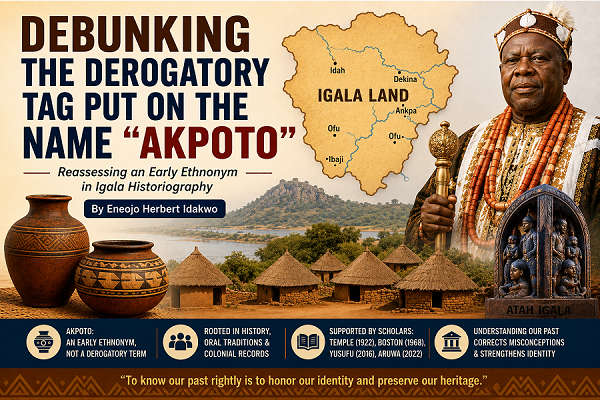
The term Akpoto (also rendered Okpoto in some colonial records) occupies an important place in the historiography of the Igala people. In contemporary discourse, however, the name is frequently employed as a derogatory label, particularly in reference to certain communities within Igala land. This interpretation finds little support in historical scholarship. Available evidence from oral traditions, colonial ethnographies, and modern historical studies suggests that Akpoto was an early ethnonym associated with the ancestors of the present-day Igala people before the emergence of the centralized Igala Kingdom under the Attah institution (Aruwa, 2022; Boston, 1968; Temple, 1922; Yusufu, 2016). Aruwa (2022) further situates the evolution of Igala identity within the broader context of pre-dynastic political development and cultural continuity, reinforcing the historical significance of Akpoto in early Igala historiography. Although scholars differ on the precise geographical extent and historical application of the term, there is broad agreement that it was not originally a derogatory expression. This article argues that the derogatory use of Akpoto represents a distortion of history rather than a reflection of its original meaning.

Keywords: Akpoto, Okpoto, Igala, Igala Kingdom, Attah, ethnonym, historiography, Kogi State.
Introduction
Ethnic identities evolve alongside political institutions. Throughout Africa, communities have borne different ethnonyms at different stages of their historical development, reflecting political transformation, migration, and state formation rather than changes in ancestry (Forde, 1955).
Within Igala historiography, one of the most misunderstood historical designations is Akpoto. In present-day usage, the term is often employed pejoratively, particularly against some communities within Igala land. This contemporary usage has encouraged the mistaken belief that Akpoto was itself an insulting name imposed upon the Igala people.
Historical scholarship presents a different picture. Early colonial records, oral traditions, and modern historical analyses consistently identify Akpoto or Okpoto as an important historical designation associated with the early ancestors of the Igala people before the consolidation of the Igala Kingdom (Aruwa, 2022; Boston, 1968; Temple, 1922; Yusufu, 2016). Consequently, understanding the historical meaning of Akpoto is essential for reconstructing early Igala history and correcting contemporary misconceptions.
Akpoto in Historical Literature
One of the earliest documented references appears in Temple’s (1922) Notes on the Tribes, Provinces, Emirates and States of the Northern Provinces of Nigeria, where both Okpoto and Igara (Igala) appear in the ethnographic description of the peoples of the Northern Provinces. The coexistence of these designations demonstrates that Okpoto was recognized as a legitimate historical identity rather than a derogatory expression.
Similarly, the colonial administrator F. F. W. Byng Hall, in Notes on the Okpoto and Igara Tribes, treated the Okpoto and Igara as subjects of ethnographic inquiry. The work itself illustrates that colonial administrators regarded the designation as a recognized historical identity deserving of documentation rather than ridicule.
Boston’s (1968) pioneering study, The Igala Kingdom, remains the standard scholarly reconstruction of early Igala political history. Although primarily concerned with the rise of the Attah institution, Boston demonstrates that the kingdom evolved from earlier communities that gradually became politically integrated. His work provides the historical framework within which Akpoto traditions can be understood.
A recent contribution by Aruwa (2022) provides additional insight into the pre-dynastic history of the Igala people. In Readings on Igala People, Land and Language, Aruwa examines the historical evolution of Igala land, language, and identity, arguing that the emergence of the centralized Igala Kingdom followed centuries of political, cultural, and social development among related communities. His reconstruction reinforces the understanding that early ethnonyms associated with these ancestral communities should be interpreted within their historical context rather than through contemporary perceptions. Consequently, the historical significance of Akpoto lies not in any supposed derogatory meaning but in its place within the evolution of early Igala identity.
Likewise, Yusufu (2016), in his study of the “Akpoto-Igala phenomenon,” reviews oral traditions and historical evidence to demonstrate that Akpoto occupies a central position in discussions of Igala origins. His work situates Akpoto within the broader process of ethnic formation and political transformation instead of presenting it as a derogatory designation.
Akpoto and the Evolution of Igala Identity
Available historical evidence suggests that Akpoto functioned as one of the earliest collective ethnonyms associated with the ancestors of the present-day Igala people. Before the emergence of centralized political authority at Idah, communities occupying the lower Niger-Benue confluence shared linguistic, cultural, and economic ties while remaining politically decentralized (Boston, 1968).
The emergence of the Attah institution marked the political consolidation of these autonomous but culturally related communities. As centralized authority developed at Idah, Igala gradually became the dominant political and ethnic identity of the kingdom (Aruwa, 2022; Boston, 1968). Aruwa explains that this transformation reflected state formation rather than ethnic replacement. The political identity of the kingdom came to represent communities that had long shared historical, linguistic, and cultural affinities.
Accordingly, the transition from Akpoto to Igala should be understood as an evolution in political identity rather than evidence that the two names referred to different peoples.
Was Akpoto a Derogatory Name?
Neither colonial ethnographies nor modern historical scholarship provides evidence that Akpoto originated as a derogatory designation.
Temple (1922), Byng Hall, Boston (1968), Aruwa (2022), and Yusufu (2016) all employ the term as a historical identifier. None characterizes it as abusive or contemptuous. Instead, it appears within discussions of ethnicity, migration, settlement, language, and political development.
The contemporary perception of Akpoto as derogatory therefore appears to be a relatively recent social development rather than an inherited historical reality.
Historical meanings often change over time. Ethnonyms that originally served neutral descriptive purposes may later acquire political or social connotations unrelated to their original significance. Such later reinterpretations should not be mistaken for historical fact.
Contemporary Misuse of the Name
The greatest problem surrounding Akpoto today is not its historical existence but its modern misuse.
Neither the historical reconstruction presented by Boston (1968) nor the more recent synthesis by Aruwa (2022) supports restricting Akpoto to a single locality within present-day Igala land or employing it as a term of ridicule. Rather, both scholars place early Igala identity within a broad historical process that culminated in the emergence of the Igala Kingdom. Yusufu (2016) similarly treats Akpoto as an important component of early Igala history rather than as a label for one section of the modern kingdom.
Consequently, although historians continue to examine the precise historical scope of the designation, there is no scholarly justification for using Akpoto derogatorily against any community or region within Igala land. Such usage distorts the historical meaning of a term that belonged to the shared heritage of the ancestors of the Igala people.
Implications for Igala Historiography
Historical scholarship should promote accuracy rather than perpetuate inherited misconceptions.
Recognizing Akpoto as an important historical ethnonym does not imply that it should replace Igala as the accepted identity of the people. Neither does it suggest renaming any part of Igala land.
Rather, it requires acknowledging that Akpoto forms part of the historical evolution of the Igala nation. The name deserves scholarly respect because it represents an important phase in the development of Igala identity before political centralization under the Attah institution.
A proper understanding of the historical significance of Akpoto contributes to historical consciousness, cultural pride, and unity among the Igala people.
Conclusion
The cumulative evidence from colonial records, oral traditions, and modern historical scholarship demonstrates that Akpoto was not originally a derogatory designation. Instead, it formed part of the historical vocabulary associated with the ancestors of the present-day Igala people before the political consolidation of the Igala Kingdom (Aruwa, 2022; Boston, 1968; Temple, 1922; Yusufu, 2016).
Although historians continue to debate the precise historical scope and application of the term, there is no credible historical evidence that it originated as an expression of contempt. Its contemporary use as a derogatory label against any community within Igala land therefore lacks historical legitimacy.
The purpose of revisiting the history of Akpoto is not to advocate replacing the name Igala, which remains the accepted identity of the people. Rather, it is to encourage a more accurate reading of Igala history by recognizing Akpoto as an important component of the historical evolution of the Igala nation. Once this historical reality is appreciated, the misuse of Akpoto as a derogatory expression against any section of Igala land becomes both historically indefensible and culturally inappropriate.
References
Aruwa, I. E. (2022). Readings on Igala people, land and language. El-Johns Publishers.
Boston, J. S. (1968). The Igala Kingdom. Oxford University Press.
Byng Hall, F. F. W. (n.d.). Notes on the Okpoto and Igara Tribes.
Forde, D. (Ed.). (1955). Peoples of the Niger-Benue confluence. International African Institute.
Ogba, A. S. (2004). 500 Years of Ankpa History. Ankpa Historical Society.
Temple, O. (1922). Notes on the tribes, provinces, emirates and states of the Northern Provinces of Nigeria. Government Printer.
Ukwedeh, J. N. (2003). History of the Igala Kingdom, c.1534-1854: A study of political and cultural integration in the Niger-Benue confluence of Nigeria. Ahmadu Bello University Press.
Yusufu, M. A. (2016). A study of the origin of an indigenous community in Central Nigeria: Interrogating Akpoto-Igala phenomenon.