
By Idris Ejima Aruwa
21/07/2026
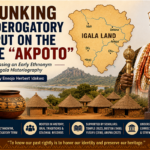
When I came across the article titled “Debunking the Derogatory Tag Put on the Name ‘Akpoto’ (Reassessing an Early Ethnonym in Igala Historiography)” by Eneojo Herbert Idakwo, I was initially curious. I wondered why the subject of Akpoto should be revisited at a time when the unity of the Igala people is paramount and issues capable of creating division ought to be approached with caution. However, given the author’s reputation as one of the most prolific writers and researchers I greatly respect, I took the time to study his work carefully.
The answer to my curiosity became evident in his concluding remarks:
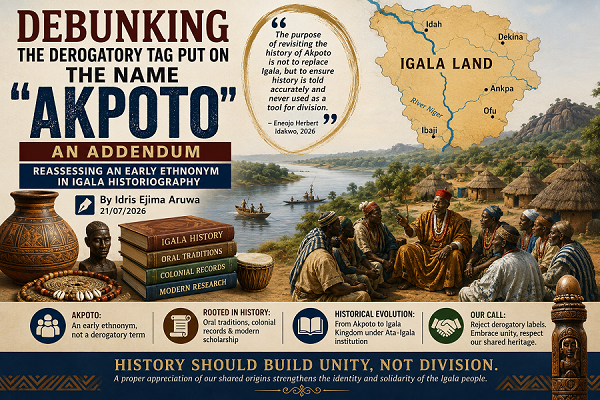
“The purpose of revisiting the history of Akpoto is not to advocate replacing the name Igala, which remains the accepted identity of the people. Rather, it is to encourage a more accurate reading of Igala history by recognizing Akpoto as an important component of the historical evolution of the Igala nation. Once this historical reality is appreciated, the misuse of Akpoto as a derogatory expression against any section of Igala land becomes both historically indefensible and culturally inappropriate.” (Idakwo, 2026)
Mr. Idakwo’s reference to my book, Readings on Igala People, Land and Language, in discussing this subject is highly commendable. It reflects his deep understanding of and appreciation for the body of research that has been undertaken in this field. I share his position that the derogatory use of Akpoto represents a distortion of history rather than a reflection of its original meaning. The available evidence from oral traditions, colonial ethnographies, and modern historical studies suggests that Akpoto was an early ethnonym associated with the ancestors of the present-day Igala people before the emergence of the centralized Igala Kingdom under the Ata-Igala institution (Idakwo, 2026).
The discipline of onomasiology—the study of names—teaches us that names are often bestowed by others rather than chosen by those who bear them. Like many gifts, a name is usually given without the prior knowledge, advice, or consent of the recipient. The names of languages and ethnic groups are frequently assigned by neighbouring peoples. Nevertheless, a name does not define a people’s language, whether spoken or written, nor does it determine their culture, values, beliefs, or social identity.
The words Okpoto or Akpoto appear to be derived from the Nupe words Kpoto or Kpwatwa, which refer to a waterside settlement or port. Historically, the earliest interactions between neighbouring ethnic groups and the ancestors of the Igala especially the Nupes, Benin, Hausa, Yoruba and the British colonial emissaries occurred along the Niger-Benue confluence. It is therefore reasonable to infer that these ancestors possessed a strong riverine culture, particularly around Idah.

Their most significant interactions were with the Nupe people, with whom they shared extensive political and economic relationships. This suggests that the early settlers of Idah—the ancestral homeland of the Igala people—were originally identified as Akpoto.
With the emergence of Abutu Ejeh from the old Kwararafa Confederacy, who became the progenitor of Ayegba Oma Idoko—the ruler credited with establishing the Ata-Igala institution—a new political identity gradually emerged. The name Igala became the accepted designation of the kingdom and its people. The origin of the name Igala, however, remains an area of ongoing historical inquiry, as no scholar has yet established a definitive explanation for its emergence. Ayegba Oma Idoko became the first Ata-Igala, ruling over the territory that came to be known as Ane-Igala. While political leadership and state organization changed, the language and cultural identity of the people remained fundamentally the same.
One consequence of this shift in ethnic nomenclature was that settlements located close to the royal palace increasingly adopted the name Igala as a marker of political legitimacy and royal affiliation. Conversely, communities outside the royal enclave continued to be identified—or were labelled—as Akpoto. Over time, this distinction evolved into a social classification that unfortunately acquired derogatory connotations, despite its historical origins.
I also have reason to believe that many of the communities now collectively referred to as Akpoto have preserved some of the oldest forms of Igala vocabulary. By contrast, the spoken Igala of Idah and its environs has undergone considerable lexical influence due to the cosmopolitan nature of the ancient capital. As the administrative and political centre of a vast kingdom, Idah attracted migrants from diverse ethnic backgrounds following the establishment of the Igala Kingdom. These interactions inevitably influenced the vocabulary, pronunciation, and style of spoken Igala in Idah, while communities beyond the royal capital retained linguistic features that may more closely reflect the older forms of the language.
Recognizing these historical and linguistic realities should not be seen as an attempt to undermine the collective Igala identity. Rather, it enriches our understanding of the historical evolution of the Igala nation and reinforces the need to reject the derogatory use of Akpoto. History should serve as a bridge to unity, not a tool for division. A proper appreciation of our shared origins strengthens, rather than weakens, the identity and solidarity of the Igala people.
I want to commend Eneojo Herbert Idakwo for the clarity, scholarship, and balanced perspective he has brought to this important subject. His thoughtful reassessment of the history of Akpoto contributes meaningfully to a more accurate understanding of Igala historiography while reinforcing the need for unity among the Igala people.
It is my sincere prayer that the Igala nation will rediscover the strength of its shared heritage, reclaim the glory of its illustrious past, and continue on a path toward an even greater future. May our history inspire unity rather than division, and may our collective identity remain a source of pride for generations to come.