By Ibrahim Bunu
ibrahimbunu2520@gmail.com
The strength of a democracy lies not in its ability to preserve the past but in its capacity to adapt to the future. Across the world, nations evolve, constitutions are amended, institutions are reformed, and governance structures are redesigned to meet emerging realities. It is therefore both surprising and troubling that some commentators have chosen to describe ongoing discussions on regional governance, constitutional reforms, state policing, and fiscal restructuring as a “constitutional coup.”
Nothing could be further from the truth.
The article by Hassan Husaini, MNI, is rich in rhetoric but weak in historical context, comparative governance analysis, and constitutional reality. While every citizen has the right to question government policies, it is dangerous to equate constitutional reform with constitutional destruction.

The fundamental question before Nigeria today is simple:
Can a nation facing persistent insecurity, economic inefficiency, bureaucratic centralization, and developmental imbalance continue to operate with a governance model designed decades ago without considering reforms?
The answer is obvious.
Constitutional Amendment Is Not a Coup
A constitutional coup occurs when leaders seize power outside constitutional processes.
What is currently being discussed in Nigeria is the exact opposite.
The Constitution itself provides mechanisms for amendment.
Section 9 of the 1999 Constitution explicitly outlines procedures for altering constitutional provisions.
The framers of the Constitution understood that no constitution is perfect or eternal.
If constitutional amendments were illegitimate, the Constitution would never have provided a process for amendment.
Nigeria has amended its Constitution multiple times since 1999.
Nobody called those amendments coups.
The United States Constitution has been amended twenty-seven times.
India’s Constitution has been amended more than one hundred times.
South Africa has amended its Constitution numerous times since 1996.
Democracies evolve.
That is not constitutional rebellion.
That is constitutional growth.
The Myth That Regional Governance Is Unconstitutional
One of the central arguments advanced by critics is that geopolitical zones are unconstitutional.
This argument ignores political reality.
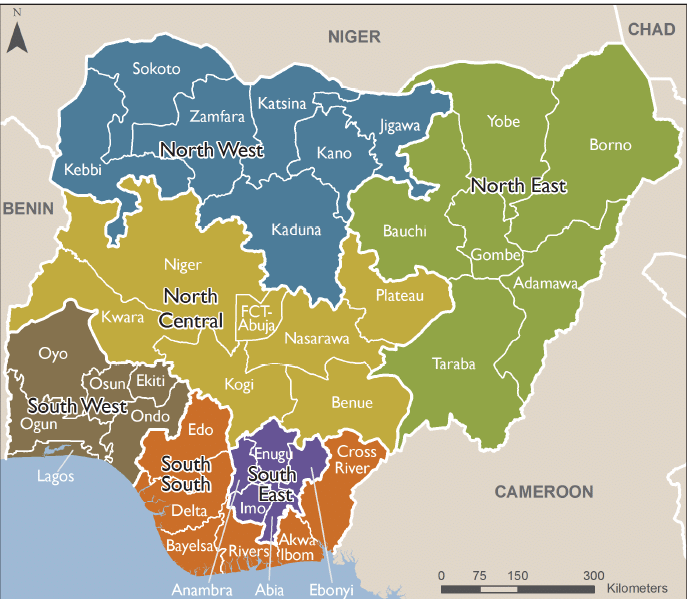
Nigeria’s six geopolitical zones have existed officially for nearly three decades.
Successive administrations have used them for:
* Federal appointments
* National planning
* Security coordination
* Development commissions
* Revenue discussions
* Electoral calculations
* Federal character balancing
Today, no serious national discussion occurs without reference to:
* North-West
* North-East
* North-Central
* South-West
* South-East
* South-South
These zones may not currently constitute constitutional tiers of government, but they are already embedded in Nigeria’s administrative architecture.
The debate therefore is not whether they exist.
The debate is whether they should be given clearer constitutional responsibilities.
That is a legitimate democratic conversation.
The World Has Moved Toward Devolution
The greatest weakness of the anti-restructuring argument is its assumption that excessive centralization guarantees national unity.
Global evidence suggests otherwise.
Many of the world’s most successful federations operate with strong regional structures.
Germany
Germany consists of powerful states known as Länder.
These states exercise significant authority over education, policing, taxation, infrastructure, and economic development.
Germany remains one of the world’s strongest economies.
Canada
Canadian provinces possess extensive constitutional powers.
Quebec even maintains unique cultural and linguistic autonomy.
Canada remains stable and united.
Switzerland
Switzerland’s cantons enjoy enormous autonomy.
Power is deliberately decentralized.
Yet Switzerland consistently ranks among the world’s best-governed nations.
India
India’s federal model grants significant powers to states.
Different states pursue different development strategies while remaining part of one nation.
India’s diversity did not destroy the federation.
Devolution strengthened it.
United Kingdom
Scotland, Wales, and Northern Ireland exercise devolved powers through their own legislative institutions.
The United Kingdom remains intact despite these arrangements.
The lesson is clear.
Strong regions do not necessarily weaken nations.
Poor governance does.
Why Nigeria’s Current Centralized System Is Struggling
Nigeria currently operates one of the most centralized federal systems in the world.
Abuja controls:
* Policing
* Electricity regulation
* Major infrastructure decisions
* Natural resources
* Revenue distribution
* Security architecture
The result has been predictable.
States routinely wait for federal allocations.
Governors often possess responsibility without sufficient authority.
Local governments remain weak.
Development becomes slow and bureaucratic.
When insecurity erupts in remote communities, decisions must often travel through layers of federal approval before action occurs.
This model is increasingly unsustainable.
The question therefore is not whether reform is needed.
The question is how reform should be implemented.
State Police Is Not a Threat to Democracy
Opponents frequently cite Section 214 of the Constitution.
That provision currently establishes a single police force.
That is true.
But constitutions are not immutable documents.
If Nigerians determine through constitutional processes that state policing offers a better security framework, amendments can be made.
Many successful democracies operate multiple policing structures.
The United States has:
* Federal agencies
* State police
* County sheriffs
* Municipal police departments
Canada follows similar arrangements.
Australia follows similar arrangements.
Germany follows similar arrangements.
Nobody argues that these countries have collapsed because of decentralized policing.
The challenge is not whether state police should exist.
The challenge is designing safeguards against abuse.
Those safeguards can be legislated.
Fiscal Restructuring Is Not Economic Heresy
Nigeria’s overdependence on centrally distributed revenue has created a culture of dependency.
Many states focus more on monthly allocations than economic productivity.
A restructured fiscal arrangement could encourage:
* Competition
* Innovation
* Resource development
* Regional planning
* Internal revenue generation
This is how federal systems thrive.
States and regions become engines of growth rather than passive recipients of federal transfers.
The objective is not to weaken the federation.
The objective is to make it more productive.
The False Narrative of Authoritarianism
Perhaps the most alarming aspect of Hassan Husaini’s article is the attempt to link:
* Fuel subsidy removal
* Exchange-rate reforms
* State police
* Regional governance
* Constitutional amendments
into a single alleged authoritarian plot.
This is a political argument, not a constitutional one.
One may disagree with government policies.
One may criticize implementation.
One may challenge outcomes.
That is democracy.
But disagreement with policy does not automatically prove authoritarian intent.
Democracies are judged not by the existence of debate but by their willingness to permit it.
The fact that these proposals are being openly debated demonstrates democratic engagement rather than democratic collapse.
The Real Question Before Nigeria
The debate should not be framed as:
“Constitution versus restructuring.”
The real debate is:
“Can Nigeria achieve security, prosperity, and national cohesion under a governance structure that many experts, commissions, elder statesmen, civil society organizations, and regional leaders have argued requires reform?”
For decades, Nigerians from across political divides have called for greater devolution of powers.
These calls did not begin under the current administration.
They predate it by many years.
What is being proposed today is not a revolution.
It is a continuation of a long national conversation.
Conclusion: Reform Is Not Rebellion
Nigeria stands at a crossroads.
One path insists that every existing structure must remain untouched regardless of outcomes.
The other recognizes that nations must occasionally reform themselves to survive and prosper.
History shows that great nations are not those that fear change.
Great nations are those that manage change wisely.
No serious advocate of restructuring is calling for the destruction of Nigeria.
The goal is precisely the opposite.
The goal is to build a federation that is more secure, more productive, more accountable, and more responsive to the needs of its people.
The Constitution was created to serve Nigeria.
Nigeria was not created to serve an unchanging Constitution.
If constitutional reforms are pursued through lawful democratic processes, they are not a constitutional coup.
They are democracy at work.
And history may ultimately remember restructuring not as the moment Nigeria weakened its federation, but as the moment it finally strengthened it.