By Otunba (Dr) Abdulfalil Abayomi Odunowo, National Chairman, Asiwaju Ahmed Tinubu Support Group (AATSG)
Nigeria is currently navigating one of the most challenging economic transitions in its history. The removal of fuel subsidies, unification of exchange rates, rising food prices, and the restructuring of entrenched economic systems have brought real pain to millions of families. Many Nigerians are struggling with higher living costs, and these difficulties cannot be wished away.
However, in the midst of this hardship, an honest national conversation is necessary: What concrete programmes has the Tinubu administration actually put in place for ordinary citizens?
Far too many people judge the government based on headlines, rumours, or political slogans without knowing the actual initiatives designed to support students, traders, farmers, youths, women, artisans, and vulnerable households. Others dismiss everything outright without examining the opportunities available.
The Asiwaju Ahmed Tinubu Support Group (AATSG) believes Nigerians deserve clear, factual civic education not propaganda, not blind criticism, but truth that empowers people to act.

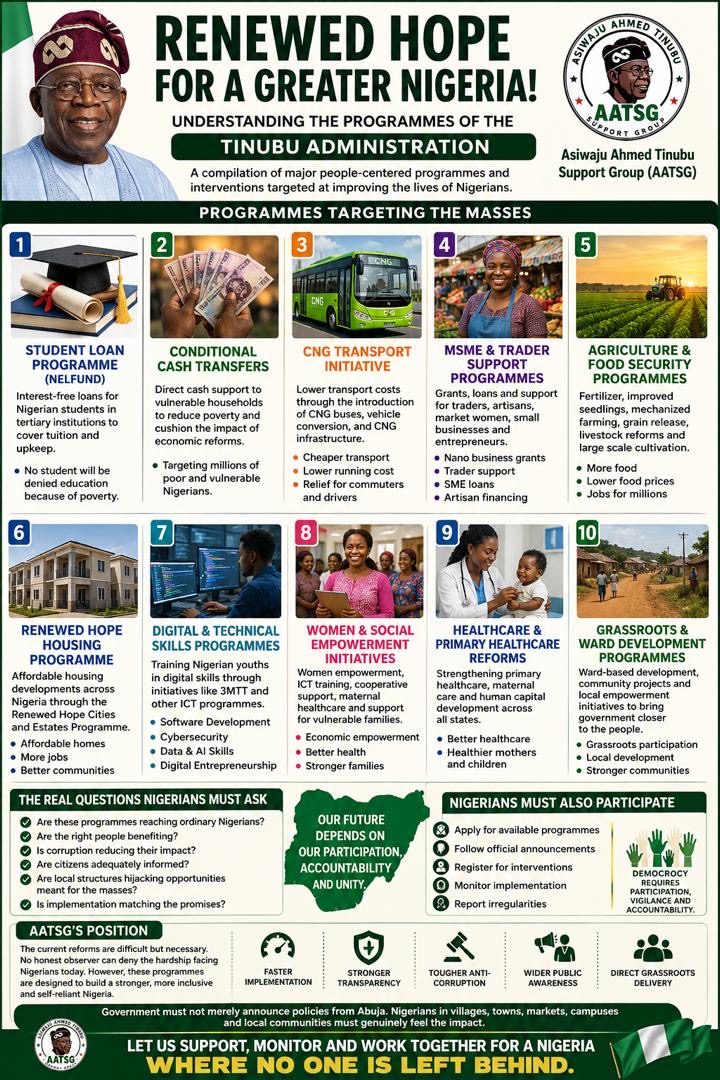
President Bola Ahmed Tinubu’s administration introduced the Renewed Hope Agenda a comprehensive framework built on economic reform, infrastructure development, social investment, youth empowerment, food security, healthcare improvement, and grassroots development.
Here is a clearer explanation of the major programmes targeting ordinary Nigerians:
1. Student Loan Programme (NELFUND)
For the first time in Nigeria’s history, a well-structured, national student loan scheme has been launched to support indigent students with tuition and living expenses.
This programme directly tackles the painful reality of bright young Nigerians dropping out of university due to lack of funds. Families that previously could only educate one child may now support more. If you have children in tertiary institutions or know qualified students facing financial difficulties, this is an opportunity worth applying for. Don’t let ignorance or scepticism stop you the window to apply is open.
2. Conditional Cash Transfers
The government has expanded cash transfer programmes aimed at the most vulnerable households. The goal is to reduce extreme poverty and provide a buffer against the immediate effects of economic reforms.
While questions remain about speed and transparency, the intention is clear: put money directly into the hands of those who need it most. Citizens should actively verify registration processes in their communities and ensure deserving households are included.
3. CNG Transport Initiative
After fuel subsidy removal drove transport costs sky-high, the administration launched the Compressed Natural Gas (CNG) programme. This includes converting vehicles to run on cheaper gas, deploying CNG buses across the country, and reducing long-term dependence on expensive petrol.
For commercial drivers, this could be a game-changer significantly cutting daily fuel expenses and increasing profit margins. If you are a transporter, this is the moment to explore conversion opportunities and government support schemes. The earlier you act, the greater your advantage.
4. MSME and Trader Support Programmes
Recognising that millions survive through informal businesses, the government rolled out nano grants, trader support schemes, SME loans, and artisan financing.
Target beneficiaries include market women, roadside traders, mechanics, tailors, vulcanizers, barbers, and small-scale entrepreneurs. These programmes are designed to inject capital into the backbone of Nigeria’s economy. If you run a small business, go and register. Ask questions at your local government office or market association. Many opportunities die unused because people don’t apply.
5. Agriculture and Food Security Programmes
With food inflation hurting every household, the government declared food security a national emergency and introduced initiatives including fertiliser distribution, improved seedlings, mechanisation support, strategic grain reserves, and expanded cultivation.
These programmes aim to boost local production and ultimately bring down food prices. Farmers and aspiring agribusiness owners should seek information on available inputs and support in their states. The more citizens engage with these schemes, the faster food security can be achieved.
6. Renewed Hope Housing Programme
Housing deficit remains a major challenge. The administration launched the Renewed Hope Cities and Estates initiative to deliver more affordable housing units nationwide.
Beyond shelter, successful execution can create thousands of jobs in construction and related industries. Watch out for application processes in your state and advocate for transparent allocation.
7. Digital & Technical Skills 3 Million Technical Talent (3MTT) Programme
The government is training Nigerian youths in high-demand digital skills: software development, cybersecurity, data analysis, UI/UX design, AI, and digital entrepreneurship.
In a world where remote work and tech jobs can earn dollars, this programme equips young people with globally competitive abilities. If you are a youth or know one, this is your call to action register, learn, and position yourself for the future economy.
8. Women & Social Empowerment Initiatives
Through the Renewed Hope Initiative and other schemes, women are receiving ICT training, cooperative support, maternal healthcare interventions, and economic empowerment projects.
9. Healthcare Reforms
Efforts are being made to strengthen primary healthcare, maternal care, and overall health system governance across states.
10. Grassroots & Ward-Level Development
A key feature of the agenda is taking development closer to the people through ward-based empowerment and community-driven initiatives.
The Real Questions Nigerians Must Ask
Programmes have been announced. The more critical questions now are:
* Are these programmes reaching the intended beneficiaries?
* Is implementation effective and transparent?
* Are corrupt elements diverting opportunities?
* Are citizens being adequately informed and mobilised?
These are legitimate questions every responsible Nigerian should ask and follow up on.
NIGERIANS, IT IS TIME TO PARTICIPATE ACTIVELY
One of Nigeria’s biggest problems is passive citizenship. Many people only complain on social media without taking practical steps.
Take action today:
* Visit official websites and verified government portals for each programme.
* Register for opportunities that apply to you or your family.
* Ask questions in your wards, markets, and associations.
* Demand transparency and accountability from local officials.
* Monitor implementation in your community and speak up when things go wrong.
Democracy is not a spectator sport. Your participation determines how well these programmes serve the people.
AATSG’s Position
We acknowledge the genuine hardship many Nigerians are facing. Economic reforms are tough and painful in the short term. However, structural changes are often necessary for long-term progress.
What is urgently needed now is:
* Faster and more efficient implementation
* Greater transparency and accountability
* Stronger anti-corruption measures
* Wider public awareness campaigns
* Direct delivery to the grassroots
The true measure of the Renewed Hope Agenda will not be the promises made in Abuja, but the tangible improvements felt in homes, markets, farms, and communities across Nigeria.
History will not remember those who only complained.
It will remember those who took action, participated, held leaders accountable, and worked towards a better Nigeria.
The opportunities are there. Now is the time to seize them.
Renewed Hope is not just a slogan it can become reality through collective action.
Asiwaju Ahmed Tinubu Support Group (AATSG)
Signed
Otunba (Dr) Abdulfalil Abayomi Odunowo
National Chairman AATSG
Empowering Citizens • Building Awareness • Demanding Accountability