


By Okoi Obono-Obla
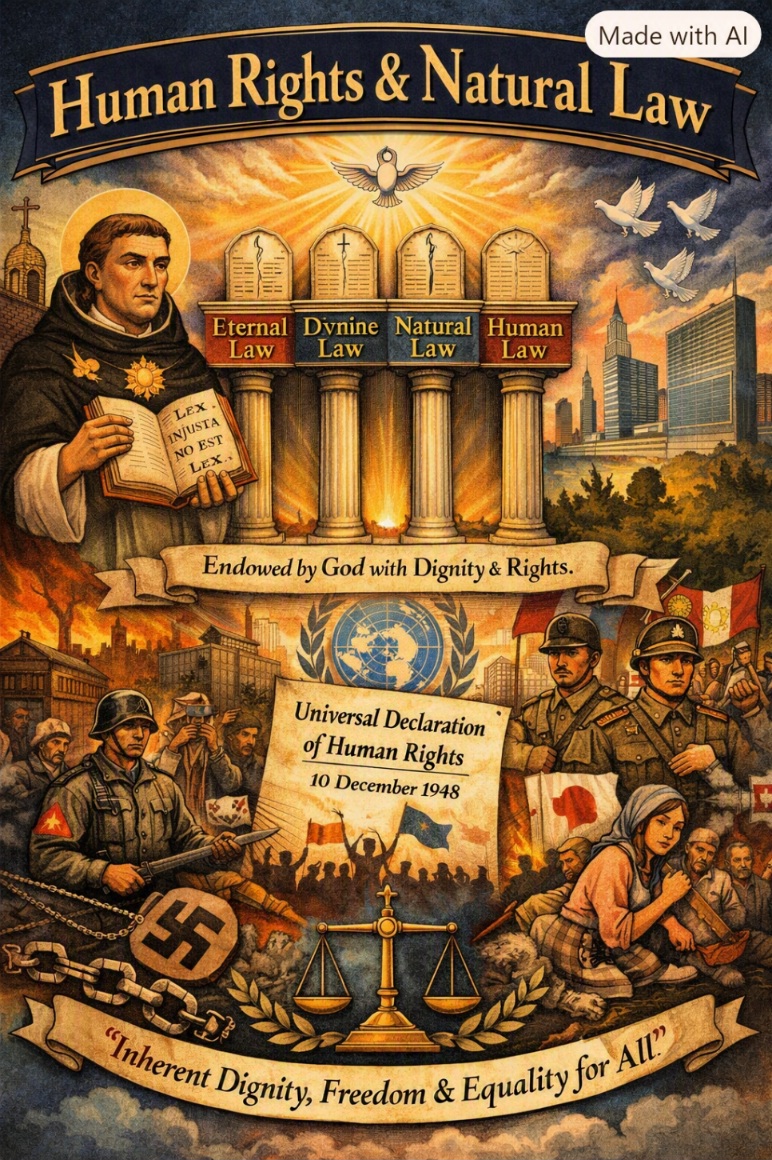
Human rights are those rights which, according to the doctrines of eternal law, divine law and natural law as expounded by the Catholic theologian and philosopher St. Thomas Aquinas, are bestowed upon us by Almighty God. They are sacrosanct and inalienable, to the extent that no principality, authority, State or person can take them away or abridge them.
St. Thomas Aquinas and the Hierarchy of Law
The philosophical foundation for this understanding of rights is found in Aquinas’s treatise on law in the Summa Theologica. Aquinas presents law as a hierarchy emanating from God:
First is Eternal Law, which is the supreme reason and divine wisdom of God by which He governs the entire universe. It is the ultimate source of all order, justice and law.
Second is Divine Law, which is that portion of eternal law revealed by God to man through Holy Scripture and divine revelation, to direct man to his supernatural end and eternal salvation.
Third is Natural Law, which is the participation of eternal law in the rational creature. It is the light of reason imprinted by God in the heart of every man, enabling him to distinguish good from evil, and to incline towards the preservation of life, procreation, knowledge, and society. It is from natural law that man apprehends the inherent dignity of the human person.
Fourth is Human Law, otherwise called positive law, which is the specific enactment made by human authorities for the common good. For Aquinas, the validity of human law depends entirely on its conformity with natural law. An unjust law, in his famous dictum, is not law at all – lex injusta non est lex.
For centuries, this natural law tradition provided the moral compass for law and governance.
The Rise of Legal Positivism and its Catastrophic Consequence
In the 19th and early 20th centuries, this tradition was challenged and largely displaced by the analytical school of legal positivism, championed by jurists such as Jeremy Bentham, John Austin and later H.L.A. Hart. Positivism insisted on a rigid separation of law and morality. Law, in Austin’s formulation, was simply the command of the sovereign backed by sanction. Its moral content was irrelevant to its validity.
The catastrophic consequences of this separation of law from morality were unleashed upon humanity during the Second World War.
In Germany, the Third Reich under Adolf Hitler came to power legally and then used the machinery of positive law to systematically strip Jews, Roma, political opponents and other groups of their citizenship, property, liberty and ultimately life. The Nuremberg Laws of 1935 and subsequent decrees provided a veneer of legality for persecution that culminated in the Holocaust, in which six million Jews and millions of others were exterminated in a bureaucratically organized genocide.
In Italy, the fascist regime of Benito Mussolini institutionalized dictatorship, suppression of political dissent, aggression against other nations, and in 1938, the promulgation of racial laws.
In Imperial Japan under Emperor Hirohito, ultra-militarism and a doctrine of racial superiority led to unspeakable violations of human rights across Asia and the Pacific, including massacres, forced labour, the system of sexual slavery known as “comfort women,” and atrocities such as the Nanjing Massacre.
All these acts were, in a narrow positivist sense, “legal” because they were authorized by the positive laws of those States at that time.
The Revulsion and Return to Natural Law: The Birth of Modern Human Rights
The horror of these events produced a global revulsion and a profound jurisprudential crisis. At the Nuremberg and Tokyo Tribunals, the Allied powers decisively rejected the defence that perpetrators were merely obeying the positive law of their State. The tribunals affirmed a higher law – that certain acts constitute crimes against humanity and war crimes even if permitted by domestic law, because they violate the fundamental dictates of humanity and natural law.
This marked a decisive return to natural law thinking, with its underpinnings of humanitarianism and respect for human dignity.
This movement culminated on 10th December 1948 with the promulgation of the Universal Declaration of Human Rights by the United Nations General Assembly. For the first time in history, the international community codified in a universal instrument that all human beings are born free and equal in dignity and rights, and are endowed with reason and conscience.
What was a moral declaration in 1948 has since crystallized into binding law. It has become fashionable, indeed obligatory, for every modern State to enshrine human rights provisions in its constitution and legal system.
Today, fundamental human rights have attained the status of jus cogens – peremptory norms of general international law from which no derogation is permitted. They are obligations erga omnes – owed to the international community as a whole.
Thus, the tragic lessons of the Second World War reaffirmed the timeless wisdom of St. Thomas Aquinas: the State does not grant human rights; it merely recognizes and protects what God and nature have already bestowed, and which no State has the authority to take away.