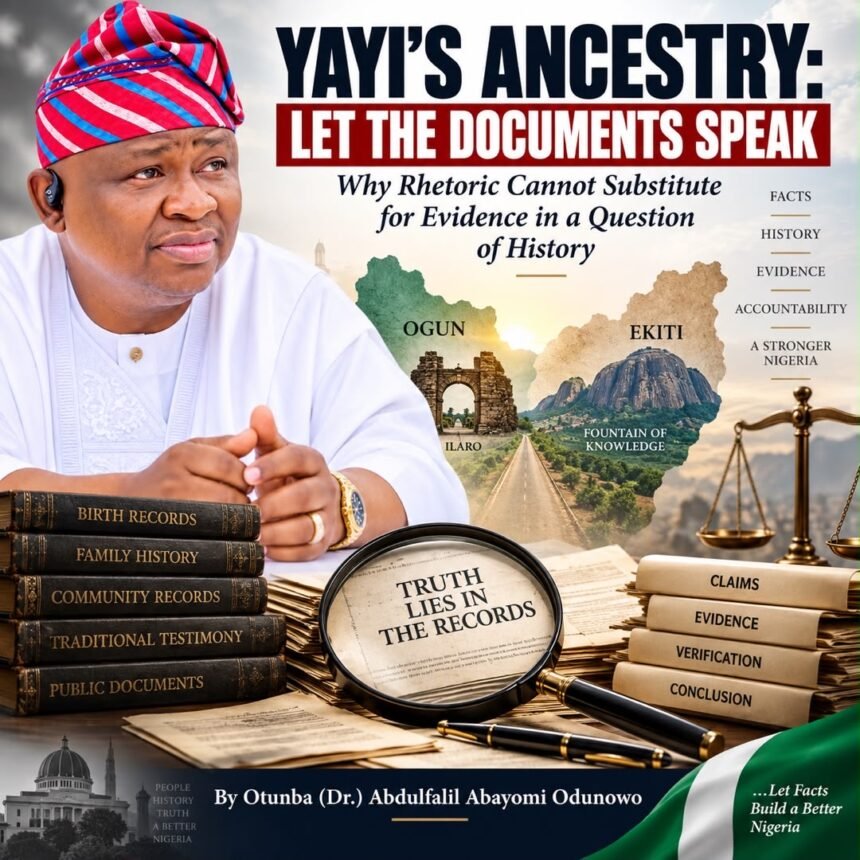
By Otunba (Dr.) Abdulfalil Abayomi Odunowo
The controversy over the ancestry of Senator Solomon Olamilekan Adeola, widely known as Yayi, has now reached a stage where rhetoric ought to yield to evidence.
A recent article titled “Beyond Parochialism: Why Yayi’s Alleged Ekiti Ancestry Is No-Brainer” tried to wave away concerns about the senator’s ancestry as politically driven and baseless.
There is nothing wrong with defending Senator Adeola. And there is nothing inherently improper about questioning claims made about the ancestry of a public figure.

The trouble starts when either side begins to present assertion as though it were proof.
THE QUESTION IS SIMPLE
Where does Senator Solomon Olamilekan Adeola’s family ancestry originate, and what independently verifiable evidence establishes it?
That question should not call for insults.
It should not require political propaganda.
It should not turn on whether one supports or opposes Yayi.
And it certainly cannot be resolved by branding those asking questions as lazy, mischievous, intellectually deficient, or politically desperate.
History does not become true simply because its advocates speak more loudly.
History is established by evidence.
TWO CLAIMS DESERVE THE SAME TEST
Those alleging that Senator Adeola has ancestral roots in Ekiti bear a responsibility to produce evidence.
They should tell the public:
Which Ekiti community?
Which family?
Which compound?
Who was the relevant ancestor?
What is the genealogical chain linking that ancestor to Senator Adeola?
And, crucially, what historical or documentary evidence supports the claim?
Those are entirely legitimate questions.
But intellectual fairness demands that we apply exactly the same test to the rival claim that Senator Adeola’s paternal ancestry is rooted in Pahayi/Ago-Ishaga in Ilaro, Ogun State.
It cannot be enough to simply say:
“Yayi is from Ilaro.”
We must ask, just as plainly:
Which family?
Which compound?
Who were his ancestors?
Where did they live?
Where were they buried?
What records link one generation to the next?
What evidence existed before the current political controversy?
That is how history ought to be examined.
THERE IS ALREADY A PUBLISHED ILARO GENEALOGY
This is where the discussion gets more interesting.
Published accounts supporting Senator Adeola do not merely say he is from Ogun State. Some go further and set out a specific paternal genealogy tied to the Onibata-Isaga/Ago-Ishaga/Pahayi area of Ilaro.
One published account traces the family line through:
Olege → Sangolade → Ogundimu Sangoloni → Ogunleye → Abdul-Gafar Ayinde Adeola → Solomon Olamilekan Adeola.
That is useful evidence because it gives researchers something concrete to test.
But an important distinction must be kept in view:
A published genealogy is a claim capable of verification. It does not become conclusive proof automatically just because it has appeared in print.
Each generation should be independently tested against historical records, family records, burial histories, land or compound records, and credible testimony from people in a position to establish the family history.
The very same standard must apply to anyone putting forward an alternative Ekiti genealogy.
THE OTHER SIDE CANNOT SIMPLY BE DISMISSED
This controversy can no longer be accurately described as nothing more than an anonymous social-media rumour. Named individuals have publicly advanced the alternative ancestry claim.
Senator Adeola has publicly rejected it and challenged those making it to substantiate their allegations. Abayomi Hunye, who has publicly made the claim, has reportedly responded that he possesses documentary evidence and is prepared to defend his position through the judicial process.
That does not mean Hunye has proved his allegation.
Far from it.
A person saying, “I have documents,” is not the same thing as those documents being authenticated and establishing what the person says they establish.
But the proper response cannot be:
“The allegation is baseless, so there is nothing to investigate.”
The proper response should be straightforward:
Produce the documents.
Let Nigerians see them.
Let historians examine them.
Let genealogists test them.
Let the families concerned respond to them.
And where legal questions arise, let the courts determine their legal significance.
NOT EVERY DOCUMENT CARRIES THE SAME WEIGHT
There is another point worth stressing.
Historical investigation requires an evidentiary hierarchy. A political statement issued in 2026 cannot automatically carry the same weight as a contemporaneous record created fifty or seventy years earlier.
Researchers should therefore look for original or independently verifiable materials such as birth and death records, marriage records, burial records, old school documentation identifying parents or guardians, employment records, family documents, land and compound records, historical community records, and electoral declarations predating the present controversy.
Traditional and family testimony can also matter, especially in societies where substantial genealogical history was transmitted orally. But oral evidence should, wherever possible, be tested against independent documentary evidence.
Most importantly, evidence created before the political controversy arose deserves particular attention because it is less vulnerable to the allegation that it was produced specifically to influence the present debate.
LET US ALSO CORRECT THE HISTORICAL RECORD
The recent article itself shows why factual verification matters. It states that Senator Adeola served in the Lagos State House of Assembly between 2003 and 2007 before entering the House of Representatives.
Available biographical records indicate that he actually served two terms, from 2003 to 2011, before entering the House of Representatives in 2011.
He later represented Lagos West in the Senate and today represents Ogun West in the Senate.
This may seem like a relatively minor mistake.
But it reinforces the bigger point. When demanding factual accuracy from others, we must first submit our own claims to verification.
TRANSFORMERS AND SEWING MACHINES CANNOT PROVE ANCESTRY
The article also devotes considerable space to Senator Adeola’s empowerment activities. A transformer was reportedly donated to a community. A tailor reportedly received a sewing machine. There are accounts of empowerment programmes and other interventions.
Those claims may certainly form part of a discussion about Senator Adeola’s performance as a politician. But they tell us nothing at all about his ancestry.
A man could provide one thousand transformers and still have ancestry somewhere else.
Another man could provide nothing to his constituents and still possess an ancestry stretching back hundreds of years within his community.
Performance is one issue.
Ancestry is another.
Mixing the two weakens the argument rather than strengthening it.
BIRTHPLACE IS NOT ANCESTRY
We must also separate four issues that are increasingly being muddled together:
Birthplace.
Residence.
Ancestry.
Constitutional eligibility.
They are not necessarily the same thing.
A Nigerian can be born in Lagos, educated in Lagos, spend most of his working life in Lagos, have paternal ancestors from Ogun, and maternal ancestors from another state.
There is nothing unusual about that.
So, proving where somebody was born does not automatically establish ancestral origin. By the same token, establishing ancestry does not by itself answer every legal question about eligibility for political office.
Those legal questions must be answered according to the Constitution, electoral legislation, and authoritative judicial interpretation.
THIS SHOULD NOT BECOME AN ETHNIC WAR
There is something even more important than Senator Adeola’s individual case. Nigeria must be very careful not to turn ancestry into a tool of ethnic hostility.
Questioning historical claims is legitimate.
Demanding documentary evidence is legitimate.
Investigating the genealogy of someone seeking public office may also be legitimate where ancestry or constitutional qualification has become materially relevant. But attacking people because of where their ancestors allegedly came from is something else entirely.
There is nothing inferior about being from Ekiti.
There is nothing superior about being from Ogun.
So the purpose of establishing Senator Adeola’s ancestry should never be to stigmatise one Nigerian identity in favour of another.
The purpose should simply be to establish the historical truth where competing factual claims have been placed before the public.
LET EVERYBODY PUT THEIR CARDS ON THE TABLE
This controversy now presents an opportunity.
Those claiming an Ekiti ancestry should publish their genealogy and supporting evidence.
Those maintaining the Pahayi/Ilaro ancestry should equally make the historical record available for independent scrutiny. If there are old photographs, produce them. If there are birth records, produce them. If there are burial records, identify them. If there are ancestral houses and family compounds, document them. If there are historical land records, examine them. If there are surviving elderly relatives capable of providing evidence, record their testimony. If there are records predating Senator Adeola’s entry into Ogun politics, they deserve particular attention.
And if someone possesses documents contradicting the established account, those documents should be authenticated rather than merely announced at press conferences.
WE MUST BE WILLING TO ACCEPT WHATEVER THE EVIDENCE ESTABLISHES
That is perhaps the most important principle of all. An investigation whose conclusion has already been decided is not an investigation.
If independently authenticated evidence establishes an unbroken ancestral connection between Senator Adeola’s paternal family and Pahayi/Ilaro, responsible people should accept it.
If credible evidence establishes a different ancestral history, that evidence must be confronted as well.
And if the evidence ultimately remains incomplete or contradictory, we should have the intellectual honesty to say:
The matter has not yet been conclusively established.
There is no shame in that conclusion.
The greater danger lies in manufacturing certainty where the evidence does not justify it.
LET HISTORY BE HISTORY
Senator Solomon Olamilekan Adeola has built a substantial political career spanning the Lagos State House of Assembly, the House of Representatives, and the Senate, first representing Lagos West and now Ogun West.
His political record can be debated.
His policies can be debated.
His ambitions can be debated.
His performance can be debated.
But ancestry is not determined by applause, political strength, newspaper endorsements, or the number of empowerment programmes a politician has carried out.
Ancestry is a question of history.
Eligibility is a question of law.
Performance is a question of governance.
Political preference belongs to the electorate.
We should stop conflating these four questions.
The challenge before everyone involved in this controversy should therefore be simple:
Bring the evidence.
Not insults.
Not political slogans.
Not assumptions.
Not emotional appeals.
Bring the genealogy.
Bring the original documents.
Authenticate them independently.
Then let the evidence tell us what history actually says. Because, in the end, the question should never be:
“Whose political story do you believe?”
The proper question is:
“Where is the evidence, can it be independently authenticated, and what exactly does it prove?”
Otunba (Dr.) Abdulfalil Abayomi Odunowo
National President SCN
SpeakUp Collective Nigeria.