
By Okoi Obono-Obla
Matriclan Justice: A Forgotten Restorative System in Ugep, Yakurr, Cross River State, Nigeria
In all legal systems, murder is considered one of the gravest offences, for which the offender, if found guilty, is liable to face the ultimate penalty — death.
Among the Ugep people of Yakurr in Cross River State, murder is equally regarded as a grave offence and an abomination. However, the traditional Ugep system approached it not from a purely punitive perspective, but from a restorative one that sought to heal, restore, and rebalance the community.

The foundation of this system is the matriclan. Within the Ugep matrilineal structure, individuals who trace their descent through a common maternal progenitor — sharing the same maternal bloodline — form a matriclan. Bound by consanguinity through shared female ancestry, the matriclan is the primary unit of identity, belonging, and collective responsibility.
The Principle of Atonement Through Replacement
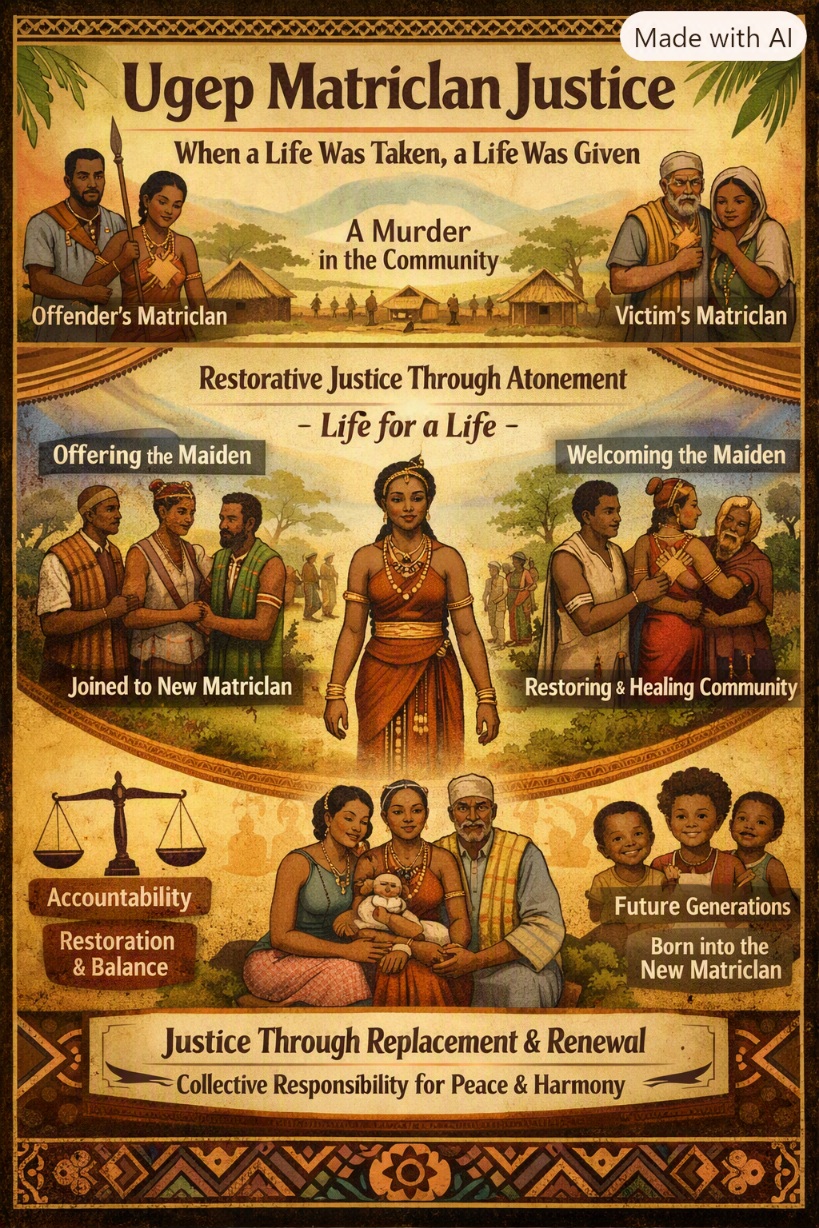
The murder of a person, particularly a member of one’s own broader community, was an assault on the matriclan itself. If such a tragedy occurred, justice was not left to the individual offender alone. The entire matriclan of the perpetrator was obligated to atone and to compensate the matriclan of the deceased by replacing the life that was lost.
This was done through the solemn donation of a maiden from the offender’s matriclan to the bereaved matriclan.
The process was deeply ceremonial. The maiden would be formally adopted into her new matriclan, severing all umbilical and kinship ties with her original matriclan. She gained full rights, privileges, and status as a member of her new matriclan. It had to be a female, and deliberately so — because in a matrilineal system, her children would be born into and perpetuate the matriclan she had been compelled to join, thus ensuring the true and lasting restoration of the loss.
What Then Is Justice?
In its simplest form, justice is what is fair, just and meritorious. It arises when a person who has been wronged seeks redress, and that complaint is examined and determined by a person or body entrusted with that responsibility.
Jurisprudentially, however, the concept is broader. It encompasses:
Fairness and Equity: The unbiased application of the law, giving all parties equal opportunity.
Substantive Justice: The law itself must be fair; a fair procedure applied to an unjust law does not produce justice.
Distributive Justice: The fair allocation of resources, rights and opportunities.
Meritorious Justice: Rewarding merit and penalizing wrongdoing.
This broader philosophical analysis, however, is largely a Western conceptualization.
The Ugep conception offers a distinct paradigm. When murder occurred, justice was not a matter for the state to punish the offender in isolation. It was a matter for the two matriclans involved — that of the murderer and that of the victim — to right the wrong and restore the right of the aggrieved. The offending matriclan, by donating a maiden, made up for the loss its action had caused the victim’s matriclan.
This system, practised in Ugep during the pre-colonial and early colonial periods, was profoundly restorative. It did not merely punish; it restored. It fostered accountability not just at the individual level but across entire kinship networks, making every member a stakeholder in maintaining peace. It is precisely because responsibility was collective that murder cases were exceedingly rare during that era.
Conclusion
The Ugep matriclan justice system challenges the modern assumption that justice must be retributive to be effective. Long before contemporary debates on restorative justice, the Ugep had institutionalized a system that prioritized the survival and continuity of the community over the elimination of the offender.
While the practice of donating a person is incompatible with modern human rights law and cannot be revived, its underlying philosophy remains relevant: that true justice should heal the wound of the victimized collective, enforce communal accountability, and deter future violence through kinship responsibility. In an age grappling with overcrowded prisons and recidivism, the wisdom of Ugep’s forgotten system reminds us that restoration can sometimes be more powerful than retribution.