By Okoi Obono-Obla
@Olusegun Adeniyi,
Your post titled “Names of Nigerian Federal Chiefs of Staff from 1960 to Date” is historic, educative and interesting. However, you omitted two names from your list.
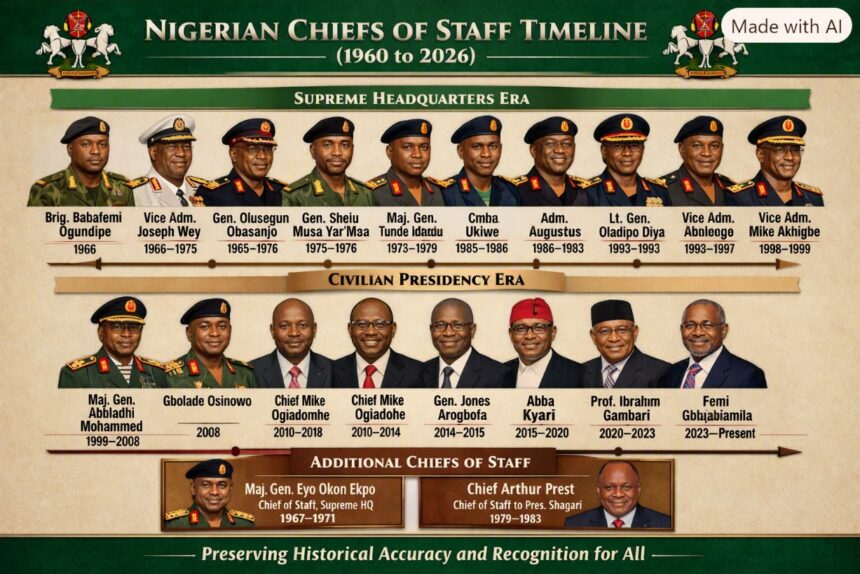
For the purpose of historical accuracy, the list should include:

1. Brigadier Babafemi Ogundipe served as the first Chief of Staff, Supreme Headquarters, from 16 January 1966 to 29 July 1966 under Major General Johnson Aguiyi-Ironsi, making him the de facto second-in-command of the military government.
2. Vice Admiral Joseph Edet Akinwale Wey served as the second Chief of Staff, Supreme Headquarters, from 1 August 1966 to 29 July 1975 under General Yakubu Gowon, effectively serving as Gowon’s second-in-command.
3. General Olusegun Obasanjo served as the third Chief of Staff, Supreme Headquarters, from 29 July 1975 to 13 February 1976 under General Murtala Muhammed, before becoming Head of State following Murtala’s assassination.
4. General Shehu Musa Yar’Adua became the fourth Chief of Staff, Supreme Headquarters, on 13 February 1976 and served until 30 September 1979 under General Olusegun Obasanjo, functioning as the de facto second-in-command of the military government.
5. Major General Tunde Idiagbon served as the sixth Chief of Staff, Supreme Headquarters, from 31 December 1983 to 27 August 1985 under Major General Muhammadu Buhari, acting as Buhari’s second-in-command.
6. Commodore Ebitu Ukiwe became Chief of General Staff in August 1985 after General Ibrahim Babangida overthrew Buhari, serving as Babangida’s second-in-command until October 1986.
7. Admiral Augustus Aikhomu served as Chief of General Staff from October 1986 to August 1993 under General Ibrahim Babangida, functioning as the de facto Vice President of the military government.
8. Lieutenant General Oladipo Diya served as Chief of General Staff from 17 November 1993 to 21 December 1997 under General Sani Abacha, and was the de facto second-in-command of the Abacha government.
9. Vice Admiral Mike Okhai Akhigbe served as Chief of General Staff from 8 June 1998 to 29 May 1999 under General Abdulsalami Abubakar, the final military Head of State before the return to civilian rule.
10. Major General Abdullahi Mohammed became the first Chief of Staff to the President on 29 May 1999 under President Olusegun Obasanjo, and continued in the position after Umaru Musa Yar’Adua became President in 2007, leaving office on 2 June 2008.
11. Gbolade Osinowo served as Chief of Staff to President Umaru Musa Yar’Adua from 2 June 2008 until 18 September 2008, when Yar’Adua abolished the office and relied instead on a group of close advisers.
12. Chief Mike Oghiadomhe served as Chief of Staff to President Goodluck Jonathan from 17 May 2010 until 10 February 2014, when he resigned.
13. General Jones Arogbofa served as Chief of Staff to President Goodluck Jonathan from 18 February 2014 until 29 May 2015, when Jonathan’s administration ended.
14. Abba Kyari served as Chief of Staff to President Muhammadu Buhari from 27 August 2015 until his death on 17 April 2020.
15. Professor Ibrahim Agboola Gambari served as Chief of Staff to President Muhammadu Buhari from 13 May 2020 until 29 May 2023, when Buhari’s administration ended.
16. Femi Gbajabiamila became Chief of Staff to President Bola Ahmed Tinubu on 14 June 2023 and remains the incumbent as of August 2026.
In addition, your post listing all those who have served as Chief of Staff in Nigeria from 1960 to 2026 is not accurate because you omitted:
17. Major General Eyo Okon Ekpo, who served as Chief of Staff, Supreme Headquarters, from 1967 to 1971, when he was appointed Federal Commissioner for Agriculture by General Yakubu Gowon, then Head of State and Commander-in-Chief of the Armed Forces. Major General Ekpo retired from the Nigerian Army in 1975. After retirement, having studied law, he was appointed as a Magistrate and later as Senior Magistrate in the public service of the old Cross River State.
18. Chief Arthur Prest, who served as Chief of Staff to President Shehu Shagari from October 1979 to December 1983.
It should also be noted that under the several military regimes we had in Nigeria from 1966 to 1979 and from December 1983 to 29 May 1999, the Chiefs of Staff to the Military Heads of State were, understandably and in strict adherence to military tradition and protocol, serving military officers and were second-in-command in the chain of military command and hierarchy.
However, in the constitutional and civilian dispensation, the Chief of Staff is a subordinate of the President appointed as administrative staff to head the staff working in the Office of the President. He is not in any ramification second-in-command, does not have any constitutional role as such, and does not succeed the President.
Under the 1999 Constitution of the Federal Republic of Nigeria, as amended, the office is not expressly created, but derives its legality from the executive powers of the President. Section 5(1) vests all executive powers of the Federation in the President. Section 171(1) and 171(2)(c) empowers the President to appoint persons to hold or act in offices in the public service of the Federation and to remove them. Furthermore, Section 151(1) provides that the President may appoint any person as a Special Adviser to assist him in the performance of his functions, while Section 148 makes it clear that the Vice-President, not the Chief of Staff, is the constitutionally recognized second-in-command, as provided in Section 142 and Section 146 on succession.
Therefore, unlike the Chief of Staff, Supreme Headquarters or Chief of General Staff under military rule who were de facto second-in-command, the Chief of Staff to the President in a civilian administration is merely the head of the President’s administrative staff, appointed at the pleasure of the President to assist in running the Presidency.
Conclusion: It is important that historical records of this nature reflect the complete line of those who have occupied such a strategic office, in order to preserve institutional memory, ensure accuracy, and give due recognition to all who have served the nation in that capacity.