
By Okoi Obono-Obla
The history of the creation of the present 18 Local Government Areas (LGAs) of Cross River State, recognized under the constitutional order that came into force in 1999, is often misunderstood. Many young people, who were either too young or not yet born during the events, have been misled by misinformation circulating on social media. This article seeks to set the record straight.
Abi and Yakurr Local Government Areas:
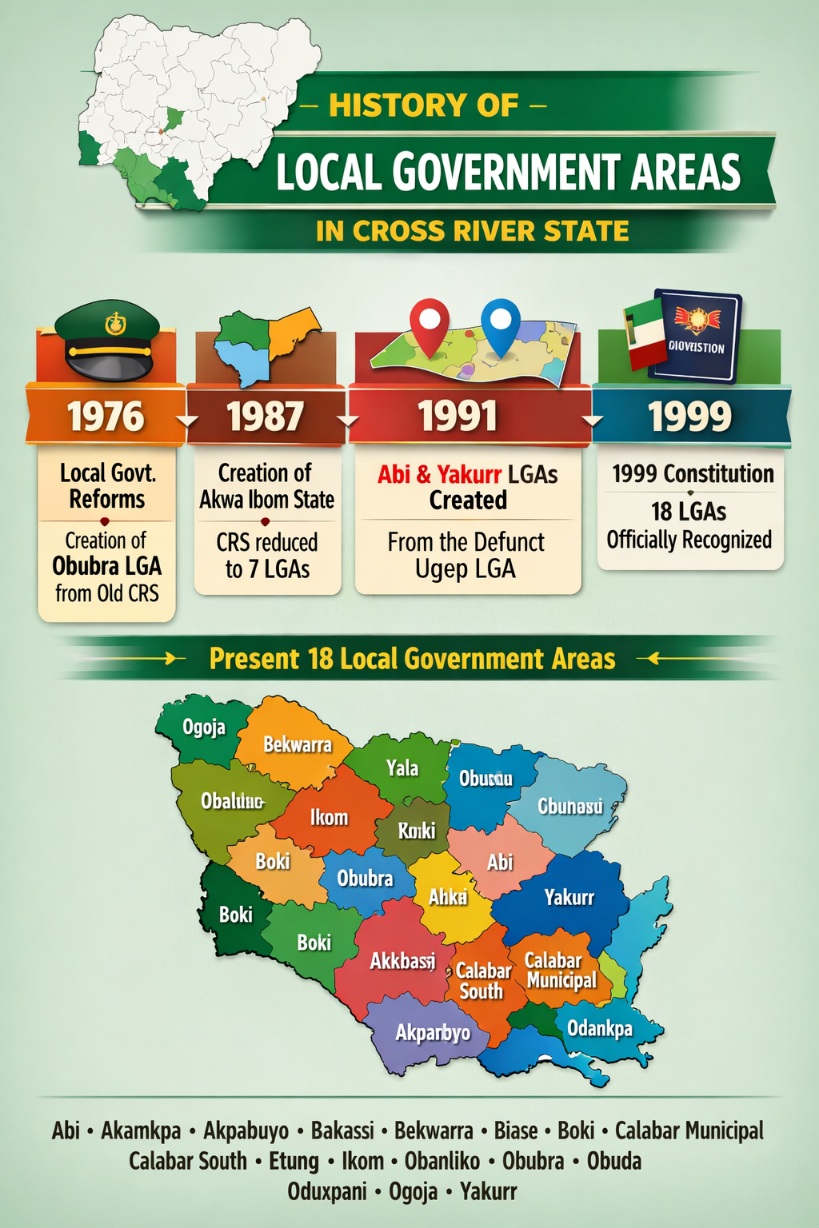
Abi and Yakurr LGAs were created on 26 September 1991. I participated actively in the events that led to the change of Ugep North and Ugep South LGAs, which were created from the defunct Ugep LGA. The defunct Ugep LGA itself was created from the old Obubra LGA, which came into existence in 1976 during the Local Government Reforms carried out by the military administration of General Olusegun Obasanjo. These LGAs were eventually included in the 1979 Constitution, which came into force on 1 October 1979.
Accordingly, under the old Cross River State, the LGAs included Calabar Municipality, Akamkpa, Odukpani, Abak, Ukanafun, Obubra, Obudu, Ogoja, Ikom, Ikot Ekpene, Oron, Itu, Eket, Ikono, Etinan, Uyo, and Ikot Abasi.

When Akwa Ibom State was created out of Cross River State in 1987, the following LGAs became part of Akwa Ibom: Uyo, Ikono, Ikot Ekpene, Oron, Ikot Abasi, Ukanafun, Etinan, Eket, and Itu. Cross River State was left with Calabar Municipality, Obubra, Akamkpa, Ogoja, Obudu, Odukpani, and Ikom.
It therefore became imperative to create new LGAs in the new Cross River State that arose from the ashes of the old one, and Ugep LGA was created out of Obubra. The first Sole Administrator appointed for the defunct Ugep LGA was Obol E.E. Ekanem, a civil servant. After him, Elder Bolaji Anani became Chairman, and during the 1989 transition program initiated by the military, Honourable Justice Ekapong Ubi Ofem was elected the first and only Chairman of Ugep LGA.
The life of Ugep LGA ended abruptly on 26 September 1991 when Ugep North (headquarters at Ugep) and Ugep South (headquarters at Idomi) were created. Within 48 hours, however, General Ibrahim Babangida’s administration reversed the decision and replaced them with Abi (headquarters at Itigidi) and Yakurr (headquarters at Ugep). This is how the present Abi and Yakurr LGAs were born.
The first elected Chairman of Yakurr was the late Barrister Inyang Arikpo. His tenure ended abruptly on 26 November 1993 when General Sani Abacha toppled the transitional government set up by General Babangida after the annulment of the 1993 presidential election won by Chief M.K.O. Abiola. Abacha dissolved both state and local governments. At the time, Chief Clement David Ebri was Governor of Cross River State, elected in January 1992 for a four-year tenure, but his administration was cut short by Abacha’s coup.
Other LGAs Created Alongside Abi and Yakurr:
– Bekwarra — Created from Ogoja
– Biase — Created from Akamkpa
– Obanliku — Created from Obudu
– Akpabuyo — Created from Odukpani
– Boki — Created from Ikom
– Etung — Created in 1996 out of Ikom
– Yala — Created from Ogoja
– Bakassi — Created in 1996 from the Akpabuyo/Odukpani axis due to Cameroon’s incursion into the Bakassi Peninsula. This dispute led to military skirmishes and eventually to the International Court of Justice ruling of 24 October 2002, which awarded sovereignty of parts of Bakassi to Cameroon.
Current Structure:
Today, Cross River State has 18 LGAs: Abi, Akamkpa, Akpabuyo, Bakassi, Bekwarra, Biase, Boki, Calabar Municipal, Calabar South, Etung, Ikom, Obanliku, Obubra, Obudu, Odukpani, Ogoja, Yakurr, and Yala.
- Conclusion:
The creation of the present 18 LGAs in Cross River State was shaped by reforms, military decrees, and political transitions. Understanding this history is essential to dispel myths and ensure that younger generations appreciate the true evolution of their state’s administrative structure.