By Otunba (Dr) Abdulfalil Abayomi Odunowo
Fellow Nigerians,
The President’s Independence Day address contains important truths about where Nigeria has come from and some encouraging evidence about where the economy may be heading. But at 66, Nigerians deserve something beyond celebration or condemnation. We deserve an honest distinction between economic stabilisation, economic recovery and economic prosperity. They are not the same thing.
Nigeria has made progress on some important macroeconomic indicators. Real GDP growth strengthened to around 4 per cent in 2025 (IMF estimates place it at 4.0 per cent, with projections near 4.1 per cent for 2026), after 3.4–4.1 per cent in 2024 following GDP rebasing. Inflation declined sharply from a peak near 34.8 per cent at end-2024 to the mid-teens by mid-to-late 2026 (around 15.4 per cent year-on-year in August 2026). Gross foreign reserves improved to the mid-to-high $40 billions by end-2025 and higher in 2026, with net reserves rising dramatically from roughly $4 billion at end-2023 to about $34.8 billion by end-2025. The foreign-exchange market is more stable than during the severe dislocations that followed the 2023 reforms. Government revenues have increased relative to earlier years, while non-oil exports reached a record $6.1 billion in 2025 (up about 11.5 per cent from 2024), driven by cocoa, urea, cashew and other products.
These achievements should be acknowledged irrespective of political affiliation. But Nigerians must equally understand what these numbers mean and what they do not mean.

THE ECONOMY MAY BE STABILISING, BUT MANY HOUSEHOLDS ARE NOT YET RECOVERING
The most important economic distinction Nigerians need to understand today is this:
Falling inflation does not mean falling prices.
It means prices are increasing at a slower rate.
A family whose food bill rose from ₦50,000 to ₦120,000 (or more) during the 2023–2024 inflation spike does not suddenly recover because the rate of increase has slowed. Unless wages and household incomes subsequently rise faster than remaining price levels, that family remains poorer in real purchasing-power terms.
This explains what may appear to be a contradiction. Government can truthfully say inflation is falling. Economists can truthfully say the economy is stabilising. And an ordinary Nigerian can truthfully say, “Life is still extremely difficult.”
All three statements can coexist. World Bank data illustrate the gap: poverty rose from 56 per cent in 2023 to 61 per cent in 2024 and 63 per cent in 2025 roughly 140 million people despite the later disinflation. Household incomes have not grown fast enough to offset the cumulative effects of earlier price shocks.
That is the economic reality we must confront.
THE PRESIDENT DID NOT CREATE NIGERIA’S STRUCTURAL PROBLEMS
It would be historically inaccurate to attribute Nigeria’s economic difficulties entirely to the present administration. For decades, Nigeria postponed difficult reforms while remaining heavily dependent on petroleum revenues, importing enormous quantities of refined petroleum products, struggling with unreliable electricity, maintaining inadequate transport infrastructure and failing to create enough productive employment for a rapidly expanding population.
Successive civilian and military governments contributed to these structural weaknesses. Nigeria’s problem did not begin in May 2023.
The petrol subsidy regime had become extremely expensive. NEITI and earlier official figures show cumulative spending of roughly ₦13.7 trillion (about $74 billion) on petrol subsidies between 2005 and 2020/21 alone, with peaks such as over ₦2 trillion in 2011. Multiple exchange-rate windows official, interbank, bureau de change, investors & exporters, and parallel markets had long created distortions and arbitrage opportunities; dual and multiple systems date back to the 1986 Structural Adjustment Programme and recurred in various forms through the 1990s, 2000s and 2010s. Government revenues remained low relative to development needs. Oil theft reduced public revenue. Deficit financing and monetary expansion contributed to inflationary pressures.
These problems were real. Therefore, reforms were necessary. But acknowledging that reforms were necessary does not mean every aspect of their implementation, sequencing or social protection should escape scrutiny.
THE MEDICINE ALSO HAS SIDE EFFECTS
The President compares Nigeria to a cancer patient who must endure painful treatment rather than continue taking morphine. It is a powerful analogy. But there is another part of medicine that should not be forgotten: the doctor must also ensure that the patient survives the treatment.
The removal of petrol subsidies and restructuring of the foreign-exchange market addressed genuine distortions. They also produced large consequences for transportation costs, food prices, imported inputs, manufacturing costs and household purchasing power. Inflation accelerated sharply after mid-2023, peaking near 35 per cent in late 2024 before the subsequent decline.
The relevant question therefore should no longer be whether reforms were necessary. The better questions are:
Were they properly sequenced?
Were vulnerable Nigerians sufficiently protected?
Did government itself reduce its cost of governance while citizens were being asked to sacrifice?
And now that government revenues have improved, how quickly will those additional resources become better electricity, healthcare, education, roads, security, transportation and employment?
Those are legitimate questions in a democracy.
“THE EMERGENCY IS OVER” MAY BE PREMATURE
The President declares: “The emergency treatment is over. The foundation has been repaired.”
This is where greater caution is required.
Macroeconomic stabilisation does not automatically mean that Nigeria’s social and economic emergency has ended.
Poverty remains widespread (63 per cent in 2025 by World Bank estimates). Food insecurity remains severe. Millions of households remain vulnerable to relatively small economic shocks. Youth employment and productive job creation remain major challenges. Food prices remain high relative to household incomes even after the recent slowdown in food inflation.
Electricity remains unreliable: installed capacity has hovered around 13,000–14,000 MW in recent years, yet average available or dispatched power has typically been in the 4,000–5,500 MW range, far below the needs of Africa’s largest economy by population. Insecurity continues to prevent some farmers from fully cultivating their land. Manufacturers continue to face high energy, financing and logistics costs.
These are not minor details. They determine whether GDP growth exists only in national statistics or becomes visible in Nigerian homes.
Therefore, the more defensible conclusion is:
Nigeria appears to have made meaningful progress in macroeconomic stabilisation, but the household welfare emergency is not yet over.
4 PER CENT GROWTH IS ENCOURAGING BUT NIGERIA NEEDS MORE
Growth above 4 per cent is welcome, especially after weaker earlier years and the disruptions of reform. But Nigeria is a rapidly growing country with millions of young people entering working age each year.
Our challenge is therefore not merely GDP growth. It is GDP growth per Nigerian, productivity growth and employment-intensive growth.
We should ask:
How many factories are opening?
How many sustainable jobs are being created?
How many small businesses are surviving?
How much agricultural output is increasing?
How much manufacturing capacity is being utilised?
How much are real wages improving?
How many Nigerians are leaving poverty?
Those indicators ultimately determine whether economic growth becomes economic development.
FOREIGN INVESTMENT ALSO REQUIRES CAREFUL INTERPRETATION
Nigeria has recently recorded substantial increases in foreign capital inflows. That is positive.
But Nigerians should distinguish between foreign portfolio investment and foreign direct investment. Portfolio investors may purchase Nigerian securities because interest rates and financial-market conditions are attractive. Foreign direct investment normally involves longer-term commitments to factories, infrastructure, technology, productive enterprises and employment.
Nigeria ultimately needs both, but particularly the second. The real test will be whether economic stability begins attracting large-scale, long-term investment into Nigerian production.
THE NEXT BATTLE MUST BE FOOD
No government can convincingly proclaim widespread prosperity while millions of citizens struggle to feed themselves.
Nigeria possesses enormous agricultural potential. But potential does not feed people.
Farmers need security. They need irrigation. They need mechanisation. They need affordable fertiliser and quality seeds. They need rural roads. They need storage. They need processing facilities. They need affordable finance. And they need reliable markets.
Nigeria’s food problem must therefore be treated not simply as an agricultural problem but as a national security, infrastructure and productivity challenge.
AND THEN THERE IS ELECTRICITY
After 66 years of independence, one question should trouble every Nigerian: How can one of Africa’s largest economies still be discussing reliable electricity as an aspiration?
Installed capacity has grown from roughly 2.5 GW in 1980 to about 14 GW in recent years, yet actual generation and delivery remain far lower and unreliable. Electricity sits underneath almost everything contained in the President’s economic vision.
You cannot industrialise without electricity.
You cannot competitively process agricultural products without electricity.
You cannot build globally competitive manufacturing while factories depend heavily on self-generated power.
You cannot create millions of productive digital and industrial jobs without abundant and reliable energy.
Solving Nigeria’s electricity problem must therefore become one of the clearest measurements of economic transformation.
GOVERNMENT REVENUE HAS IMPROVED. NOW NIGERIANS SHOULD DEMAND RESULTS.
One of the greatest opportunities created by the reforms is increased public revenue. That should change the national conversation.
The question should no longer merely be:
How much revenue did government collect?
It should increasingly become:
What did Nigerians receive for that revenue?
How many kilometres of roads?
How many functioning primary healthcare centres?
How many schools?
How many megawatts of reliable electricity?
How much irrigation?
How many agricultural storage facilities?
How many kilometres of railway?
How many jobs?
How much reduction in poverty?
How much improvement in security?
Revenue is an input. Human development is the outcome.
THIS IS BIGGER THAN PRESIDENT TINUBU
Nigeria’s difficulties did not begin three years ago. And Nigeria’s future cannot be reduced to one President, one political party or one election.
For 66 years, Nigeria has possessed almost everything required to become one of the world’s important economies: oil, gas, agricultural land, solid minerals, a vast domestic market, Atlantic access, an extraordinary diaspora, entrepreneurial people, and one of the youngest populations in the world.
Yet electricity remains inadequate. Millions remain poor. Healthcare remains insufficient. Education outcomes remain troubling. Infrastructure deficits remain enormous. And insecurity continues to consume lives and economic opportunities.
That is a collective national failure accumulated across generations and administrations. But history cannot become an excuse for today’s government either.
Every government inherits problems. Every government must ultimately be judged by what it does with what it inherited.
THE REAL TEST BEGINS NOW
If macroeconomic stabilisation has genuinely been achieved, then the next phase must be much harder to fake.
Nigerians should begin seeing the results in their lives. Inflation must continue falling. Food must become more affordable relative to incomes. Real wages must recover. Electricity must improve. Agricultural production must increase. Manufacturing must expand. Businesses must obtain affordable credit. Security must improve. And millions of productive jobs must be created.
Only when those things begin happening consistently can macroeconomic recovery become human recovery.
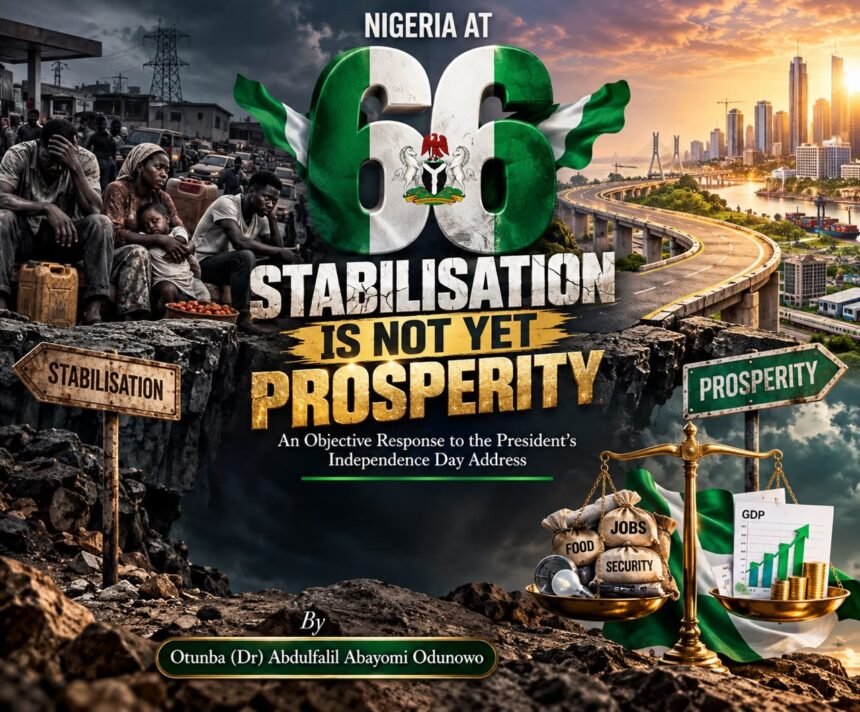
STABILISATION IS NOT PROSPERITY
Therefore, on Nigeria’s 66th Independence anniversary, neither pessimism nor triumphalism adequately describes our situation.
There are genuine signs of macroeconomic improvement. They should not be denied simply because one opposes the government. But there remains profound hardship among ordinary Nigerians. That should not be dismissed simply because some economic indicators have improved.
The President says: “Now begins the age of prosperity.”
Perhaps the more realistic statement for Nigeria today is:
Now must begin the difficult work of converting stabilisation into prosperity.
Because prosperity is not an inflation chart.
Prosperity is not foreign reserves.
Prosperity is not GDP alone.
Prosperity is when a worker’s salary can again feed his family.
Prosperity is when farmers can safely cultivate their land.
Prosperity is when businesses can produce without generating most of their own electricity.
Prosperity is when young Nigerians can find productive work without believing migration is their only future.
Prosperity is when illness does not destroy a family’s finances.
Prosperity is when children receive quality education regardless of the circumstances of their birth.
Prosperity is when economic growth becomes something Nigerians can experience rather than merely something economists can measure.
At 66, Nigeria has heard enough promises from successive governments. The country now requires measurable outcomes.
If the reforms have repaired the foundations, Nigerians should increasingly see what is being built upon them.
If government revenues have increased, Nigerians should see the infrastructure.
If investment is returning, Nigerians should see the factories and jobs.
If agriculture is improving, Nigerians should eventually feel it in food prices.
If the economy is recovering, Nigerian families should eventually feel it in their purchasing power.
That should be our national measurement.
Not propaganda.
Not opposition rhetoric.
Not political affiliation.
Results.
Nigeria may indeed have changed economic direction. But the destination cannot yet be declared reached.
The next chapter must therefore be about transforming improved macroeconomic statistics into improved Nigerian lives.
Only then will we be able to say, with evidence rather than hope, that Nigeria’s age of broadly shared prosperity has truly begun.
This version deliberately incorporates documented historical costs (subsidies, multiple FX regimes), recent official and multilateral data (growth, inflation path, reserves, non-oil exports, poverty trends, power capacity versus delivery), and the structural continuity of challenges across administrations, while preserving the original non-partisan framing that acknowledges measurable gains without overstating their translation into household welfare.
Signed by
Otunba (Dr) Abdulfalil Abayomi Odunowo
National Chairman AATSG
ASIWAJU Ahmed Tinubu Support Group