
By: Okoi Obono-Obla
1.0 INTRODUCTION
My attention has been drawn to the Legal Opinion authored by Fun-ororo Narebor, Esq., titled “Legal Opinion on the Purported Extension of the Tenure of the Governor of Rivers State Beyond May 29, 2027 Following the 2025 State of Emergency.”
Mr. Narebor correctly concludes that Governor Siminalayi Fubara’s tenure ends on May 29, 2027. However, his intermediate analysis that the suspension is unconstitutional because Section 305 does not provide for it, and that the Governor could nevertheless obtain a court order to extend his tenure to November 29, 2027 by relying on Peter Obi v INEC, is with respect, fundamentally flawed.

2.0 FACTS AS STATED BY NAREBOR
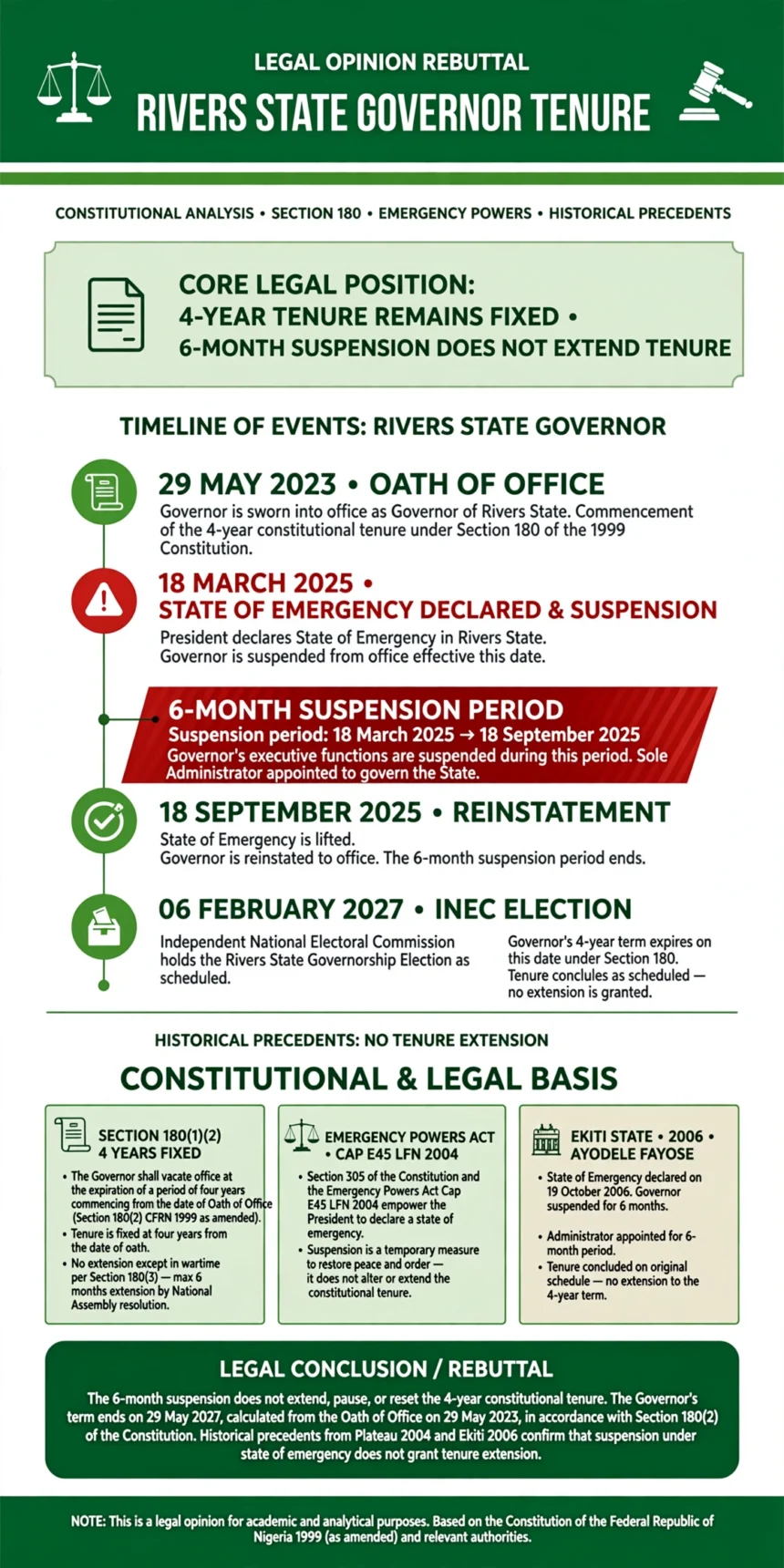
We adopt his facts: Governor sworn May 29, 2023; State of Emergency declared March 18, 2025; Governor suspended; Vice Admiral Ibok-Ete Ibas appointed as Sole Administrator; reinstated September 18, 2025; INEC fixed next Governorship election for February 6, 2027.[Rtd]
3.0 THE CENTRAL FALLACY: SECTION 305 DOES NOT OPERATE IN A VACUUM
Mr. Narebor states:
“Section 305 of the Constitution… It does NOT provide for suspension or removal of an elected Governor.”
That is a narrow reading. Section 305 is not self-executing. Section 305(2), (3) and (6) expressly empowers the President to make Regulations and contemplates an Act of the National Assembly to give effect to emergency powers.
That Act exists. It is the Emergency Powers Act, Cap E45, Laws of the Federation of Nigeria, 2004, originally enacted as Emergency Powers Act, 1961.
Section 3(1) of the Act provides:
“The President may make regulations as appear to him to be necessary or expedient for securing the public safety; the defence of Nigeria; the maintenance of public order and the suppression of mutiny, rebellion and riot; and for maintaining supplies and services essential to the life of the community.”
Section 3(1)(e) and (f) allows regulations:
“(e) for suspending the operation of any law;
(f) for suspending any executive or legislative authority…”
Pursuant to this Act, the President made the State of Emergency (Rivers State) Proclamation, 2025 and the Emergency Powers (General) Regulations, 2025, which provide for suspension of the Governor, Deputy Governor and House of Assembly and appointment of an Administrator.
Both instruments were approved by Resolutions of the Senate and House of Representatives as required by Section 305(6)(b) of the Constitution.
Therefore, until the Federal High Court or Supreme Court declares the Emergency Powers Act inconsistent with Section 1(3) of the Constitution and therefore void, the President’s power to suspend flows from Section 305 read together with the Act. Mr. Narebor’s assertion that there is no power to suspend ignores the enabling Act.
4.0 HISTORICAL PRECEDENT DOES NOT SUPPORT TENURE EXTENSION
Mr. Narebor overlooks settled history. Full emergency with suspension and appointment of Sole Administrator has been imposed three times since 1999:
a) Plateau State – May 18, 2004: Governor Joshua Dariye suspended, Maj. Gen. Chris Alli appointed Administrator.
b) Ekiti State – October 19, 2006: Governor Ayo Fayose suspended, Brig. Gen. Tunji Olurin appointed Administrator.
c) Rivers State – March 18, 2025: Governor Siminalayi Fubara suspended, Vice Admiral Ibok-Ete Ibas appointed Administrator.[Rtd]
In 2013, President Goodluck Jonathan declared emergency in Borno, Yobe and Adamawa States, but deliberately did not suspend any Governor or House of Assembly. That distinction is important.
In none of the suspension precedents – Plateau 2004 and Ekiti 2006 – was tenure extended. Governor Dariye was reinstated in November 2006 and left office on May 29, 2007. He did not claim six extra months. Governor Fayose did not. That is the constitutional convention.
If Mr. Narebor’s logic were correct, Dariye would have stayed till November 2007.
5.0 PETER OBI V INEC HAS NO APPLICATION TO RIVERS STATE
This is the most serious misapplication in Mr. Narebor’s Opinion.
Peter Obi v INEC (2007) 11 NWLR Pt 1046 436 SC was not an impeachment case. It was an election petition case. Chris Ngige was sworn on May 29, 2003. Peter Obi challenged that election. The Court of Appeal held Ngige was not duly elected. Obi was declared winner and took oath on March 17, 2006.
The Supreme Court held that his four-year tenure under Section 180 must be computed from March 17, 2006 when he took oath as the rightful winner, not from May 29, 2003 when the usurper took oath.
That same principle produced staggered elections in Oni v Fayemi, Aregbesola v Oyinlola, Oshiomhole v Osunbor, Mimiko v Agagu, and Sylva v Dickson. In all those cases, the clock started at the second, valid oath after the court declared the petitioner duly elected.[Ekiti][Osun][Edo][Ondo][Bayelsa]
That is to meet the justice of the matter in election litigation.
Governor Fubara’s case is not an election petition. He was duly elected. He took only one oath on May 29, 2023. His election was never nullified. There is no second oath to trigger a fresh computation. You cannot import Peter Obi to add six months to a mid-tenure suspension.
The other case Mr. Narebor cites, Ladoja v INEC, is an impeachment case under Section 188. Governor Ladoja of Oyo State was impeached without compliance with Section 188 and the Supreme Court declared it a nullity. That is not emergency suspension under Section 305 + Emergency Powers Act ratified by the National Assembly.
6.0 SECTION 180 IS COMPUTABLE, NOT COMPENSABLE
Section 180(1) & (2) says a Governor holds office for four years from the date he took the oath. It does not say four years of effective occupation of Government House.
Section 180 lists the only ways to vacate office: death, resignation, impeachment, permanent incapacity. Suspension is not listed as a ground to pause the clock.
To grant an order that tenure ends November 29, 2027 would be for a Federal High Court to amend Section 180 by judicial fiat, contrary to Section 9 procedure for constitutional amendment. The Supreme Court warned in Marwa v Nyako (2012) 6 NWLR Pt 1296 199 that tenure is sacrosanct and cannot be elongated or abridged.
If a court could add six months for Rivers, it must add six months for Plateau and Ekiti, destroying the uniformity of the electoral calendar under Section 178.
Even if the suspension is later held unconstitutional, the remedy is a declaration of unconstitutionality, not elongation. The Governor who acquiesced, handed over, and benefited from reinstatement under the same Proclamation cannot approbate and reprobate.
7.0 CONCLUSION
I agree with Mr. Narebor’s final destination but not his route:
i) Governor Fubara’s tenure expires on May 29, 2027. INEC’s election date of February 6, 2027 complies with Section 178(2) of the Constitution which requires election not earlier than 150 days and not later than 30 days to expiration.
ii) The suspension from March 18 to September 18, 2025 was done pursuant to Section 305 of the Constitution, the Emergency Powers Act, Cap E45 LFN 2004, and the Emergency Regulations, 2025 duly approved by the National Assembly. It enjoys presumption of constitutionality.
iii) The November 29, 2027 claim is legally untenable, with or without a court order. Peter Obi v INEC cannot be stretched to cover emergency suspension, and Plateau and Ekiti precedents confirm that tenure is not extended for emergency period.
Any attempt to remain beyond May 29, 2027 will be unconstitutional and an usurpation contrary to Section 1(2) of the Constitution.
@ Obono-Obla is a Legal Practitioner and former Special Adviser to the President.