By Okoi Obono-Obla
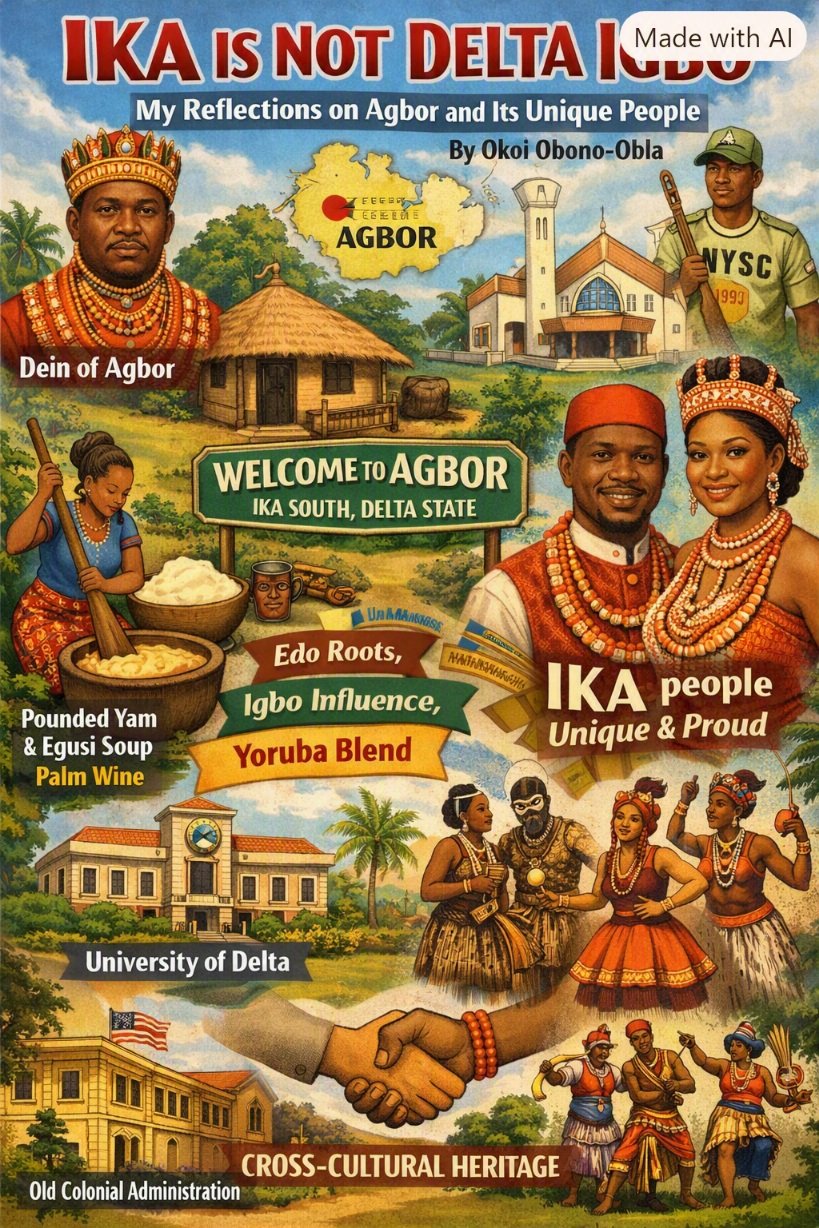
I read the Facebook post on the Edo Culture page in which the writer loudly and proudly wrote thus: “We, the Ika people; Abavo, Agbor, Akumazi, Idumuesah, Igbodo, Mbiri, Otolokpo, Owa, Umunede, Ute-Ogbeje, Ute-Okpu, are not Delta Igbo.”
I am from Cross River State, but I have a great friend from Agbor who lives in the United States of America. He is a great guy — kind, very generous and considerate.
In 2024, I visited him when he came to Nigeria at his family home in Agbor, and I enjoyed myself very well. His sisters prepared pounded yam and egusi soup, which he served us with fresh palm wine. Even when I visited him in the USA, his sisters there were always very kind and nice each time he took me to visit them.
During that visit to Agbor, I wrote on my Facebook page thus:
Agbor is the most populous city among the Ika people, with approximately 224,000 people. It is located in Ika South Local Government Area of Delta State, in the South-South geo-political zone of Nigeria, West Africa. Agbor is the headquarters of Ika South Local Government Area. It is home to the University of Delta, previously known as the College of Education. The upgrade of the institution to a university in 2021 has led to Agbor being classified as a college town.
I observed that the Ika language sounds like a dialect of Bini or Edo, but sometimes it also sounds like a dialect of Igbo. Culturally, however, the people are more Edo in outlook. They are very civilized and unique people and must retain their peculiar identity.
By the way, one of my brothers, Engr. Pastor Thompson, is married to an Agbor woman. She is a kind, generous and virtuous woman who is always caring and considerate and goes out of her way to weld the family into one indivisible unit. I also believe the Ika people deserve their unique identity.
Agbor has grown exponentially and today it is one of the biggest cities in Nigeria. I remember that in September 1990, I was posted to Agbor for my National Youth Service Corps (NYSC) after my orientation camp in Pantami. It was then Bendel State, comprising the present Delta and Edo States, which evolved from the old Mid-Western Region created by an Act of Parliament in 1964. But Agbor was then so rural in outlook and rustic, and I didn’t like it, so I went to Benin City to put pressure on NYSC officials to change my primary assignment from Agbor to Benin City.
But in 2024, when I visited Agbor again with my friend, Architect Philip Njowusi, Agbor had grown exponentially into an urban city with very lovely neighbourhoods and paved streets.
Agbor is a kingdom with a rich history. The monarch is His Royal Majesty, Dein Keagborekuzi I, born Benjamin Keagborekuzi Ikenchuku Gbenoba on 29th June, 1977. He is the Dein of Agbor Kingdom, a Nigerian traditional state in Delta State. He was named the world’s youngest crowned monarch in the 1980 edition of the Guinness Book of World Records, and he is the highest-ranking traditional ruler in the whole of Delta State at both state and federal levels, and the second highest-ranking monarch in the entire South-South region of Nigeria. He was the Chancellor of the University of Ilorin from 2006 to 2015. He is well educated and intellectually sound. The dynasty of the Dein of Agbor started in about 1270 AD and has lasted till today.
My friend, Architect Philip Njowusi, a United States-based architect and businessman who is incidentally from Agbor, designed the Palace of the Dein of Agbor and the Roman Catholic Cathedral built and donated by the distinguished banker Jim Ovia. He took me to the Palace and the Church, and I was very impressed with these architectural masterpieces.
The Ika people are simply a reflection and embodiment of the mosaic complexity of Nigeria, where sometimes cultures or people are wrongly identified, categorized or misrepresented with wrong labels or tags. The problem started with the advent of colonialism, when European ethnographers and colonial administrators wrongly labeled some groups or created new groups or even tribes which were unknown to our people before colonialism, and there was no effort after independence to decolonize much of what the colonialists left behind.
The Ika people are a cross and blend of the Yoruba, Benin and Igbo, resulting in an amazing tapestry.