By Okoi Obono-Obla
The analysis of the percentage of candidates fielded by the APC, PDP, NDC and APM for the National Assembly elections is crucial for projecting the likely outcome of the presidential election holding on the same day. This scenario logically helps us to determine which party is the strongest and most likely to win the presidential election, moreover in a country with a history of contentious presidential outcomes often followed by allegations of rigging.
Following the release of the final list of candidates by the Independent National Electoral Commission (INEC) for the January 16, 2027 elections, a total of 4,878 candidates will be on the ballot. Eighteen will contest for the presidency, while 4,860 will battle for 109 Senatorial and 360 House of Representatives seats.
The breakdown of nominations by leading parties is as follows:
| Party | Senate (109 seats) | % Coverage
| House of Reps (360 seats) | % Coverage |
Total NASS (469 seats) | Overall % Coverage |
| APC | 109 | 100% | 360 | 100% | 469 | 100% |
| NDC | 103 | 94.5% | 327 | 90.8% | 430 | 91.7% |
| PDP | 103 | 94.5% | 302 | 83.9% | 405 | 86.3% |
| APM | 103 | 94.5% | 232 | 64.4% | 335 | 71.4% |
| ADC | 107 | 98.2% | 220 | 61.1% | 327 | 69.7% |
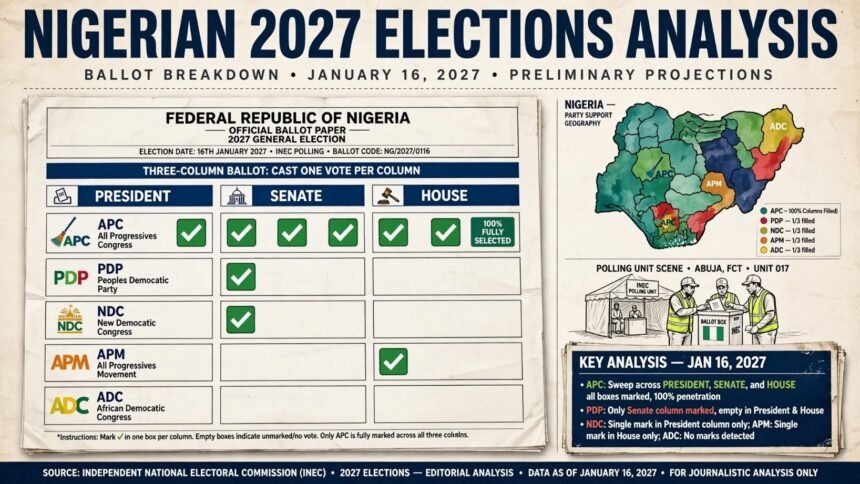
The ruling All Progressives Congress (APC) is the only party fielding candidates for all 469 positions, a move observers have described as a declaration of intent.
The data reveals a clear hierarchy of national spread. While most parties achieved over 94% coverage in the Senate race, the House of Representatives contest, which requires greater grassroots structure, exposed their weaknesses. The NDC emerges as the most spread opposition party with 91.7% coverage, followed by the PDP with 86.3%. The APM and ADC have significant gaps, missing candidates in over 35% and 38% of federal constituencies respectively.
Implications for the Presidential Election
Since the presidential and National Assembly elections will hold simultaneously, the strength of National Assembly nominations will directly impact the presidential outcome through three factors:
1. Voter Mobilization and Polling Unit Machinery: National Assembly candidates provide the critical ground structure – funding agents and mobilizing voters. The APC’s 100% presence means its presidential candidate has a campaign army in every constituency. Parties with gaps have no local structure to drive presidential votes in those areas.
2. Ballot Visibility and Voter Psychology: A voter who does not see his party’s National Assembly candidate on the ballot is less motivated to vote for its presidential candidate. In the 140 constituencies where the ADC has no House candidate, its presidential candidate suffers from ballot absence.
3. Protection of Votes: In Nigeria’s contentious electoral history, where presidential results are often disputed with allegations of rigging, having party agents in all polling units is crucial for vote protection. Only full national coverage guarantees this.
CONCLUSION
Based purely on nomination strength and electoral logistics, the APC is currently the strongest party and the most likely to win the January 16, 2027 presidential election. Its 100% coverage ensures national visibility, full mobilization, and vote protection.
The NDC, with 91.7% coverage, has positioned itself as the leading opposition in terms of national spread, ahead of the PDP. The presidential contest will likely be between these three, but the ADC and APM, with coverage below 72%, appear to be regional players who may only play a spoiler role by splitting opposition votes.
In same-day elections, you cannot win the presidency without winning the grassroots.