

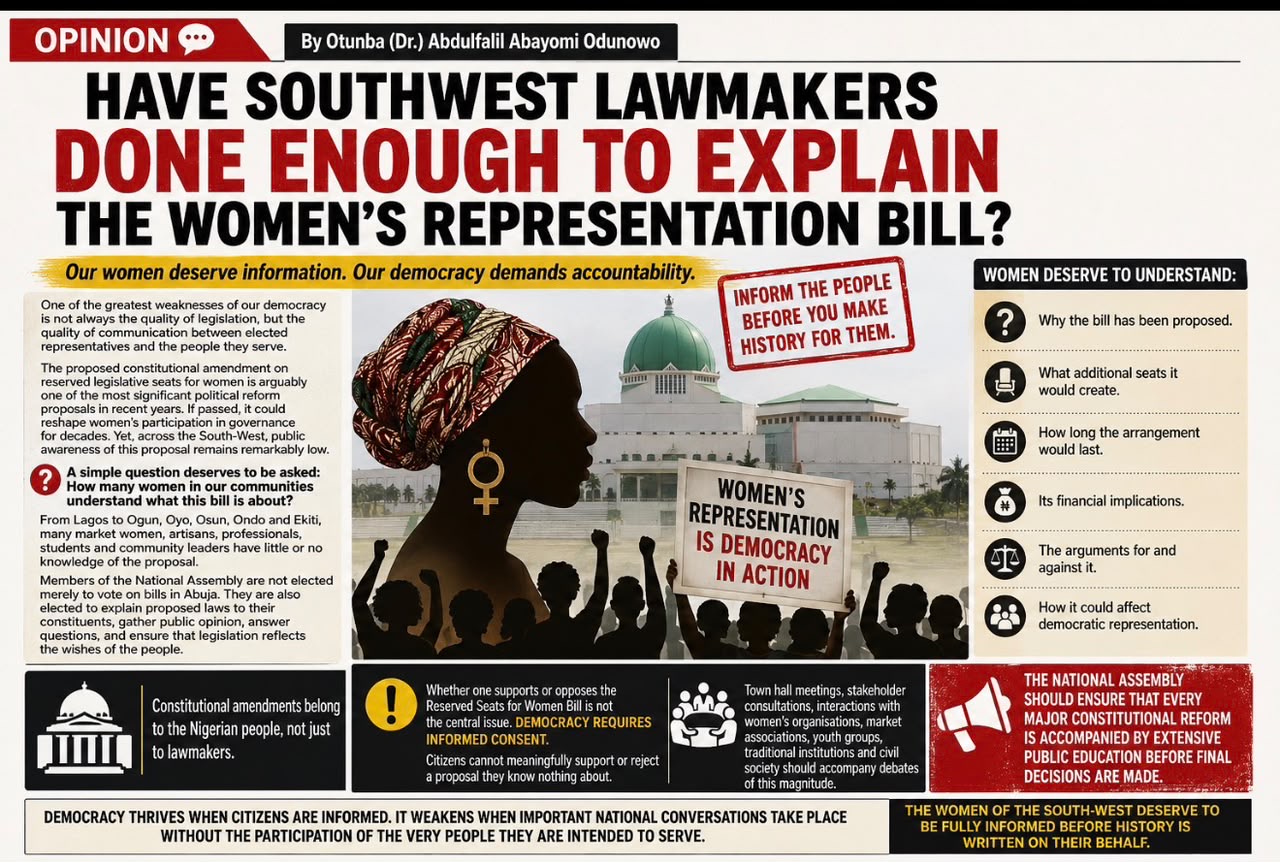
By Otunba (Dr.) Abdulfalil Abayomi Odunowo
One of the biggest weaknesses in our democracy isn’t always the quality of legislation, but the quality of communication between elected representatives and the people they serve.
The proposed constitutional amendment on reserved legislative seats for women (HB 1349 / SB 440) stands as one of the most consequential political reform proposals in Nigeria’s Fourth Republic. It would create additional seats 74 in the National Assembly (37 each in the Senate and House of Representatives) and three per state House of Assembly as a temporary 16-year corrective step to strengthen women’s participation without displacing existing seats.
Yet across the South-West, public awareness remains strikingly low.

A simple question needs asking: How many women in our communities truly understand what this bill is about?
From Lagos to Ogun, Oyo, Osun, Ondo, and Ekiti, many market women, artisans, professionals, students, and community leaders know little or nothing about the proposal. Many haven’t heard its objectives, potential benefits, financial implications, duration, or even the concerns raised by its critics.
That communication gap should worry every elected representative.
Historical Context: A Persistent Deficit That Demands Action
Since the return to democracy in 1999, women’s representation in Nigeria’s National Assembly has stayed painfully low, never rising beyond single digits in percentage terms, even though women make up nearly half the population.
• In the Senate (109 seats): Representation began at just 3 women (2.8%) in 1999–2003, peaked at 9 women (8.3%) in 2007–2011, and has lingered around 6–7% in recent assemblies. In the current 10th Assembly, it stands at roughly 4 women out of 109 (about 3.7%).
• In the House of Representatives (360 seats): It climbed to a high of 25–26 women (around 7%) in 2007, but has generally remained between 3–7%. Recent figures show around 16–17 women (4.7%).
Overall, only about 157 women have been elected to the National Assembly over more than two decades, compared to thousands of men. Nigeria sits near the bottom globally and in Africa for women’s legislative representation.
The South-West, often seen as a beacon of progressive politics and education, hasn’t escaped this national pattern. While it has at times posted relatively higher proportions in some cycles, the actual numbers remain modest, pointing to structural barriers — including patriarchal gatekeeping, the monetization of politics, and limited access — that the reserved seats proposal is meant to confront.
Members of the National Assembly are not elected simply to vote on bills in Abuja. They are also elected to explain proposed laws to their constituents, gather public opinion, answer questions, and make sure legislation reflects the wishes of the people.
Whether one supports or opposes the Reserved Seats for Women Bill isn’t really the central issue. Democracy depends on informed consent. Citizens can’t meaningfully support or reject a proposal they know almost nothing about, especially one that could reshape governance for a generation.
The South-West has long taken pride in political awareness, civic engagement, and progressive leadership. That tradition ought to show in how lawmakers engage the public on major constitutional amendments. Town hall meetings, stakeholder consultations with women’s organisations, market associations, youth groups, traditional institutions, and civil society should go hand in hand with debates of this scale.
If these engagements have happened, they haven’t reached enough people. If they haven’t happened, they should start now.
Women deserve more than being told that a bill exists. They deserve to understand:
• Why the bill has been proposed (to correct decades of under-representation).
• What additional seats it would create and how they would be allocated.
• How long the arrangement would last (proposed 16-year sunset/review clause).
• Its financial implications for the federation.
• The arguments for and against it.
• How it could affect democratic representation and broader governance.
Only after receiving this information can women, and the wider public, make an informed judgment.
This is not an attack on any individual legislator or political party. It is a call for greater accountability and deeper public engagement. Constitutional amendments belong to the Nigerian people, not only to lawmakers in Abuja.
The National Assembly should ensure that every major constitutional reform is matched with extensive public education before final decisions are made.
Democracy thrives when citizens are informed. It weakens when important national conversations unfold without the participation of the very people they are meant to serve.
The women of the South-West and indeed all Nigerians deserve to be fully informed before history is written on their behalf.
Signed
Otunba (Dr) Abduldalil Abayomi Odunowo
National President SCN
SpeakUp Collective Nigeria
Sunday 19th July 2026.