By Okoi Obono-Obla
Even if we assume, without conceding, that Ikwerre is a dialect of Igbo or that Ikwerre people bear Igbo names, that does not make the Ikwerre genetically Igbo.
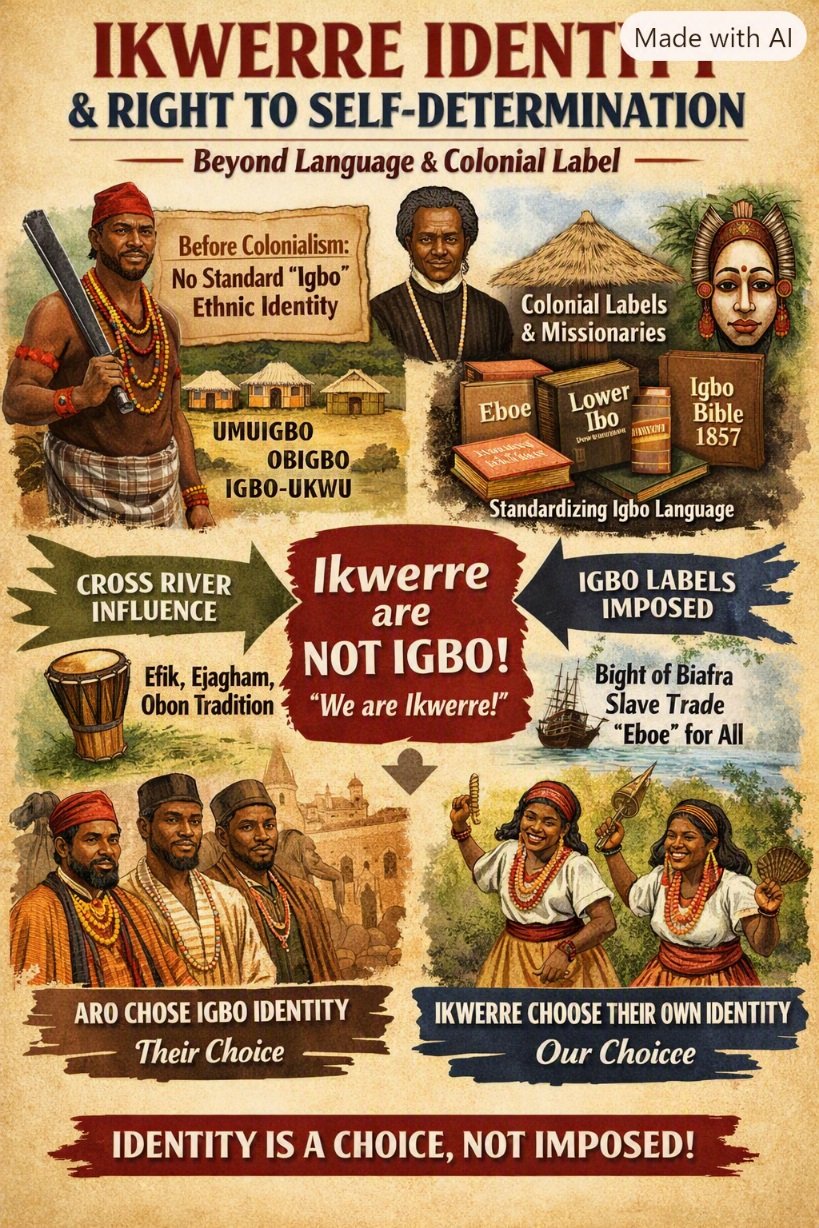
We must remember that 200 years ago, before colonialism, there was no ethnic nationality officially documented as “Igbo” in its modern political sense. The name “Igbo” itself has a debated origin and was recorded in various spellings — Eboe, Ibo, Igbo — as early as the 18th century. Place names like Umuigbo, Obigbo and Igbo-Ukwu also predate European contact. What did not exist then was the standardized, pan-Igbo identity we know today.
That standardization was largely the work of missionary linguists. Bishop Samuel Ajayi Crowther, an Oyo man — whom the Hausa called Yoruba or Yariba — did not invent the Igbo language. Igbo existed as a spoken language cluster centuries before him. What Crowther did, assisted by a young Igbo interpreter named Simon Jonas, was produce the first written materials in Igbo after the British Niger Expeditions of 1854 and 1857, including Isoama-Ibo: A Primer in 1857 and Vocabulary of the Ibo Language in 1882. The more comprehensive standardization came later, between 1900 and 1929, through the Church Missionary Society’s Union Igbo project, which blended dialects such as Onitsha, Owerri, Arochukwu, Unwana and Bonny to translate the Igbo Bible.

Even today, some dialects among Igbo people remain mutually unintelligible, which underscores that Igbo is a language cluster rather than a single uniform tongue.
The complexity of this identity is best illustrated by the Aro. The Aro identify as Igbo today, yet historically they are an amalgam of many groups from the Cross River Basin — Igbo, Ibibio, Ekoi/Ejagham and others — who came together to form the Aro Confederacy. Their dialect and institutions, such as the Ibini Ukpabi oracle, reflect that mixed heritage of Efik, Ibibio, Ejagham and Igbo influences. If a group with such mixed origins can choose to identify as Igbo, then others with similar cultural overlaps must also be allowed to choose differently.
The Ikwerre people have consistently identified as non-Igbo, and we must allow them. It is their fundamental right to identify as Ikwerre or Igbo.
The conundrum of identity in Nigeria is not peculiar to the Ikwerre; it is explained by the complexity of Nigeria. In Calabar, for instance, there are three distinct groups — Qua Ejagham, Efik and Efut — but those unfamiliar with the ethnography of the region tend to call everybody from the area Calabar or Efik.
The same external labeling explains the Igbo question. Northerners historically called everybody from the old Eastern Nigeria Ibo or Igbo. When the colonialists came to the coastal region of the Niger Delta, they called those they met there Lower Ibo, and later when they made incursions into the interior, they called the inhabitants Upper Ibo. This colonial labeling is how groups like the Ikwerre were wrongly classified as Igbo or Ibo.
This confusion is rooted in the geography of the slave trade itself. The Bight of Biafra — now renamed the Bight of Bonny — encompasses the coastline from present-day Bayelsa, Rivers, Akwa Ibom and Cross River States in Nigeria to Cameroon, Equatorial Guinea and Gabon. While its immediate coastal fringe is predominantly inhabited by Ijaw, Ogoni, Ibibio-Efik and other groups, its vast hinterland is predominantly Igbo, and historically the Bight was the principal port for shipping Igbo captives. Europeans, however, used the term “Eboe” loosely for anyone shipped from its ports, whether they were truly Igbo or not. That is why even people from Benin or Essako could be documented as Eboe.
You will recall the Olaudah Equiano story, often cited in this debate. He was captured as a lad and taken to America, and in his 1789 autobiography said he was Eboe from Essaka. While some have sought to locate Essaka in present-day Edo State, mainstream historical scholarship identifies Essaka as an Igbo community in what is now southeastern Nigeria, which at the time was nominally under the influence of the Kingdom of Benin.
Ultimately, the fundamental right to self-determination inures in favour of the Ikwerre people to identify themselves as Ikwerre and not Igbo, and we should allow them to be. The Ikwerre also practice aspects of Cross River tradition, such as Obon. Can Cross River people also lay claim to them because they share those cultural traits?
Identity cannot be imposed.
Conclusion
The labels — Eboe, Lower Ibo, Upper Ibo, and even Bight of Biafra — were external conveniences created by traders and colonialists. They were never a scientific ethnography. The fact that a group shares names, borders, or cultural traits does not extinguish its right to define itself. The Aro experience shows that identity can be mixed in origin yet unitary in choice. If we respect the Aro when they say they are Igbo, we must also respect the Ikwerre when they say they are Ikwerre.