By Okoi Obono-Obla
Human beings are at once biological and social creatures. Wherever people of diverse cultures, traditions and languages have found themselves sharing a common geographical space, a profound social process begins. Proximity compels interaction, interaction breeds relationships, and relationships, over time, forge a new and shared identity.
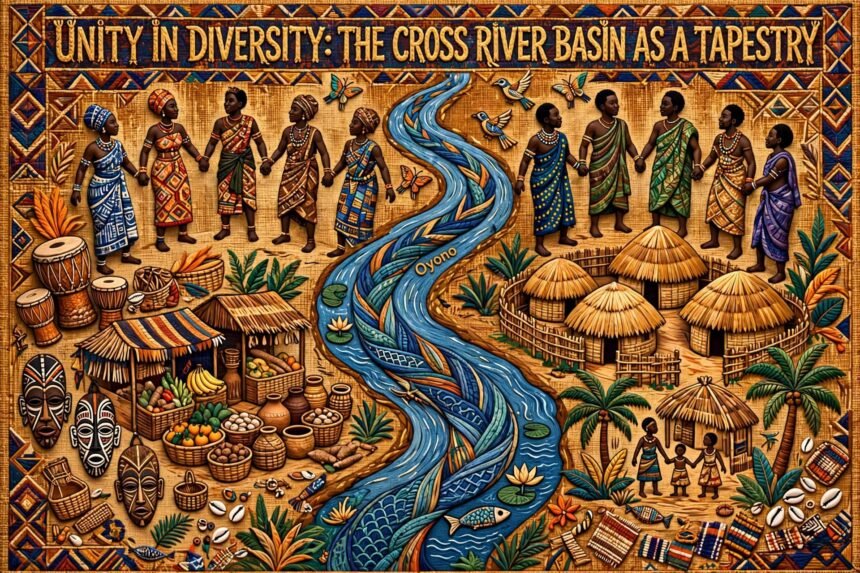
The Cross River Basin is a powerful illustration of this principle.
When I wrote that the traditional name of the Cross River is Oyono or Oyongha, before colonial cartographers renamed it Cross River, our brothers from Akwa Ibom State joined the debate and advanced the narrative that Oyono is an Ibibio word meaning “meandering.” The debate itself reveals a deeper truth: all the cultures, traditions and peoples in the Cross River Basin are interwoven and share so much linguistically and culturally that it is often impossible to assign a single origin to what is truly collective heritage.

It is this very tapestry that makes the region one of the richest in terms of culture and history. It is a tapestry our leaders should use as an anchor to unite our people, rather than as a tool to divide them for selfishness and the craze to acquire power for self-glorification and personal interest.
How is such a tapestry woven? Through three enduring bridges.
The first and most intimate bridge is intermarriage. When families from different ethnic or linguistic backgrounds unite through marriage, they do more than create a new household. They create kinship networks that cut across old divides. This has been the story of the Cross River Basin for centuries. There was extensive acculturation, blending and intermarriage among peoples within the basin in Nigeria and extending to Cameroon, the Democratic Republic of Congo, Equatorial Guinea and Gabon. Children of such unions become living embodiments of two or more cultures, carrying names, bloodlines and stories from both sides.
The second bridge is language. No language lives in isolation. When neighbours trade in the market, farm side by side, or worship in the same town square, they inevitably borrow words from each other. A word for a new crop, a new tool, or a new idea is adopted because it is useful. Over generations, these loanwords become so embedded that speakers forget their foreign origin.
For example, the Lokaa language, spoken in Yakurr and Abi Local Government Areas of Cross River State, contains a rich mix of Efik, Ejagham, Akunakuna, Bahumono and Akpa words blended together to produce a language which may be mutually unintelligible to speakers of those parent groups. This linguistic borrowing is not a sign of weakness, but of pragmatism and creativity. In many cases, entirely new dialects emerge, serving as a lingua franca for all.
The third and deepest bridge is the blending of culture itself. Customs, cuisine, music, dress, festivals and worldviews begin to mix. A community may adopt a neighbour’s method of preparing food while retaining its own method of celebrating a harvest. This process, which anthropologists call acculturation or syncretism, does not happen overnight. It is gradual, often unconscious, and driven by daily life.
Consider the Bahumono nationality, consisting of eight communities – Ebijakara (Ebriba), Ebom, Ediba, Usumutong, Anong, Igonigoni, Afafanyi, and Abeugo. They were once part of the Aro Confederacy, a confederation of almost all the groups in the Cross River Basin from the 16th to 17th centuries before colonialism. Today they are closely related to the Efik, Waawa, Yakurr, Akunakuna, Ekoi and Annang peoples. Indeed, the Annang people of Akwa Ibom, the homeland of Senate President Godswill Akpabio, are closely related to the Bahumono.
This shared ancestry makes recent political taunts – such as the claim that the accommodating nature of the Odukpani people of Cross River State allows people from Ikot Ekpene in Akwa Ibom to be appointed as village heads – miss the historical point. What some see as accommodation is in fact kinship. With over 250 ethnic groups and more than 500 languages, Nigeria’s history is a long story of this borrowing, intermarriage and cultural fusion.
Crucially, this blending does not necessarily mean the erasure of the old. This is the most remarkable part of the process. Groups can forge a new, overarching identity – as members of the same basin, the same state, or the same nation – while still retaining their individual and group identities. A person can be proudly Efik and proudly Cross Riverian; proudly Annang and proudly Nigerian. The new identity is composite, not substitutive.
This is what makes true harmony possible. Harmony is not sameness. It is not achieved when everyone abandons their culture to adopt another. It is achieved when different groups strike an understanding: an implicit social contract to respect differences, to celebrate commonalities, and to manage conflicts through dialogue and kinship rather than division.
When diverse peoples live together, they are faced with a choice. They can live side by side in suspicion, or they can live together and forge something new. History shows that the human tendency, given time and peace, is toward the latter. By intermarrying, by sharing words, and by blending customs, they create a new community of understanding – one that allows each person to remain who they are, while also becoming part of something larger than themselves.