by Agbonmagbe Kazeem
Before Bola Ahmed Tinubu became President of Nigeria, his political journey had already taken him through military detention, the June 12 crisis, NADECO activism, exile, clandestine border crossings, threats and an armed attack on his convoy.
Some of these events are documented in contemporary records. Others come from Tinubu’s own recollections of his years in exile. Together, they reveal a lesser-known chapter of the journey that eventually led him to the presidency.
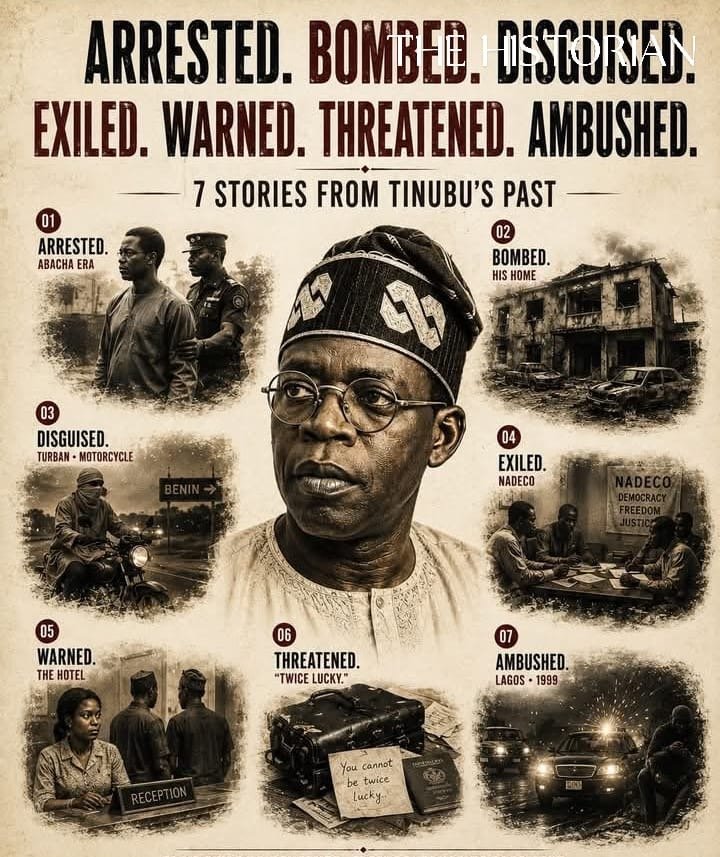
ITEM 1 — ARRESTED

In June 1994, during the military rule of General Sani Abacha, Tinubu was among former senators arrested after a meeting calling for the restoration of democratic government.
He and five others were charged with treasonable felony and conspiracy.
Amnesty International documented the arrests and described the men as prisoners of conscience, arguing that the charges were connected to their political opposition to military rule.
This was the period when the June 12 crisis had pushed Nigeria into one of its most dangerous political periods.
Tinubu was no longer simply an opposition politician.
He was now a target of the military government.
ITEM 2 — BOMBED
Before his exile, Tinubu says his Lagos home had been bombed.
The attack occurred in October 1993, during the growing political crisis following the annulment of the June 12, 1993 presidential election.
Tinubu later recalled that his uncle, Kafaru Tinubu, a former police officer, warned him that his life was in danger.
He stopped returning home and went underground.
He also later recalled that soldiers took over his house and guest house and seized his property, including eight of his cars.
Imagine what that meant.
The place where you lived was no longer safe.
The people looking for you had the power of the state behind them.
And eventually, staying in Nigeria became too dangerous.
ITEM 3 — DISGUISED
Then came one of the strangest parts of the story.
Tinubu says he left Nigeria for Benin Republic at about 1 a.m.
He was disguised in a large turban and babanriga, with his face largely covered.
He then travelled toward the border on a motorcycle.
This wasn’t the image most people associate with the man who would eventually become one of Nigeria’s most powerful politicians.
There was no presidential convoy.
No official security detail.
No government office.
Just a man trying not to be recognized.
ITEM 4 — EXILED
But reaching Benin Republic did not mean Tinubu stopped fighting.
According to his recollections, he continued working with members of NADECO and moved between Benin and Nigeria.
He described helping activists cross the border around the Badagry area and participating in meetings connected to the pro-democracy struggle.
NADECO — the National Democratic Coalition — had emerged as one of the major forces demanding the restoration of democracy after the annulment of the June 12 election.
Tinubu’s years outside Nigeria were therefore not simply years of hiding.
They were also years of political organizing.
He eventually reached Britain, where the struggle continued from exile.
ITEM 5 — WARNED
Then came the hotel episode.
Tinubu says that while hiding in Benin Republic, he went out on an okada to buy amala.
When he returned toward his hotel, he noticed two men wearing Muslim skullcaps questioning the receptionist.
Then the receptionist looked at him.
And winked.
Tinubu understood the signal.
According to his account, the men had come looking for him.
He did not enter the hotel.
He turned around and escaped again.
Think about how small that moment was.
One look.
One wink.
One decision.
And possibly another escape.
ITEM 6 — “YOU CANNOT BE TWICE LUCKY.”
The danger followed him beyond Benin.
Tinubu later recalled that while he was involved in the pro-democracy struggle from Côte d’Ivoire, military assailants broke into his hotel room in Abidjan.
They took his briefcase and diplomatic passport.
But they left a message:
“YOU CANNOT BE TWICE LUCKY.”
It was a chilling warning.
But according to Tinubu’s recollection, the attackers had overlooked one important thing.
He still had a photocopy of the British visa document that had helped him leave Benin.
He took it to the British High Commission in Abidjan.
Officials verified his situation and helped arrange his departure.
Once again, he escaped.
ITEM 7 — AMBUSHED
Then the story moved into another chapter.
After General Abacha died in 1998, Tinubu returned to Nigeria.
In 1999, he became Governor of Lagos State.
Then, on 12 December 1999, only months into his governorship, armed men attacked his convoy in Lagos in the early hours of the morning.
His vehicle was hit by gunfire.
Tinubu survived.
Four attackers were reportedly killed by security personnel.
Contemporary reports described the incident as an assassination attempt, although the Lagos police commissioner initially said it was too early to establish the motive.
Either way, the governor had survived another extremely dangerous encounter.
And suddenly, the seven words on this poster make sense:
ARRESTED.
BOMBED.
DISGUISED.
EXILED.
WARNED.
THREATENED.
AMBUSHED.
These were not all the same event.
They happened at different moments in Tinubu’s journey.
Some belonged to the political crisis of the 1990s.
Some belonged to his years in exile.
And one happened after he had returned to Nigeria and become governor.
Then came another extraordinary chapter.
In 2023, Bola Ahmed Tinubu became President of Nigeria.
Before the presidency, there was exile.
Before the governorship, there was a motorcycle.
Before the political power, there was a period when he says he had to disappear to survive.
And before the presidency, there was a warning that still echoes through the story:
“YOU CANNOT BE TWICE LUCKY.”
Perhaps the strangest part is what happened afterward.
He returned.
He became governor.
He survived another attack.
And decades after the years of exile, he reached the highest political office in Nigeria.
So what do you think?
Which of these seven chapters surprised you the most?
The arrest?
The bombing?
The turban and motorcycle escape?
The NADECO years?
The receptionist’s warning?
The “twice lucky” message?
Or the 1999 convoy ambush?
Over to the house……
“THE HISTORIAN”