By Okoi Obono-Obla
The opposition to President Bola Tinubu is not offering an alternative. It is offering confusion, contradiction, and a collection of politically incompatible personalities whose philosophies cannot co-exist in one coherent government.
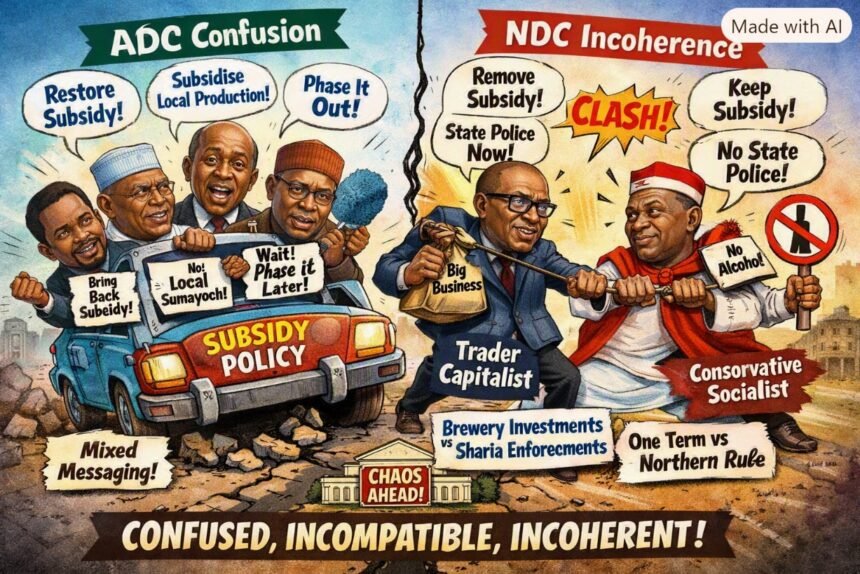
I. The ADC: One Week, Three Subsidy Policies
Take the African Democratic Congress, ADC, presidential candidate Atiku Abubakar.

Atiku himself says he will restore petrol subsidy if elected in 2027.
His Vice-Presidential candidate, Chibuike Amaechi, says the opposite — that Atiku is not planning to revive the old import-based subsidy regime at all, but will subsidise only local production.
His media aide, Paul Ibe, says Atiku will restore the subsidy temporarily and then phase it out later after the economy recovers.
Then his Senior Special Assistant on Public Communication, Phrank Shaibu, says Ibe’s statement was unauthorised, imprecise and materially misleading, and that Atiku’s proposal is not a return to the old regime but a targeted, capped, transparently budgeted and independently audited production subsidy for domestic refineries.
What a bunch of confused people saying four different things within the space of one week on an issue that is at the core of Nigerian national interest.
How can we take such people seriously? Running under a political party that is already akin to a rickety vehicle, it portends how confused they are and why they have lost our trust. They are just a bunch of megalomaniacs looking for an avenue to grab power.
II. The NDC: Capitalist Trader Meets Conservative Socialist
The same incoherence defines the other pole of the opposition — the Nigeria Democratic Congress, NDC, pairing of Peter Obi and Rabiu Kwankwaso.
Peter Obi is a businessman and trader who, in July 2022, said he would remove fuel subsidy, describing it as a “scam” and “organised crime” and that he would use the funds for power, health and education.
He is associated with Next Cash and Carry supermarket in Abuja. The business is owned by his family company, Next International Nigeria Limited, which holds franchises for several international brands and owns mega malls in Abuja and Port Harcourt that sell a mix of imported and local goods.
As Governor of Anambra State, he did not build a brewery personally. His administration facilitated and invested state resources in Intafact Beverages Limited, the SABMiller brewery in Onitsha, commissioned by President Goodluck Jonathan in August 2012, which he has since defended as the state’s biggest revenue earner.
As Governor, he distributed official vehicles to public institutions. He distributed 177 SUVs to the traditional rulers of the 177 communities in the state, 58 cars to magistrates and judicial officers, and 110 vehicles to local governments.
Today he campaigns as a born-again apostle of frugality and lean government expenditure, criticising large convoys and saying that if he is elected president, legislators would not be bought vehicles.
On subsidy, his position is outright removal:
“I will remove subsidy and look for something to replace it. The subsidy is a scam.”
“Fuel subsidy is organised crime. I said it repeatedly that it should be removed.”
After President Tinubu removed subsidy on May 29, 2023, Obi said: “I would’ve also removed petrol subsidy, floated naira — but not haphazardly… in a gradual and organised manner” with “various relieving policies.”
He is against reversal: “I subscribe and maintain that you need to remove the subsidy. Mismanagement of the proceeds shouldn’t be the reason for not removing it.”
His reported running mate for 2027, Dr. Rabiu Kwankwaso, says something entirely different: “I will end corruption in fuel subsidy, if elected” and “I will examine and review all subsidy regimes from the 1970s till date.”
When prices were increased under President Buhari, Kwankwaso criticised it as “ill-timed that would only make life more difficult” and that it would increase hunger, insecurity and unemployment, calling fuel hike “another strategy to tax Nigerians.”
On insecurity and state police, the incompatibility is even starker.
Peter Obi proposes a dual strategy: “In uniting the country, anybody who wants peace, I will talk with him; I will negotiate with him. Anybody who wants war, we will go to war.” He supports state police in principle, saying a highly centralised policing structure is “fundamentally unsuitable for a country as vast, diverse, and complex as Nigeria.” Yet after the National Assembly passed the State Police Bill in 2026, he urged postponement until after the 2027 election: “There is no guarantee that this administration can resist the temptation to take advantage of state policing to influence the 2027 general election by proxy.”
Kwankwaso, former Minister of Defence, is outright opposed to state police: “As former Minister of Defence… I don’t believe that state police is necessary.” “Governors May Use State Police For Politics… There are so many dangers associated with state police. The governors would want to use them for political protection.” He says insecurity has passed the level of state police debate and attributes it to lack of political will. He vows to raise Police and Armed Forces personnel to one million each.
On the ideological plane, Kwankwaso started the Hisbah as a 250-member committee in 2001, formally established as the Kano State Hisbah Board in November 2003, which enforces the ban on sale and consumption of alcohol in Kano State. He is socially conservative and economically left-leaning, attributing his views to Aminu Kano.
He says he has signed a written pact with Peter Obi that Obi will do only one term of four years from 2027 to 2031, after which power would return to the North.
III. Conclusion: A Disconcerting Alliance
How can such politically incompatible people run a coherent government together?
On one side, Atiku Abubakar’s camp cannot agree whether subsidy should be restored, restored temporarily, or transformed into a production subsidy — all within seven days.
On the other side, an importer-capitalist who built his reputation on a brewery investment and now preaches frugality and outright subsidy removal with delayed state police, is pairing with a socially conservative, left-leaning former Defence Minister who wants subsidy corruption reviewed first, rejects state police as a political weapon, and defends alcohol prohibition.
This is not an alternative government. It is an incoherent, inconsistent, and disconcerting assembly of contradictions — confused on policy, incompatible in personality, and contradictory in philosophical leaning and taste.