by Eneojo Herbert Idakwo
For decades, political conversations about Northern Nigeria have followed a familiar pattern. Whenever poverty, insecurity, poor educational outcomes, unemployment, or underdevelopment are discussed, attention quickly shifts elsewhere. The South is blamed. Colonial history is blamed. The federal structure is blamed. The occupant of Aso Rock is blamed.
Yet a more difficult question is often avoided: what role have Northern leaders themselves played in creating the conditions that now plague the region?
That question lies at the heart of the growing frustration expressed by many Northern voices who argue that the North’s greatest challenge is not external oppression but internal failure.

The uncomfortable reality is that Northern Nigeria has produced some of the most influential political figures in the country’s history. For much of Nigeria’s post-independence existence, Northern politicians occupied the highest offices of state, controlled significant federal resources, and exercised enormous influence over national affairs. Despite this advantage, millions of ordinary Northerners continue to live in poverty, insecurity, and economic uncertainty.
This contradiction cannot be ignored.
The Politics of Dependency
One of the strongest criticisms directed at Northern political elites is their long-standing dependence on federal allocations rather than genuine economic transformation.
The North possesses vast agricultural land, abundant mineral deposits, significant solar energy potential, and a large youthful population. These advantages should have positioned the region as one of Africa’s most dynamic economic zones.
Instead, many states remain heavily dependent on monthly federal allocations.
Rather than building sustainable industries, modern agricultural systems, processing facilities, and manufacturing centres, many political leaders became comfortable with a system that rewarded distribution rather than production.
The result is a dangerous cycle. When federal revenue falls, economic hardship immediately deepens. When political power shifts away from the region, anxiety grows because dependence has replaced self-sufficiency.
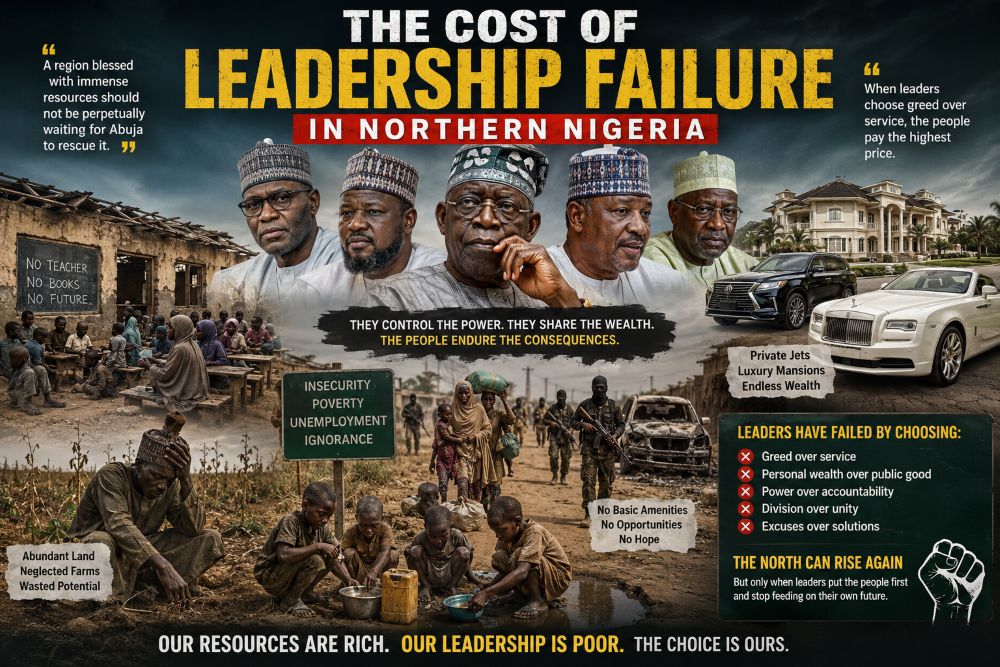
A region blessed with immense resources should not be perpetually waiting for Abuja to rescue it.
The Failure of Political Leadership
The greatest responsibility for Northern underdevelopment rests with those entrusted with leadership.
Across many states, billions of naira have flowed through government accounts over the years. Yet basic indicators of development remain alarming. Large numbers of children remain out of school. Healthcare systems struggle. Rural infrastructure is inadequate. Communities continue to suffer from insecurity.
Leadership is not measured by speeches, political influence, or electoral victories. It is measured by outcomes.
If citizens remain poor despite decades of public spending, then difficult questions must be asked about how resources were managed and what priorities guided those in power.
The tragedy is not merely the existence of poverty. The tragedy is the persistence of poverty despite enormous opportunities to address it.
The Silence of the Educated Elite
The North has produced professors, economists, administrators, lawyers, engineers, and scholars of international reputation.
Yet many critics argue that too few members of this educated class have consistently challenged destructive policies or demanded accountability from those in authority.
Knowledge carries responsibility.
Educated citizens possess the tools to identify problems and propose solutions. When they choose silence in the face of decline, they become spectators to a crisis they are uniquely equipped to confront.
The region needs more intellectual courage and less political convenience.
History rarely remembers those who remained silent while their society deteriorated around them.
Business Without Development
A healthy business class is supposed to drive growth, innovation, and job creation.
However, many observers argue that parts of the Northern business elite have become more interested in proximity to government than in productive investment.
Too much wealth remains tied to contracts, patronage, and political connections.
Too little is invested in industries capable of transforming local economies.
The consequences are visible everywhere. Young people struggle to find employment. Agricultural value chains remain weak. Manufacturing remains underdeveloped. Communities rich in natural resources often see little benefit from their own wealth.
Economic leadership should create prosperity. It should not merely accumulate private fortunes while public conditions deteriorate.
Religious Leadership and Social Responsibility
Religion occupies a central place in Northern society. For that reason, religious leaders possess enormous influence.
Many citizens increasingly expect clerics and scholars to devote greater attention to issues such as education, economic empowerment, justice, accountability, and social development.
The moral authority of religious leadership is strongest when it addresses the practical challenges facing ordinary people.
At a time when communities face poverty, insecurity, and declining opportunities, many citizens want religious voices that inspire progress, critical thinking, and collective responsibility.
Faith can be a powerful force for development when it encourages both spiritual growth and social advancement.
The Cost of Neglect
Perhaps the most painful consequence of leadership failure is the burden placed on ordinary citizens.
Farmers abandon fields because of insecurity.
Parents struggle to educate their children.
Young people migrate in search of opportunities.
Communities that should be engines of productivity become centres of frustration.
The ordinary Northerner did not create most of these structural problems. Yet he bears their consequences every day.
The gap between the wealth of many leaders and the hardship of ordinary citizens has become increasingly difficult to justify.
Tinubu Is Not the North’s Fundamental Problem
Many political debates today focus on President Bola Ahmed Tinubu.
Before him, similar criticisms were directed at former President Goodluck Jonathan.
Yet this raises an important question.
If Northern Nigeria’s challenges existed before Jonathan and continue under Tinubu, can either man honestly be described as the root cause?
The evidence suggests otherwise.
No president can be held solely responsible for decades of educational decline, weak institutions, poor governance, insecurity, and underinvestment at state and local levels.
Blaming every problem on whoever occupies the presidency may be politically convenient, but it distracts from deeper realities.
The North’s future will not be determined primarily by who occupies Aso Rock.
It will be determined by whether Northern leaders are willing to confront the failures within their own systems.
A Region Rich in Potential
Despite its challenges, Northern Nigeria remains one of Africa’s most promising regions.
Its agricultural capacity is enormous.
Its mineral wealth is substantial.
Its population is young and energetic.
Its strategic location provides access to regional markets.
These advantages have not disappeared.
What has been missing is leadership capable of transforming potential into prosperity.
The future of the North does not depend on sympathy from other regions. It depends on vision, accountability, productivity, and responsible leadership.
The Real Choice Before the North
The debate should not be about who to blame next.
The debate should be about what must change.
The North can continue to search for external enemies and political scapegoats, or it can undertake a serious examination of its own leadership culture.
No society develops by excuses.
No region prospers through dependency.
No people advance when their leaders place personal enrichment above public welfare.
The harsh truth is that Northern Nigeria’s greatest obstacle may not be the South, the presidency, or the federal system.
It may be the failure of those who were entrusted to lead.
Until that reality is honestly confronted, meaningful transformation will remain elusive, regardless of who occupies the presidential villa.