By Sam Eno, PhD
From the Forgotten Masquerade of the 1960s to the Grand Spectacle of the New Yam Festival
There are moments in the life of a people when history must be rescued from memory before memory itself becomes history.
The story of Etangala in Ugep is one such story.

For many years, it has been widely believed that Etangala was introduced into Ugep from our sister community of Nko in 1986. That account is not entirely wrong, but it is incomplete. It confuses the second coming and modern revival of Etangala with its much earlier presence in Ugep.
The truth is that Etangala existed in Ugep as far back as the early 1960s, long before the events of 1986 that brought about its spectacular revival and transformation into one of the most anticipated attractions of the Ugep New Yam Festival.
I know this not merely from stories handed down to me, but from personal childhood experience.
THE ETANGALA OF MY CHILDHOOD
As a little boy, I witnessed Etangala in Ugep in 1967. I was about seven years old.
At that time, Etangala was not yet the enormous cultural spectacle that we know today. It was more localized and was particularly associated with Usaja and Egbizum.
The first masquerade I remember was Eno Njong, a tall, fair, and remarkably handsome man from Usaja. He was followed by another imposing figure, Bassey Ferdinand, also a tall, huge, and handsome man.
To a child of seven, these men and the mysterious world of the masquerade were unforgettable. My senior brothers would carry me along, literally holding my hands as we followed the spectacle. I may have been too young to understand the cultural significance of what I was witnessing, but the images remained etched in my memory.
And sometimes, the testimony of a child who actually saw something is more valuable than a later assumption about when that thing began.
The story can still be independently verified. Any man or woman from Usaja, Egbizum, or Lekpankom who is about sixty years or older should be able to recall the old Etangala tradition.
THEN CAME THE WAR
In 1967, the Nigerian Civil War erupted.
And history, with its brutal capacity to interrupt the rhythm of ordinary life, intervened.
Bassey Ferdinand, one of the principal figures associated with Etangala at the time, joined the army. With his departure, there was nobody to continue the masquerade in the manner in which it had been performed.
And so, quietly and without ceremony, the Etangala tradition in Ugep disappeared.
It did not die because the people rejected it.
It died because history interrupted it.
The war ended, but Etangala did not return to Ugep. In the years that followed, however, the masquerade became increasingly popular in Nko, where it developed into a beautiful and captivating cultural spectacle.
Ugep youths began travelling to Nko to watch it.
They went as spectators.
They went as admirers.
And, unknowingly, they were also becoming cultural witnesses.
1986: THE SECOND COMING
Then came 1986.
A tragic accident involving some Ugep youths returning from an Etangala spectacle in Nko occurred around the Convention School. The incident shocked the community and generated renewed interest in bringing Etangala back to Ugep.
But there was an important question: How could Ugep revive a tradition that had disappeared many years earlier?
The answer came through the traditional institution.
The people of Emenko in Bikobiko approached the late Obol Ubi Ujong, the Obol Lopon of Ugep and Paramount Ruler of Yakurr, seeking permission to travel to Nko, learn the art and organization of the Nko Etangala, and bring it back to Ugep.
Permission was granted.
And thus began what may rightly be called the second coming of Etangala to Ugep.
The people went to Nko. They learned. They observed. They returned.
What came back was Etangala, but in a new form.
It was no longer simply the localized masquerade remembered from Usaja and Egbizum in the 1960s. It became a more organized, colourful, and expansive cultural performance, gradually adapting itself to the character and aspirations of Ugep.
Therefore, it is historically correct to say:
The modern Etangala of Ugep was learned from Nko in 1986.
But it is historically incorrect to say:
Etangala was first introduced into Ugep from Nko in 1986.
Those are two very different claims.
The first recognizes the historical relationship between Ugep and Nko.
The second erases the earlier Ugep tradition.
FROM MEMORY TO MEGA-SPECTACLE
What happened after 1986 is itself a remarkable chapter in the cultural evolution of Ugep.
Etangala did not merely return.
It grew.
It acquired new energy, new organization, new artistry, and a new place within the cultural calendar of the community.
Today, it has become one of the major attractions of the Ugep New Yam Festival, drawing thousands upon thousands of people from within Yakurr, across Cross River State, Nigeria, and beyond.
Yesterday’s Etangala spectacle demonstrated just how far this tradition has travelled.
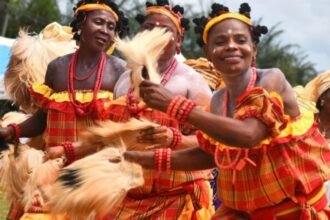
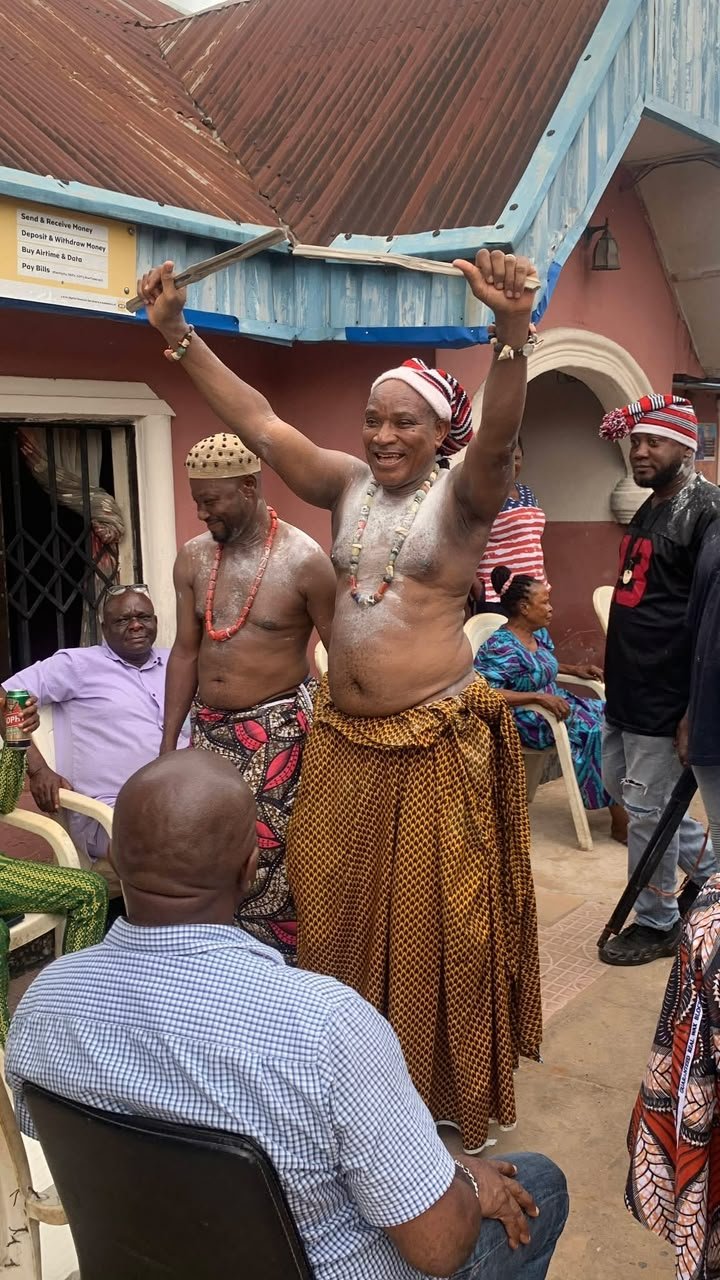
More than 50,000 spectators and followers reportedly converged on Ugep, dressed in an extraordinary variety of beautiful attires and costumes. The streets became a moving theatre of colour, sound, movement, music, and cultural identity.
It was not merely a masquerade procession.
It was a people’s theatre.
It was culture performed in the open.
It was history walking through the streets.
It was Ugep telling its story without needing a stage.
And in that enormous human gathering, one could see something profoundly important: the capacity of culture to bring people together, to create communal excitement, and to transform inherited traditions into living spectacles.
THE NEW GENERATION ARRIVES
One of the most fascinating additions to this year’s Etangala spectacle was the emergence of the new display groups known as Alpha, Omega, Delta, Gamma, and Beta.
Their appearance added another dimension to an already magnificent cultural performance.
Beautifully presented and visually compelling, the groups demonstrated that tradition does not necessarily mean stagnation.
A culture remains alive precisely because every generation finds a way to enter it, interpret it, and contribute something new.
Alpha, Omega, Delta, Gamma, and Beta are therefore more than new display groups. They represent the continuing evolution of Etangala.
They show that while the roots of the masquerade remain firmly planted in the past, its branches can continue to grow.
THE HISTORICAL DISTINCTION WE MUST PRESERVE
There is no contradiction in acknowledging both Nko’s influence and Ugep’s earlier Etangala tradition.
Indeed, doing so gives us a more accurate and richer history.
The evidence of memory and personal experience points to an Etangala presence in Ugep from at least the early 1960s.
The Civil War interrupted that tradition.
After the war, Etangala flourished in Nko and became an attraction for Ugep youths.
In 1986, following the tragic accident involving Ugep youths returning from Nko, the community sought permission from the traditional authority to learn the Nko version and reintroduce Etangala into Ugep.
Thus, 1986 marks the revival and transformation of Etangala in Ugep, not its original birth in Ugep.
That distinction matters.
History is not only about identifying what happened. It is also about identifying when, where, and in what form it happened.
The modern Etangala may have come from Nko.
But the memory of Etangala in Ugep predates 1986.
ETANGALA: A LIVING CULTURAL HERITAGE
Perhaps the greatest lesson from this story is that culture is rarely a straight line.
Traditions disappear and return.
They travel from one community to another.
They are borrowed, adapted, reinvented, and eventually made one’s own.
Etangala’s journey between Ugep and Nko is therefore not a story of ownership alone. It is a story of cultural exchange, memory, adaptation, and renewal.
The Etangala that the people of Ugep witnessed in the 1960s may not have looked like the magnificent spectacle of today.
But it was there.
The Etangala of 1986 may have learned much from Nko.
But it was embraced, developed, and transformed by Ugep.
And the Etangala of today, commanding the attention of tens of thousands of spectators, adorned with magnificent costumes and energized by groups such as Alpha, Omega, and Beta, is now unmistakably part of the cultural identity of the Ugep New Yam Festival.
From the quiet performances of Usaja and Egbizum in the 1960s, through the silence imposed by war, to the rediscovery of the tradition in Nko and its spectacular return to Ugep in 1986, Etangala has travelled a long road.
It is a road paved with memory.
It is a road marked by loss and revival.
It is a road that connects generations.
And perhaps that is the real beauty of Etangala.
It has survived because Ugep remembered.
Yesterday, more than 50,000 people gathered to watch it.
But behind the spectacular costumes, the music, the dancing, and the enormous crowd lies another spectacle that cannot be seen with the eyes: the spectacle of history coming alive.
And for those of us who saw the Etangala of the 1960s, yesterday’s magnificent performance was more than entertainment.
It was a reunion with a forgotten past.
Etangala has returned, but it never truly left.
- Sam Eno, PhD
Executive Director, The African Research and Development House