

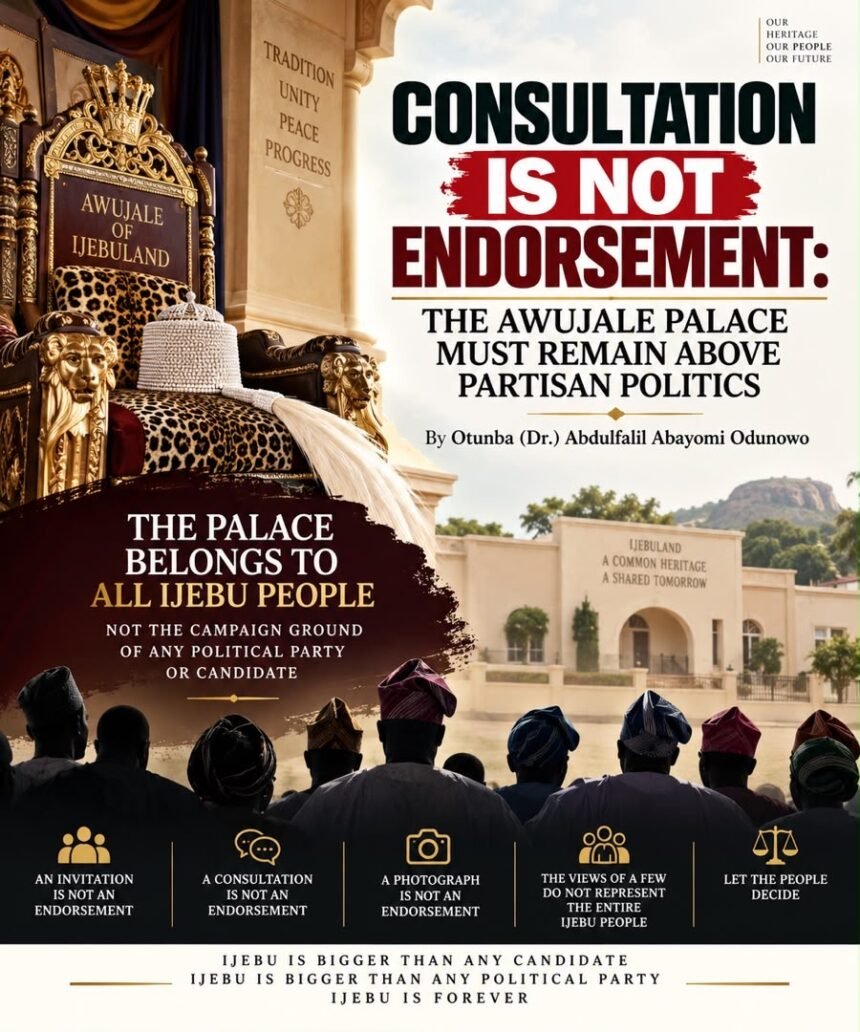
By Otunba (Dr.) Abdulfalil Abayomi Odunowo
The Awujale Palace is not merely another meeting venue. It is the institutional heart of Ijebuland an ancient stool whose recorded history stretches back centuries, long before the colonial creation of Ijebu Province and the modern Nigerian state. It belongs to every son and daughter of Ijebu, irrespective of political party, personal preference, association or electoral ambition.
That is why what transpired at the palace on Tuesday, 22 September 2026, during the ongoing interregnum that began with the transition of our late revered monarch, deserves careful reflection and, more importantly, clarification.
Oba Sikiru Kayode Adetona, Ogbagba Agbotewole II, who reigned from his installation on 2 April 1960 until his passage on 13 July 2025 at the age of 91, occupied the throne for an extraordinary 65 years one of the longest reigns in modern Nigerian history. Throughout that period, he maintained a clear and repeatedly stated distinction between receiving politicians and endorsing politicians.

Political leaders and candidates could visit the palace, present themselves and explain their programmes. Critical Ijebu stakeholders could be invited to listen. But the traditional institution remained above partisan politics. The late Awujale articulated this principle with characteristic directness. In March 2015, when then-President Goodluck Jonathan paid a private visit to the palace, Oba Adetona told him plainly:
“In Ijebu here, it is not possible for any Oba, not even only in Ijebu, in Yorubaland, to go out and say vote for this, vote for that; that person is looking for trouble. But give them the opportunity to present their programmes so that people can make up their minds on what to do. I think this is a very sound democratic principle.”
He reinforced the same stance in August 2018 during the Ojude Oba festival, when partisan chants briefly interrupted the cultural proceedings. The monarch warned:
“Ojude Oba is about culture and tradition. It is non-political. It has been like that since our forefathers started it. It is an abomination for anyone to drag politics into it.”
The consistent message, as understood across decades of political visits, was essentially this: Come and speak to our people. Convince them. Let them listen to you. But ultimately, let the people decide.
That principle protected the dignity of the Awujale stool because the Awujale was father to all APC, PDP and every other political persuasion.
This is why some aspects of the 22 September meeting raise legitimate concerns. If Senator Solomon Olamilekan Adeola (Yayi) was invited to the palace during this period of interregnum for consultation and interaction, his presence at that meeting cannot, by itself, reasonably be transformed into an endorsement by Ijebuland.
The distinctions are fundamental and must be stated without ambiguity:
* An invitation is not an endorsement.
* A consultation is not an endorsement.
* A photograph is not an endorsement.
* Expressions of support by individuals present at a meeting do not automatically constitute the collective political decision of Ijebuland.
SO WHO ENDORSED WHOM?
If approximately twenty people attended the meeting and some of them expressed support for Senator Adeola or the APC, they are fully entitled to their political views. Those views, however, should be attributed accurately to the individuals or organisations concerned.
If twenty individuals endorsed Senator Adeola, let it be reported as: “Twenty individuals endorse Senator Adeola.”
If a particular association endorsed him, let the association be identified.
If a formally constituted traditional body passed a resolution endorsing him, let that institution be named and the resolution made available.
But if what occurred is to be presented as an endorsement by Ijebu, then straightforward questions of institutional legitimacy demand answers:
* Was endorsement of Senator Adeola on the official agenda of the meeting?
* Who proposed the endorsement?
* Who seconded it?
* Was there a vote, or was consensus formally established?
* In what institutional capacity were those present acting?
* Was a formal resolution adopted?
* Are there minutes or a communiqué recording such a decision?
* Most importantly, what authority did those present possess to make a political declaration on behalf of the entire Ijebu people?
These are not hostile questions. They are questions about transparency, process and the proper representation of our people at a moment when the stool itself remains vacant and succession is the subject of ongoing legal and familial disputes.
THE PALACE MUST NOT BE SEEN AS A CAMPAIGN PLATFORM
What is particularly concerning is the reported atmosphere in which people asked for favours and made statements about voting for the APC or supporting a particular political project within the setting of the palace. Individuals have every right to support any candidate or party of their choice. The setting, however, matters profoundly.
When partisan declarations are made within the palace during an officially convened meeting, without a clear distinction between individual political opinions and the institutional position of the palace, an impression can easily arise that the traditional institution itself has taken sides. That impression must be avoided.
There are sons and daughters of Ijebuland contesting political offices across different platforms. How are they expected to regard their paramount traditional institution if they perceive the palace as being used to advance one candidate against another?
The Yoruba proverb remains instructive:
“Ọmọ ẹni kò yẹ̀sẹ̀ ìdí bẹ̀bẹ̀rẹ̀ ká fi ilẹ̀kẹ̀ sí ìdí ọmọ ẹlòmíràn.”
We should be careful not to diminish our own while decorating another person’s child. Beyond the proverb lies a more fundamental principle: the palace should belong equally to every Ijebu person, including those who disagree politically.
THE INTERREGNUM MAKES THIS EVEN MORE IMPORTANT
This matter assumes greater significance because the Awujale stool has been vacant since 13 July 2025. The interregnum has already been marked by successive delays, government suspensions of the selection process (notably in December 2025 and January 2026), internal disputes within the Fusengbuwa Ruling House (whose turn it is under the rotational system among the four recognised ruling houses), and multiple court actions. As of late September 2026, the process remains unresolved.
Those temporarily safeguarding the palace and our traditional institutions therefore carry an enormous responsibility. They are custodians of an inheritance that is far older than today’s political contests and, by God’s grace, will outlast today’s candidates and parties. They should not be perceived as substitutes for the collective political voice of Ijebuland, nor should temporary stewardship be interpreted as authority to determine the political preference of the entire people.
AND WHAT ABOUT THE WISHES OF OUR LATE AWUJALE?
Another issue deserves clarification. During the interaction, references were reportedly made to the wishes or political preference of our late revered Awujale concerning Senator Adeola.
Because claims concerning the wishes of a departed traditional ruler can easily become politically contentious, they should be treated carefully and supported by clear, contemporaneous evidence where they are presented as historical fact. Claims of endorsement whether made at the 2024 Ojude Oba or elsewhere must be examined against the late monarch’s own public statements on the impropriety of traditional rulers canvassing votes.
There is also an important question of consistency. If the wishes and legacy of Oba Adetona are to be invoked in discussions about political succession, then the same respect for his legacy should extend to other major causes with which he was closely associated throughout his long reign.
Foremost among these was the creation of an Ijebu State. Oba Adetona repeatedly emphasised that Ijebu Province was one of the colonial-era provinces that had not been granted statehood, unlike many of its peers. He consistently advocated for a new state with Ijebu-Ode as its capital. In December 2024, he and the Akarigbo of Remoland jointly hosted stakeholders at the palace to advance the cause; a bill sponsored by Senator Gbenga Daniel was before the National Assembly. After the monarch’s death, senior Ijebu chiefs affirmed that the agitation would not die with him.
Where there is now any proposal different from the position previously advanced for Ijebu State with Ijebu-Ode as capital, those advocating the change should explain clearly why that position has shifted and the authority upon which the new position rests.
We should not selectively invoke the legacy of the Awujale when it appears to support one political proposition and disregard other aspects of that legacy when they become inconvenient. Consistency strengthens institutions.
THIS IS NOT ABOUT OPPOSING SENATOR ADEOLA
Let me make this absolutely clear.
This intervention should not be interpreted as opposition to Senator Solomon Olamilekan Adeola. He has every legitimate right to visit the Awujale Palace. He has every right to consult Ijebu leaders, traditional institutions, community leaders and citizens. He has every right to present his record, explain his ambitions and ask the people for their support. Likewise, every individual who believes in his candidature has the right to support him openly.
The issue is not Senator Adeola’s right to seek support. The issue is whether individual support should be presented as institutional endorsement, and whether any such institutional endorsement if it occurred can legitimately be presented as the collective political decision of Ijebuland. Those are very different propositions.
IJEBU IS BIGGER THAN ANY POLITICAL PROJECT
For me, this is ultimately about protecting the institution of the Awujale.
The palace must remain a place where every Ijebu son and daughter APC, PDP or otherwise can enter knowing that the throne belongs equally to them. Our traditional institutions derive their moral authority precisely from their capacity to stand above temporary political divisions.
We must therefore be extremely careful not to allow the politics of today to weaken an institution that generations before us preserved and generations after us will inherit.
Political candidates should visit. Let them speak. Let stakeholders listen. Let difficult questions be asked. Let candidates explain what they have done and what they intend to do. Let those who support them express their support in their own names and in the names of organisations they are legitimately authorised to represent.
But nobody should convert consultation into a collective political mandate without demonstrating the authority and process through which that mandate was obtained.
Ijebu is bigger than twenty people.
Ijebu is bigger than any candidate.
Ijebu is bigger than any political party.
And the Awujale institution whose continuity stretches from the era of Obanta through the British conquest of 1892, the colonial province, independence and into the present interregnum is too important to be drawn unnecessarily into partisan contests.
At this sensitive moment in our history, clarity, transparency and respect for our institutions are essential. Therefore, one simple question deserves a simple answer:
Was the meeting of 22 September 2026 a consultation, or was it convened to endorse a political candidate?
If it was consultation, let it remain consultation.
If individuals offered endorsements, let those endorsements be attributed to those individuals.
If an institution formally endorsed a candidate, let the institution be identified and its resolution produced.
And if anybody claims to have spoken politically for the entire Ijebu people, then the Ijebu people are entitled to know who gave them that mandate.
That clarification is necessary not because of one candidate or one election, but because of the precedent we are establishing for the institution of the Awujale.
The palace belongs to all of us.
Let consultation remain consultation.
Let personal endorsement remain personal endorsement.
And let the collective voice of Ijebuland never be claimed without the clear authority of the Ijebu people.
History and the 65-year example of Oba Sikiru Kayode Adetona deserves that clarity.
Otunba (Dr.) Abdulfalil Abayomi Odunowo
Convener
Ijebu Lokan Fun itesiwaju ijebu movement.