
By Bolanle BOLAWOLE
turnpot@gmail.com 0705 263 1058
We are familiar with what is called the debt trap. In fact, Cheryl Payer’s “The Debt Trap: The IMF and the Third World” sits pretty in my Library. We have also heard of the “Resourse curse”, “Wheat Trap” and “Rice Trap”; but three Fridays ago (on Friday, 30th October, 2026), I learnt of another trap – the “Tuition Trap.” The occasion was at the 16th Convocation Lecture of Achievers’ University, Owo, Ondo state, delivered by Dr. Emomotimi Agama, Director-General of Nigeria’s Securities and Exchange Commission.
In Cheryl Payer’s “The Debt Trap”, the International Monetary Fund (IMF) was described as “the most powerful supra-national government in the world today” because of “the resources it controls and its power to interfere in the internal affairs of borrowing nations”, thereby giving it (the IMF) “an authority of which United Nations’ advocates can only dream.” Payer clinically x-rayed efforts by poor nations that have borrowed funds from the IMF “to gain some control over their own economies and the role of the IMF in frustrating these efforts.”

Payer’s case-studies traverse countries in Asia, Latin America, Africa and Europe, detailing the steep prices countries like Chile, Ghana and North Korea paid trying to break away from the stranglehold of “international loan-sharks” First published in 1974, “The Debt Trap” is as relevant today as it was over half-a-century ago! Can I have a witness in the house?
Resource curse, which is also known as the paradox of plenty, is an economic and political phenomenon where countries rich in non-renewable natural resources, such as gas, oil and other minerals, experience stagnant or receding economic growth instead of the prosperity one would have expected. Here, again, Nigeria is a case in point!
So also it is when we talk of the rice or wheat trap. Growing up in the late 50’s, 60’s and early 70’s, rice was a delicacy eaten only during festive periods, while bread or cake made from wheat was a rarity. But today, rice and wheat, which are not grown locally in enough quantities, have both become the staple food of Nigerians, putting a strain on the country’s foreign reserves. Some reports indicate that about 1.2 billion dollars was expended on food imports in the first half of this year (2026) alone, with rice and wheat accounting for a lion share of the forex outflow.
The deleterious effects of the above “traps” readily came to mind when Dr. Agama mentioned “tuition trap.” What on earth does that mean? Listen as this Capital Market guru builds his premises: “I came to Owo intending to deliver a lecture about how Nigerian universities might one day learn to use the capital market. Then I read your founding history and I had to rewrite it because Achievers University was not founded by a grant. It was not founded by an appropriation. It was not the gift of a government or a mission or a foreign foundation.“
What then was it? Dr. Agama provided an answer: “What began as a family business, registered in 1994, became something larger when the founder took a decision that I want every person in this hall to appreciate properly. Rather than build alone, he invited others. Shares were offered. Notable Nigerians subscribed… When the subscription closed, 90 shareholders owned this university.”
“So the theme I was given – From grant to growth – turns out to describe something this university did 19 years ago… which leaves me with a much more interesting question than the one I was invited to answer: You started in the capital market; why did you stop?”
Adversity of spoon-feeding universities
“I do not say it lightly and I do not say it to flatter…I have spent my working career watching what happens to institutions that are funded by allocation. They become excellent at applying (but) poor at earning. They organise their planning around a letter that arrives late or does not arrive (at all). They cannot distinguish themselves because the formula that funds them is designed not to distinguish. And when the fiscal weather turns – and in Nigeria it turns – they have no other leg to stand on.”
Does that sound familiar? He continues: “The institution that must earn its keep learns something the subsidised institution never learns: How to make a proposition that somebody will voluntarily fund. That is a skill. It is rarer in this country than it should be. And this university has been practising it since 2007. But – and here the lecture turns – having accepted the bargain, this university then did what almost every Nigerian private university has done: It settled on the narrowest possible way of keeping it.”
And what is that way? “It decided to fund itself out of (school or tuition) fees! I want to describe, as precisely as I can, the box that Nigeria’s private universities have built for themselves. I call it the tuition trap, and it has four walls.”
What are these walls? The first, according to him, is the market. Nigeria has over 140 private universities, which is more than half of the total number of universities in the country; yet, they account for less than 10 percent of Nigeria’s university students! As such, the private universities are under-subscribed; still new ones are being licensed almost every year, with more than 60 percent of newly licensed universities being private.
This leads to the second wall – affordability. The typical Nigerian private university is expensive, and how many parents can afford it? Reduce fees and starve the institution of funds. Increase fees and witness further drop in affordability. “There is no setting of that dial that solves both problems”, he said.
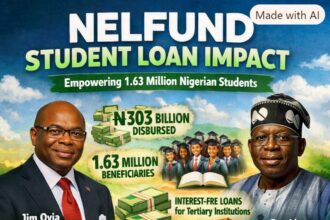
The third wall is the Federal Government’s N184 billion Nigerian Education Loan Fund to which private universities are not eligible, as a result of which students in public universities can defer the payment of school fees while those in private universities cannot.
The fourth wall is what he called maturity: “Fees are annual. A hostel block lasts 40 years. A teaching hospital wing lasts 50. A laboratory takes 30 years to earn out. A professor’s career runs 35 (years). You are trying to build 40-year assets out of surplus – one block this year, half a laboratory next year (and) a road when the cash comes…
“That is not a strategy. It is subsistence. And it is why many Nigerian private universities look, after 15 or 20 years, like a construction site that never finishes”, he said before throwing the clincher: “A university financed only by tuition is not self-funding. It is hand-to-mouth. Self-funding means having capital. Tuition is income. Income pays salaries and buys diesel. Capital builds. The two are not interchangeable, and an institution that has confused them has not escaped dependence – it has simply changed who it depends on.”
Capital market to the rescue?
What, then, does he suggest? That private universities should approach the capital market for appropriate and adequate funding. There is a surfeit of investable funds at the capital market. He listed the following: Pension assets under management ( N31.48 trillion as at July 2026); Total market capitalisation, listed securities on NGX (N215.09 trillion as at August 2026); Equity market capitalisation (About N158 trillion as at September 2026); Fresh equity raised in the banking recapitalisation (N4.65 trillion in 24 months, to Q1 2026); Diaspora remittances (N21.8 billion: 2025); and Active retail investors on the Exchange (2.7 million, from about 200,000: 2026).
Citing the examples of Ekiti and Kogi states and Afe Babalola University (another private university), he dispelled the views that a private university can only be financed by its founder(s) and through school fees. He then listed the requirements to be met by any serious institution approaching the capital market for financing.
Dr. Agama left Achievers’ University with a probing question: “You raised capital when it was hard. Why are you living on fees now that it is easy?”
As much that I know of Professor Bode Ayorinde, Pro-Chancellor and Chairman of Council of Achievers’ University, he will not allow Dr. Agama’s challenge to fall to the ground. I think every private university in this country should not only get a copy of the convocation lecture, but also act expeditiously on Dr. Agama’s propositions.
Achievers University’s 16th convocation ceremonies were a week-long pot-pourri of events, beginning with a press conference on Friday, 23 October; commissioning of Medical Students’ Hall of Residence and Maiden White Coat ceremony on Saturday, 24 October; Engineering induction: Monday, 26 October; Health induction: Tuesday, 27 October; Medical Laboratory Science induction: Wednesday, 28 October; Nursing Science induction and Convocation football match: Thursday, 29th October; and Convocation lecture and Jumat Thanksgiving service: Friday, 30th October.
The grand finale was the Convocation proper on Saturday, 31 October followed by Thanksgiving service on Sunday, 1 November, 2026. Honorary degrees were awarded to His Imperial Majesty Oba Dr. Victor Adesimbo Ademefun Kiladejo, CFR, the Osemawe and paramount ruler of Ondo kingdom; Captain Edward Boyo, Founder/Managing Director, Landrover Company Limited and Overland Airways; and Engr. Norbert C. Oleah, Founder/Group Chief Executive, Technova Africa International Limited.
NELFUND: A plea for private universities
The Chancellor of the university, Rt. Hon. (Dr.) Yakubu Dogara, CFR, presided at the event, ably supported by the university Pro-Chancellor and Chairman of the Governing Council, Professor Bode Ayorinde; the vice-chancellor, Professor Omolola Irinoye, the Registrar, Mr. Sulaiman Adebayo Olagunju, and other principal officers of the university.
In his address, Dogara said he looked forward to the day when the Federal Government’s students’ loan initiative would be extended “to our students in private universities.”
In his charge to the graduates, he said: “Nigeria needs your talent, your creativity, your innovation, and patriotism… Go out and be useful in the highest sense of the word. If you become a lawyer, serve justice. If you become a doctor, serve life. If you become an engineer, build what our country needs. If you become an entrepreneur, make jobs and make room for others. And if you are called to public service, put the nation before yourself, every time, without an exemption.”
High interest rates killing businesses
Professor Ayorinde’s address, though short, hit at the heart of the problem arresting the economic development of the country: the exorbitant cost of funds. His concern, he said, “is the prevailing cost of borrowing in NIgeria… When a commercial bank lends to a viable business at an interest rate of 25 or 30 percent per annum, the borrower faces a substantial financial burden before production begins to generate returns.”
Comparing this with what operates in the advanced countries of the world, he asked: “What can Nigeria learn from trillion-dollar economies… Their lending rates in 2026 are 3 to 4 percent in China and Japan; approximately 4 percent in Germany; around 7 percent in the US; and around 9 percent in India. These single-digit lending rates illustrate the difference between the financing environments of these economies and the high interest rates by Nigerian borrowers.”
Ayorinde added that since NIgeria “aspires to join the league of trillion-dollar economies, we must emulate their industrialisation model and financing architecture to truly belong.”
According to its vice-chancellor, Professor Irinoye, Achievers University graduated a total of 836 students at its 16th convocation ceremonies, made up of 786 undergraduates and 50 postgraduates respectively. Ninety-eight of the graduating students earned First Class Honours.
* Former Editor of PUNCH newspapers, Chairman of its Editorial Board and Deputy Editor-in-Chief, BOLAWOLE was also the Managing Director/ Editor-in-Chief of The WESTERNER newsmagazine. He writes the ON THE LORD’S DAY column in the SUNDAY TRIBUNE and TREASURES column in the NEW TELEGRAPH newspaper on Wednesdays. He is also a public affairs analyst on radio and television.