By Okoi Obono-Obla
The entire controversy surrounding the fuel subsidy regime in Nigeria was always simple economics misrepresented as politics. It was nothing more than the difference between the actual economic cost of supplying petrol and the cheaper, politically fixed pump price at which Nigerians bought it.
For decades, this differential was carried by the Federal Government at enormous cost to the national economy. Contrary to the claim that it lasted for seventy years, records show it lasted for about half a century. It started in the early 1970s, became institutionalised after the Price Control Act of 1977, and remained Nigeria’s most enduring, if unwritten, social contract until it was removed on May 29, 2023, by President Bola Ahmed Tinubu.
The cost was staggering. Between 2005 and 2020 alone, the Federal Government spent N13.7 trillion on fuel subsidy. Much of it, from my years in anti-corruption work, was mired in fraud, round-tripping, and fictitious import claims.

Where We Were in May 2023
It is important to recall the fiscal health of the Federation at the time subsidy was removed. As at inauguration day, Nigeria was insolvent in practical terms.
President Tinubu himself revealed that before he assumed office, 27 states were unable to pay salaries, not to talk of pensions. Independent BudgIT analysis confirmed this structural weakness: only 11 out of 36 states could independently pay workers’ salaries without waiting for Federal Allocation from Abuja. Some analysts put the number of truly buoyant states at even less — about 9.
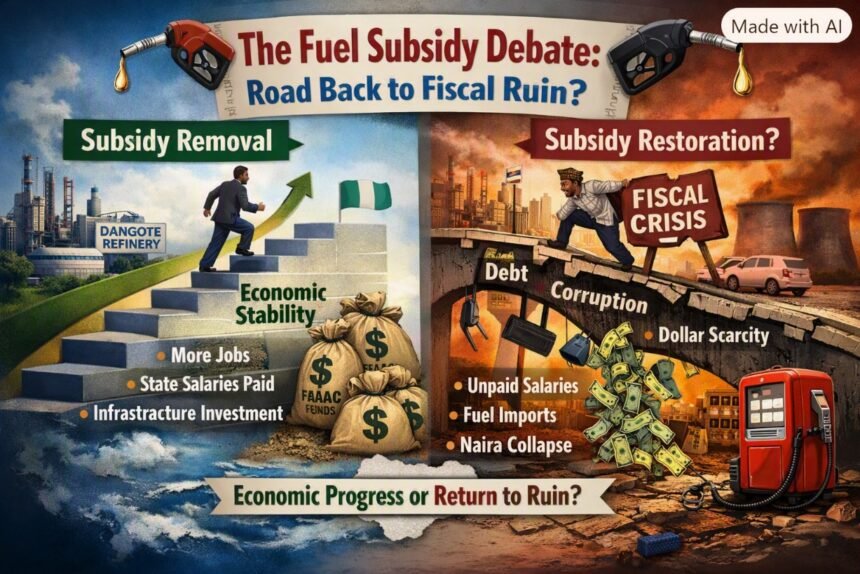
The subsidy removal, painful as it was, freed up resources. FAAC allocations to States tripled. Today, no state is borrowing to pay salaries. That is the single biggest fiscal dividend of the reform.
The Atiku Promise
It is against this background that one must interrogate the recent promise by former Vice President Atiku Abubakar, now presidential candidate of the African Democratic Congress (ADC), that he will restore fuel subsidy if elected president in 2027.
With the greatest respect, this is not a sound economic agenda. It is retrogression. First, it is illegal. The old subsidy regime was rendered illegal by the Petroleum Industry Act, 2021. Second, it is fiscally unsustainable. Restoring it means restoring a N4 trillion to N6 trillion annual hole in the federal budget. FAAC will collapse again. Third, it is anti-industrialisation. With Dangote Refinery and modular refineries now operational, a return to import subsidy will undermine investment in domestic refining.
I note that Atiku has attempted to clarify that he will not resurrect the old regime, but will replace it with a targeted, capped, transparently budgeted production subsidy. If that is his true position, he should not call it restoration.
A Critic Speaks: Nuhu Usman Nasiru
In reaction to this article, a reader, Nuhu Usman Nasiru, posed a pointed and valid question:
“But you have not spoken about the impoverishment of majority of Nigerians orchestrated by the unplanned subsidy removal, you are coming here with another sermon”
Nuhu is right about one thing — and I do not run away from it.
My Response to Nuhu
My dear Nuhu, thank you. You are right — subsidy removal has impoverished majority of Nigerians. That is not in dispute. When petrol moved from N197 to over N600 overnight, transport doubled, food prices tripled, and the real income of workers, farmers and small traders collapsed. I feel it, you feel it, every Nigerian household feels it. No serious writer can pretend otherwise.
But your word “unplanned” is where we must be honest as citizens, not as partisans.
Was removal unplanned, or was it inevitable? As at May 2023, NNPC was remitting nothing to FAAC because all crude revenue was being used to pay for subsidy. The Federal Government was borrowing through Ways and Means to pay salaries. We were subsidising fuel consumption in Niger and Chad through smuggling. The PIA 2021 had already given subsidy a legal end date of June 2023. The question was never whether it would go, but when it would collapse on our heads. To have left it was to accept national bankruptcy — a far more brutal impoverishment.
Where I agree with you completely, Nuhu, is that the removal was badly managed in its aftermath. A reform of this magnitude needed three things simultaneously:
(a) A published, ring-fenced savings account of how much was saved monthly;
(b) A massive, transparent mass-transit and CNG conversion programme;
(c) Targeted cash transfers and wage awards that actually reach the poorest, not political palliatives.
Government failed on sequencing and communication. So your anger is legitimate, but the target should be the poor management of the transition, not the inevitability of the reform itself.
Finally, restoration will impoverish Nigerians even more. The N4-6 trillion we now share to States will disappear again. States will stop paying salaries again. The Federal Government will return to Ways and Means borrowing. And because we now have local refineries, we will be subsidising imported fuel to kill our own refineries. That is double impoverishment.
The poor were already poor under subsidy. Subsidy never made a farmer in Gusau or a teacher in Ogoja rich. It made importers rich. The price of garri rose under subsidy too.
Conclusion
So, Nuhu, this is not a sermon. It is a hard truth: Subsidy removal impoverished us because we ran an economy that could only survive by making us poorer.
The debate we should be having in 2027 is not whether to restore subsidy, but how to use the savings transparently to fund a living minimum wage, CNG buses, primary healthcare, and conditional transfers to the poor — and to publish, monthly, how much is saved and how it is spent.
To promise Nigerians cheap petrol today at the expense of solvent States, stable currency and local refineries tomorrow is not economic wisdom. It is nostalgia for a failure.
Nigeria finally broke the oil spell after half a century. We must not put the spell back on.