By Okoi Obono-Obla
Introduction
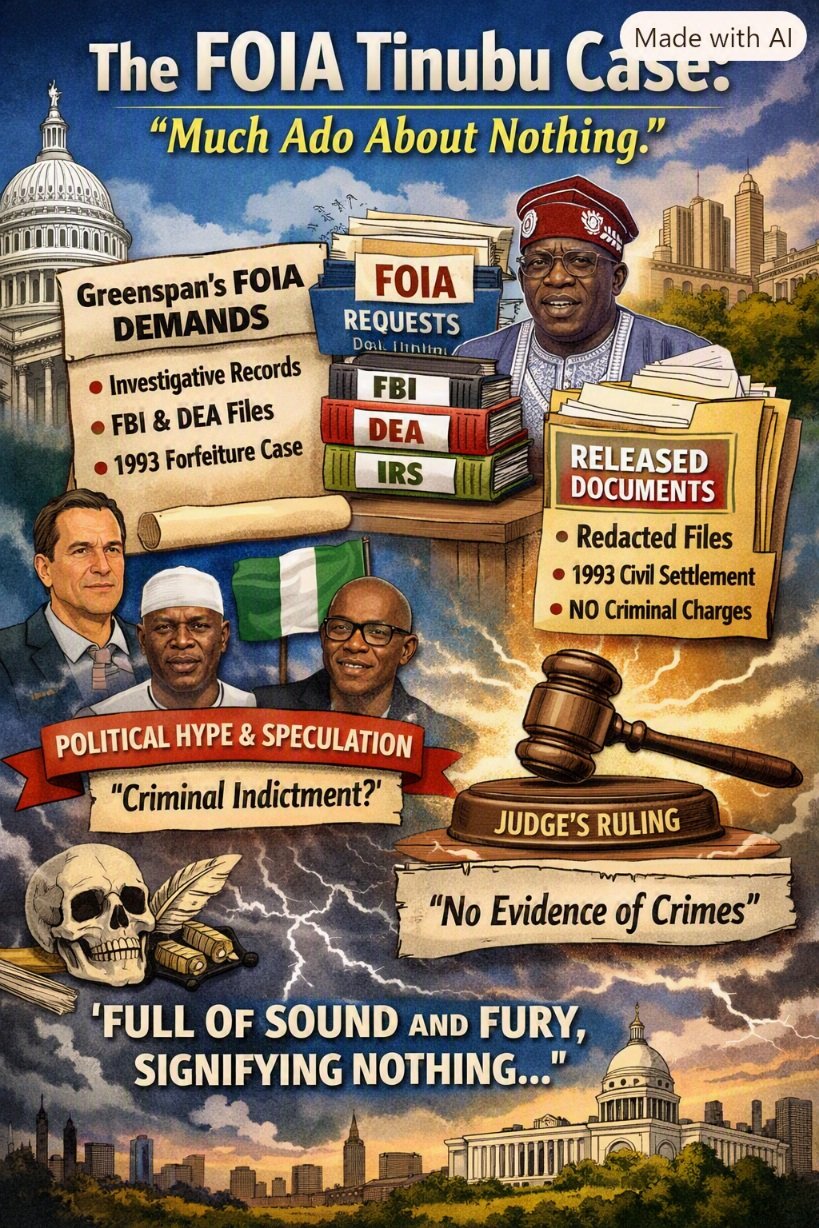
Since 2023, the Freedom of Information Act (FOIA) lawsuit filed in the United States District Court for the District of Columbia by transparency advocate Aaron Greenspan—seeking Federal Bureau of Investigation (FBI) and Drug Enforcement Administration (DEA) records relating to President Bola Ahmed Tinubu—has attracted intense political and media attention in Nigeria. Opponents of the President, particularly Atiku Abubakar and Peter Obi, orchestrated and portrayed the impending release as an earthquake that would reveal a criminal indictment.
The legal record released, however, tells a far more modest story—one not legally or politically significant.

Q&A: What the Law Says
1. Are there documents exempted from the United States FOIA?
Yes. Under 5 U.S.C. § 552(b)(1)-(9), Congress created nine exemptions. An agency may withhold information when disclosure would harm a protected interest:
– Classified national security
– Internal personnel rules
– Information prohibited by statute
– Trade secrets and confidential commercial information
– Privileged inter/intra-agency communications
– Personal privacy
– Law enforcement records that would interfere with proceedings, invade privacy, or reveal sources and techniques
– Supervision of financial institutions
– Geological information on wells
2. What information did Greenspan request in the Tinubu case?
Between 2022 and 2023, Greenspan filed 12 FOIA requests to six agencies—FBI, DEA, CIA, IRS, the Executive Office for U.S. Attorneys, and the Department of State.
He sought criminal investigative records concerning a joint investigation by the FBI, IRS, DEA, and U.S. Attorney’s Offices into a Chicago heroin distribution and money laundering ring that operated from approximately 1988 to 1994. The request named four individuals allegedly associated with it: Bola Ahmed Tinubu, Lee Andrew Edwards, Mueez Abegboyega Akande, and Abiodun Agbele.
Specifically, Greenspan requested:
– The entire FBI file for Bola Ahmed Tinubu (DOB 3/29/1952)
– FBI 302 interview reports from FBI Case No. 245-IP-71386 (1992–1993)
– DEA records from Hammond and Washington D.C. offices
– DEA case file for Abiodun Agbele (1990–1995)
– Charging decisions linked to civil forfeiture case No. 1:93-cv-04483—the 1993 case in which $460,000 was forfeited
3. Are the requested records exempted?
Not categorically, but portions are.
– FBI and DEA issued Glomar responses (“neither confirm nor deny”), invoking Exemptions 6 and 7(C) (privacy).
– IRS invoked Exemption 3 (tax confidentiality under 26 U.S.C. § 6103).
– CIA invoked Exemptions 1 and 3.
On April 8, 2025, Judge Beryl A. Howell ruled:
– FBI and DEA Glomar responses were improper and must be lifted because both agencies had already officially confirmed investigations of Tinubu, and the 1993 forfeiture was already public. They must produce non-exempt, reasonably segregable portions.
– CIA’s Glomar response was sustained.
– Agencies may still redact under Exemptions 6, 7(C), 7(D), 7(E), and 7(F).
4. Does any part of the disclosure constitute a criminal indictment capable of impeding Tinubu’s political ambition?
No.
The FOIA production consists of historical investigative files, not a new indictment, prosecution, or conviction. The only judicial action on record is the 1993 civil forfeiture, which was a civil settlement—not a criminal conviction. No criminal charges were filed against Tinubu in that matter. Judge Howell made no finding of criminal liability.
Under Section 137(1)(d) and (e) of the 1999 Constitution, disqualification requires an indictment or conviction by a court. A FOIA release does not meet that threshold, and the Presidential Election Petition Court in 2023 already considered the 1993 forfeiture and dismissed the challenge.
5. Was the case amplified beyond its legal weight?
Yes.
In the aftermath of the 2023 election, the suit was propagated in sections of the media as if a sealed U.S. criminal indictment would emerge. That framing exceeded the actual legal scope and fueled months of speculation, even as the FBI and DEA requested 90 additional days in May 2025 to complete searches.
Final Conclusion: A Shadow Chase
In the final analysis, the entirety of this FOIA exercise, as it pertains to President Bola Ahmed Tinubu’s eligibility and political standing in Nigeria, amounts to nothing more than a shadow chase intended for political hype.
Opponents exaggerated its significance, propagating it in the media as if the release of the files would be an earthquake-shaking revelation. In reality, after two years of litigation, 12 FOIA requests, and a federal judge’s order, what remains is a set of heavily redacted, thirty-year-old files whose central fact has been in the public domain since 1993.
It is, to borrow the immortal words of William Shakespeare in Macbeth, a tale “full of sound and fury, signifying nothing.”