By Okoi Obono-Obla
All is not well in the camp of the African Democratic Congress.
The party that seeks to present itself as the credible alternative for the January 16, 2027 presidential election is now consumed by a quiet but troubling storm, and the storm was stirred by no less a person than its own vice-presidential candidate, Rotimi Amaechi.
What triggered it is now public knowledge. An old footage of Amaechi delivering a damning verdict on the electability of his principal, Alhaji Atiku Abubakar, was posted by Mr. Bayo Onanuga, Special Adviser to the President on Information and Strategy, and since then the ADC has known no peace.

What the Record Shows
I have watched that footage repeatedly. Amaechi did not mince words. He said it repeatedly and emphatically: “Atiku is not electable.”
In the Trust TV interview that has now gone viral again, Amaechi argued that Atiku has been running since 1992. Every time he has won the primaries, he loses the general election. It is about electability.
In his own words: “When the former vice president said he has not failed in a party’s primary before. I hope this is the first time he will fail in a primary. But that is not even the issue. The issue is that at all times he has won primary, he has not won election. So, it is about electability. He has been there before and he lost. That is elementary analysis. So what new thing will he bring to the table?”
Today, the same Amaechi is listed by the Independent National Electoral Commission as Atiku’s running mate on the ADC ticket for the 2027 election. INEC has listed 18 presidential candidates and their running mates, and Atiku is listed with Rotimi Amaechi as his running mate.
The facts, therefore, speak for themselves.
The Janus Paradox
This is a classic case of political inconsistency and opportunism. It is what I call the Janus paradox in Nigerian politics.
Janus is the god of doorways, beginnings, transitions and duality – depicted with two faces, one looking to the past and the other to the future. That is exactly what we are seeing: one face that looked at Atiku in the past and saw an unelectable serial contestant, and another face that looks to the future and now presents him as the candidate to be elected.
Nigerian politics rewards realignment over ideological consistency. What we call inconsistency, political science calls elite coalition-building – former rivals merging to create a winning arithmetic, even if it contradicts everything they said months earlier.
But questions must be asked. At what point did Amaechi have a rethink? At what point did he develop a new perspective about Atiku’s electability to now accept to be his running mate? And what is Amaechi’s own electoral value even in Rivers State, where as campaign Director-General for former President Muhammadu Buhari, he could not deliver the state?
The Constitutional Intendment
This is where the matter goes beyond mere irony.
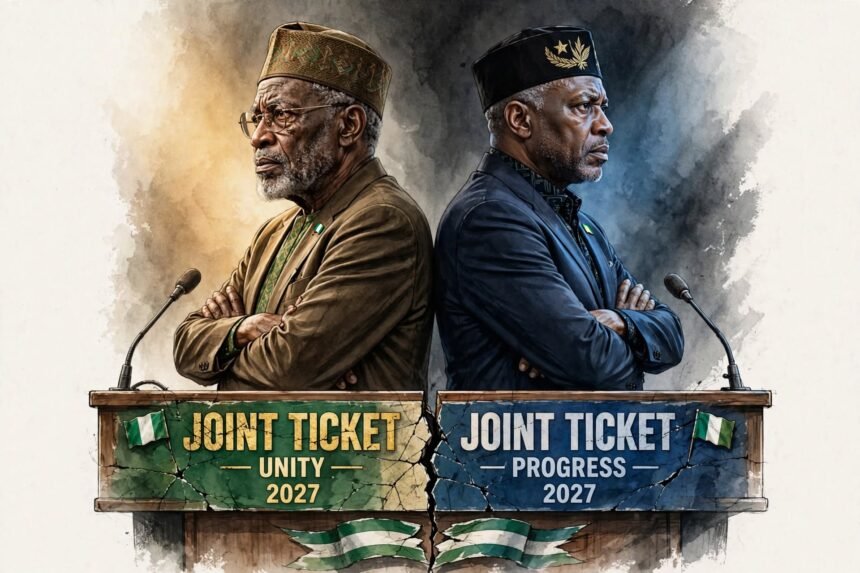
From the intendment and contemplation of the 1999 Constitution (as amended), a presidential candidate and his running mate are described as “associates” who must work as a joint ticket. Section 142(1) is clear that a presidential candidate shall not be deemed validly nominated unless he nominates another candidate as his associate from the same political party to occupy the office of Vice President.
They ought to be ideological soul mates, agreeable on fundamentals, to enable them to run a cohesive government hinged on a common agenda when elected. The Constitution does not contemplate a ticket nursing a fundamental personality clash of the type we are now seeing in the ADC joint ticket.
The Nigerian Constitution is modelled after the American Constitution, and we have seen how chaotic and disruptive it can be in the United States when a President and Vice President have big egos, clashing characters, personalities and agendas that are diametrically opposed to each other. Nigeria, with its young democracy, weak democratic institutions and fractious federation characterised by constant centripetal and centrifugal pulls and pushes, cannot afford such luxury.
We have seen this film before. The second term of President Olusegun Obasanjo and Vice President Atiku Abubakar showed how a divided joint ticket can paralyse governance.
characters, personalities and agendas that are diametrically opposed to each other. Nigeria, with its young democracy, weak democratic institutions and fractious federation characterised by constant centripetal and centrifugal pulls and pushes, cannot afford such luxury.
We have seen this film before. The second term of President Olusegun Obasanjo and Vice President Atiku Abubakar showed how a divided joint ticket can paralyse governance.
A ticket in which the running mate has publicly declared the presidential candidate unelectable and incapable of bringing anything new to the table cannot, by any stretch of constitutional imagination, promise cohesive government. It is a recipe for disaster.
The past, in politics, always hangs on the actors like a cloak.