By Otunba (Dr.) Abdulfalil Abayomi Odunowo
The Next Phase Must Be Project 20 × 774 — 20 Factories in Every Local Government
Nigeria has now had roughly three years to evaluate one of the most consequential economic experiments in its recent history: the removal of the petrol subsidy, the liberalisation of the foreign-exchange market, and the accompanying depreciation of the naira.
The Federal Government deserves credit for taking on structural problems that successive administrations struggled to fix. Petrol subsidy had become hugely expensive and highly vulnerable to abuse. Multiple exchange rates created distortions and opened the door to arbitrage. Government finances were under intense pressure.

There have also been measurable macroeconomic gains: stronger external reserves, improved fiscal space in nominal terms, a better-functioning foreign-exchange market, and renewed investor attention. But after three years, Nigeria must face an equally important question: have these reforms improved the productive capacity and real purchasing power of Nigerians?
That’s where the evidence becomes far more uncomfortable.
The government should therefore not abandon reform. It should reform the reform. And the centrepiece of the next phase should be an aggressive national industrialisation programme:
PROJECT 20 × 774
20 productive factories and processing enterprises in each of Nigeria’s 774 Local Government Areas.
That amounts to a potential network of 15,480 productive enterprises built around one simple national economic doctrine:
Produce what we import.
Process what we grow.
Export what the world buys.
This is the missing production component of Nigeria’s economic reforms. Countries that successfully moved from stabilisation to sustained prosperity did not stop at better balance sheets. They deliberately increased the number of factories, processing plants, and export-oriented enterprises across their territories.
More Naira Does Not Necessarily Mean More Money
One of the government’s strongest arguments for subsidy removal is that federal, state, and local governments now receive substantially larger naira allocations. In nominal terms, this is correct. Economically, though, it tells only part of the story.
Suppose a state received ₦100 billion before the reforms and later receives ₦200 billion. Its allocation has doubled. But what if cement, steel, diesel, machinery, vehicles, pharmaceuticals, construction materials, and other essential inputs have doubled or tripled during the same period? The government has more units of currency, yes, but it may not have proportionately more economic purchasing power.
This distinction matters. Nigeria remains heavily dependent on foreign exchange, not just for finished consumer goods but also for machinery, spare parts, industrial chemicals, medical equipment, technology, and production inputs. Even many products labelled “Made in Nigeria” still contain imported components. So when the naira loses substantial value, that depreciation eventually shows up in prices across the economy.
Cement Tells the Story
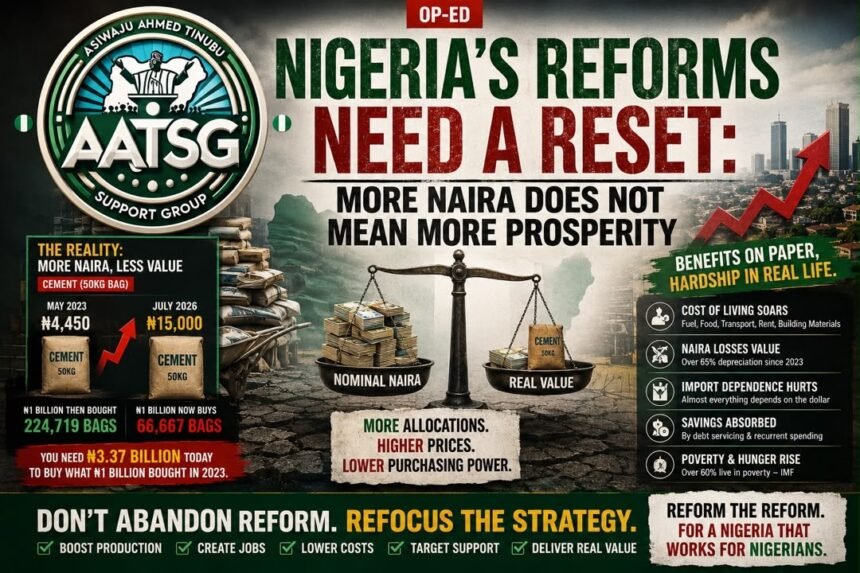
Consider something as basic as cement. Around May 2023, a 50kg bag could be purchased for approximately ₦4,000–₦5,500 depending on brand and location. By 2026, prices in many markets had climbed to ₦10,000–₦15,000 (and even higher in some locations).
At ₦4,450 per bag, ₦1 billion could buy approximately 224,719 bags. At ₦15,000 per bag, that same ₦1 billion buys only about 66,667 bags. To purchase today the same quantity of cement that ₦1 billion could purchase at ₦4,450 would require approximately ₦3.37 billion.
That’s the gap between nominal money and real economic value. If a state government’s allocation increased from ₦1 billion to ₦2 billion, officials could truthfully announce that revenue has doubled. Measured in cement purchasing power, that government could actually be poorer.
Cement is especially revealing because Nigeria possesses substantial domestic production capacity, roughly 60–65 million tonnes annually against domestic consumption of about 25–30 million tonnes, and is a net exporter. Yet energy, transportation, financing, foreign-exchange exposure for equipment and spares, and market structure still feed into the final price. The lesson goes well beyond cement: it applies to roads, houses, food, medicines, transportation, electricity, and virtually everything Nigerians buy.
The Nigerian Family Does Not Live Inside a Macroeconomic Spreadsheet
Suppose a Nigerian earned ₦100,000 monthly in 2023 and now earns ₦150,000, or the national minimum wage rose from ₦30,000 to ₦70,000. His salary has increased. But if food has more than doubled, transportation has multiplied, electricity and rent have risen, and building materials have doubled or tripled, has that Nigerian become richer? Clearly not. He has more naira but less purchasing power.
That is exactly why economic reform cannot ultimately be judged merely by FAAC allocations, foreign reserves, capital inflows, stock-market performance, or nominal GDP. Those indicators matter. Still, an economy exists for people. The Nigerian mother buying food, the farmer purchasing fertiliser, the transporter buying petrol, the businessman importing machinery, and the family trying to build a house all experience economics every single day.
Devaluation Without Production Is Dangerous
Currency depreciation is not inherently disastrous. In a productive economy, a competitive currency can stimulate exports. Domestic products become cheaper internationally. Factories expand. Exports rise. Employment increases. Foreign-exchange earnings grow. But there is one indispensable requirement: you must produce.
If Nigeria manufactured substantially more machinery, pharmaceuticals, processed foods, agricultural equipment, electrical products, textiles, vehicle components, petrochemicals, and consumer goods, a weaker naira could potentially stimulate exports. Historical experience shows that successful industrialisers paired competitive exchange rates with deliberate capacity-building.
South Korea’s Heavy and Chemical Industry drive of the 1970s targeted steel, shipbuilding, electronics, petrochemicals, machinery, and non-ferrous metals. The government provided directed finance, infrastructure, and export discipline while private firms operated the plants. Within a decade, the share of heavy and chemical industries in manufacturing value-added and in exports rose sharply; per-capita income and export targets were met years ahead of schedule. The policy was temporary, market-tested, and focused on international competitiveness from the outset.
China’s Township and Village Enterprises (TVEs) offer an even more relevant decentralised model. From roughly 1.5 million enterprises employing about 28 million people in 1978, TVEs expanded dramatically. By the mid-1990s, employment reached a peak of around 135 million. Rural industrial output grew at average annual rates near 27 per cent in the early reform years, far faster than overall GDP. TVEs contributed roughly one-third of industrial output and a large share of exports at their height. Local governments facilitated land, infrastructure, and regulatory space; private and collective entrepreneurs ran the businesses. The result was massive job creation, rising rural incomes, and a foundation for later urban and high-tech growth.
Vietnam’s Đổi Mới reforms from 1986 shifted the country from a food importer facing shortages to one of the world’s leading rice exporters, while also building strong positions in coffee, seafood, cashew, and light manufacturing. Industrial output grew rapidly; poverty fell sharply; processing of what the country grew, combined with openness to investment and exports, transformed the economy.
In each case, macro stabilisation or liberalisation was followed by deliberate expansion of productive capacity, often decentralised, private-led, and oriented toward both domestic value-addition and global markets. Devaluation or price correction alone was never the final strategy.
In an import-dependent economy, the transmission is different: the naira depreciates → imported inputs become expensive → production costs rise → transportation rises → food prices rise → businesses increase prices → wages lose purchasing power → poverty increases. That is why Nigeria cannot devalue its way to prosperity. We must manufacture our way to prosperity.
Our Problem Is Not the Dollar, It Is Our Dependence on the Dollar
Nigeria frequently discusses the exchange rate as though the value of the naira were principally a Central Bank problem. It is not. It is fundamentally a production problem.
Why do Nigerians continuously need dollars? Because we import things. Why do businesses continuously need dollars? Because they import machinery and production inputs. Why does government continuously need dollars? Because many infrastructure projects require imported equipment.
Therefore, one of the strongest long-term ways of defending the naira is not merely intervening in the foreign-exchange market. It is reducing Nigeria’s structural demand for foreign exchange while increasing the country’s capacity to earn foreign exchange. That requires factories.
Project 20 × 774: Nigeria Produces
This is why I propose an immediate national industrialisation programme: 20 factories × 774 LGAs = 15,480 productive enterprises.
But this must not become another government programme where Abuja builds thousands of factories, appoints political managers, and then watches the enterprises collapse after a few years. That model has failed repeatedly in Nigeria and elsewhere.
Government should create the industrial ecosystem. Private enterprise should run the businesses.
Each local government should identify twenty commercially viable production opportunities based upon:
* locally available raw materials;
* products Nigeria currently imports;
* goods Nigerians consume every day;
* agricultural commodities produced locally;
* existing skills within the community;
* domestic and regional market opportunities; and
* products capable of earning export revenue.
The twenty factories in Ijebu-Ode should therefore not necessarily be the same as the twenty factories in Kano, Aba, Sokoto, Calabar, Maiduguri, or Yenagoa. Every LGA should industrialise around its comparative advantage, exactly the principle that allowed China’s TVEs and Vietnam’s agro-processing clusters to scale.
Produce What We Import
Nigeria imports enormous quantities of products that Nigerians can progressively manufacture domestically. Project 20 should therefore prioritise sectors such as food processing, pharmaceuticals and medical consumables, textiles and garments, leather products, furniture, soaps and detergents, packaging materials, plastics, agricultural equipment, spare parts, electrical products, and building materials.
Nigeria should not merely ask, “What can we manufacture?” We should begin with another question: “What are Nigerians currently spending scarce foreign exchange importing that Nigerian businesses can competitively produce?” Every successful answer represents potential foreign-exchange savings, the same logic that guided Korea’s and Vietnam’s early industrial priorities.
Process What We Grow
Nigeria’s agricultural problem is not simply insufficient farming. It is insufficient value addition. We export or sell agricultural commodities cheaply and then purchase processed products at significantly higher prices. That must change.
Cassava-producing areas should have starch, flour, ethanol, and industrial processing. Tomato-producing areas should have tomato-processing plants. Oil-palm areas should produce refined oils and downstream products. Livestock-producing areas should have modern meat, leather, dairy, and feed industries. Fishing communities should have cold storage, aquaculture, and seafood-processing facilities. Cocoa-producing areas should progressively manufacture cocoa butter, powder, beverages, and finished chocolate products.
Vietnam’s transformation from rice importer to major exporter, and China’s rural processing boom, both rested on keeping larger portions of the value chain inside the country. The objective for Nigeria must be the same.
Export What the World Buys
Project 20 must not become another import-substitution programme that produces expensive goods protected permanently from competition. The ultimate ambition must be exports.
Every participating enterprise should have a pathway from Local Market → Nigerian Market → African Market → Global Market. The African Continental Free Trade Area gives Nigeria access to an enormous continental marketplace. Our ambition should therefore go beyond Made in Nigeria for Nigerians. It must become Made in Nigeria for the World, the same outward orientation that turned Korean and Vietnamese factories into engines of foreign-exchange earnings.
Attack the Foreign-Exchange Problem from Both Sides
Nigeria’s FX problem can be simplified into two forces: dollars demanded versus dollars earned. Import substitution reduces dollar demand. Exports increase dollar supply. That means Project 20 attacks the foreign-exchange problem from both directions at once.
Nigeria has spent decades trying to defend the naira primarily through monetary policy. We must now defend it through production policy, as China, Korea, and Vietnam ultimately did.
Millions of Jobs Could Be Created
Consider the potential scale. If 15,480 productive enterprises generated an average of only 100 direct jobs, 1,548,000 direct jobs could potentially emerge when the programme reaches maturity. If every direct manufacturing job supported additional employment through farming, transportation, logistics, packaging, maintenance, distribution, retail, and services, the wider employment ecosystem could run into several million jobs.
These figures are scenarios, not guaranteed forecasts. Some factories would employ fewer people; others would employ hundreds or thousands. China’s TVEs demonstrated that decentralised rural industry can absorb tens of millions of workers. Korea’s industrial drives created the manufacturing employment base of a modern economy. The potential scale of a well-executed Project 20 is extraordinary.
Industrialise the Local Government
Perhaps the greatest strategic advantage of Project 20 is geographical. Nigeria’s economic activity is excessively concentrated in a handful of cities. Young Nigerians consequently migrate from rural communities and smaller towns because economic opportunities are limited.
Imagine instead 15,480 productive enterprises distributed across Nigeria’s 774 LGAs. Farmers would have processors closer to their farms. Transportation losses would decline. Local supply chains would emerge. Property markets would develop. Technical skills would grow. LGAs would expand their tax bases. Young Nigerians could find productive employment closer to their communities. Economic development would begin moving from the bottom up. That is genuine federal economic development, the same spatial logic that powered China’s rural industrialisation.
Government Should Enable, Not Run the Factories
Government should not attempt to own 15,480 companies. Its responsibilities should include: serviced industrial land, reliable embedded electricity, water, roads, broadband, security, waste-management infrastructure, long-term manufacturing finance, export support, technical training, clear land titles, and stable regulation.
Private investors, cooperatives, Nigerian entrepreneurs, diaspora investors, and international technical partners should own and operate the enterprises. Every factory must survive the market test, precisely the arrangement that allowed Korean chaebols and Chinese TVEs to scale under government-enabled but privately operated models.
Five Questions Before One Naira of Public Support
Every Project 20 proposal should answer:
1. What does Nigeria currently import that this factory will replace?
2. What Nigerian raw material will it transform?
3. Who will purchase the product?
4. Can it compete on quality and price without permanent subsidy?
5. Can it eventually earn foreign exchange?
Projects unable to answer these questions should not receive government support simply because political interests want factories in particular constituencies. Project 20 must be economics-driven, not politically allocated.
Give Nigerians Something Tangible for Their Sacrifice
This brings us back to subsidy removal. Nigerians were asked to endure substantial economic pain because government argued that the old subsidy arrangement was unsustainable. If that sacrifice creates additional fiscal space, then part of that capacity should finance productive infrastructure capable of permanently changing the economy.
Instead of merely announcing that states and local governments are receiving record allocations, imagine telling Nigerians: Every Local Government Area will receive the infrastructure required to establish twenty productive enterprises based on its economic advantages. That is something citizens can see: factories, jobs, products, exports, skills, electricity, industrial clusters, agricultural processing, and local economic development. That begins converting sacrifice into productive assets.
States and Local Governments Must Participate
Project 20 cannot be another Abuja-only programme. The Federal Government should establish the national framework. States should provide industrial infrastructure and investment coordination. LGAs should identify economic opportunities, provide appropriate land, and support local supply chains. Private investors should provide capital, management, and market discipline. Development-finance institutions should provide long-term capital. Universities, polytechnics, and technical colleges should provide skills and technology. The diaspora should be deliberately recruited as investors and technical partners. It should become a national production compact.
Stop Measuring Success Only in Trillions of Naira
Nigeria needs a new economic scoreboard. Government should publish not merely how much FAAC increased, but:
* How many factories opened.
* How many factories survived.
* How many jobs were created.
* How much Nigeria’s import bill fell.
* How much non-oil export revenue increased.
* How many locally produced goods replaced imports.
* How much household purchasing power improved.
* How much real manufacturing output increased.
* How many Nigerian products entered African and global markets.
That is how we should measure reform, the same practical metrics that guided successful industrialisers.
Reform the Reform
President Bola Ahmed Tinubu’s administration has undertaken reforms requiring considerable political courage. But courage in beginning reforms must be matched by courage in reviewing them. Policy review is not policy failure. Government should retain reforms that are producing results, correct those producing unintended consequences, and introduce the productive policies necessary to translate macroeconomic stability into household prosperity.
The first phase of reform concentrated substantially on subsidy, exchange rates, revenue, debt, and monetary stability. The next phase must concentrate relentlessly on production, industrialisation, jobs, exports, and purchasing power.
From Managing Scarcity to Creating Abundance
Nigeria cannot indefinitely manage poverty through palliatives. We cannot keep distributing rice while importing what our people could manufacture. We cannot defend the naira indefinitely while maintaining enormous demand for foreign currency. We cannot keep celebrating higher allocations while those allocations purchase progressively fewer goods. And we cannot build prosperity simply by distributing increasingly larger quantities of a depreciated currency.
Nigeria needs to produce. Factories create products, jobs, skills, supply chains, exports, and tax revenues. They reduce imports, bring technology, strengthen communities, and can ultimately strengthen the naira. That is why Project 20 × 774 should become a central pillar of Nigeria’s next economic strategy. The economic equation should be simple:
Import less. Produce more. Export more.
The question before government should no longer merely be, “How many trillions of naira are we distributing?” It should be: “What can those trillions actually buy, what are Nigerians producing, what are we exporting, and are Nigerian families becoming materially better off?”
Nigeria does not merely need more naira. Nigeria needs a naira that buys more. Nigeria does not merely need higher government revenue. Nigeria needs an economy that produces more. Nigeria does not merely need reforms that look successful on paper. Nigeria needs reforms that Nigerians can actually feel in their homes, businesses, communities, and pockets.
The first phase of reform asked Nigerians to sacrifice. The next phase must enable Nigerians to produce.
And that next phase should begin immediately:
PROJECT 20 × 774
20 factories in every Local Government.
15,480 productive enterprises.
Produce what we import. Process what we grow. Export what the world buys.
That is how Nigeria can move from managing scarcity to creating prosperity, following the path that successful industrialisers took when they turned stabilisation into nationwide production.
Signed
Otunba (Dr) Abdulfalil Abayomi Odunowo
National Chairman AATSG
Asiwaju Ahmed Tinubu support group
Friday 21st of August 2026.