
By Okoi Obono-Obla
Towards Equilibrium: Rebalancing Power in Nigeria’s Three-Tier Federal System
Nigeria is a constitutional federation comprising 36 States and the Federal Capital Territory, Abuja. It operates a three-tier constitutional structure: the Federal Government, State Governments, and Local Governments.
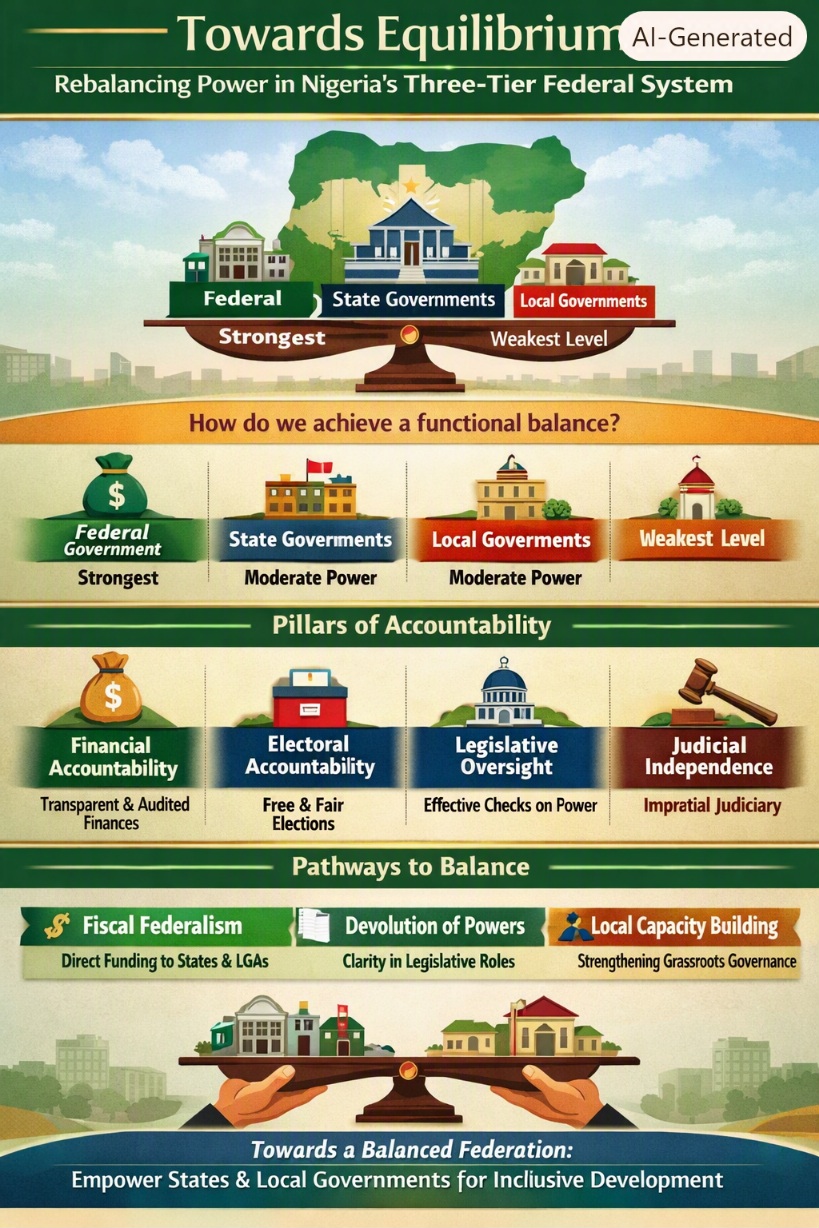
The Federal Government, as a single entity, remains the strongest of the three tiers. The State Governments are robust and rank next in strength, while the 774 Local Governments are the weakest, both structurally and financially. This structural imbalance poses a significant challenge to effective governance and even development.

The Challenge of Equilibrium
The central question is: how do we achieve equilibrium among these three tiers of government? How do we ensure that each tier is sufficiently empowered to perform its constitutional functions optimally without encroaching on the responsibilities of the others?
Achieving this balance requires more than mere constitutional declarations. It demands deliberate constitutional safeguards and practical mechanisms for cooperation. Equilibrium does not mean equality of status, but rather a functional balance where no tier is so weak that it cannot deliver on its mandate, and no tier is so strong that it subsumes the others.
Ensuring Accountability as a Foundation for Balance
Balance is impossible without accountability. To strengthen governance and make federalism work, accountability must be enforced across all tiers:
• Financial Accountability: There must be transparent allocation and utilization of resources, with independent and effective auditing mechanisms for all tiers, particularly for Local Governments where leakages are most acute.
• Electoral Accountability: Free, fair, and credible elections must be guaranteed at all levels to ensure legitimacy. The current system where State Governments largely control Local Government elections fundamentally undermines grassroots democracy and autonomy.
Legislative Accountability: The oversight functions of the National Assembly and State Houses of Assembly must be exercised effectively to check executive excesses and prevent fiscal abuse.
• Judicial Accountability: An independent judiciary must remain the impartial arbiter that safeguards constitutional boundaries and resolves disputes between the tiers of government, as recently affirmed by the Supreme Court on Local Government autonomy.
Pathways to a Balanced Federation
To move from imbalance to equilibrium, Nigeria must pursue a multi-pronged reform agenda:
1. Entrenching Fiscal Federalism: The revenue-sharing formula must be reviewed to give States and Local Governments greater financial autonomy. Local Government allocations should be paid directly from the Federation Account, free from State interference, with strict sanctions for diversion.
2. Constitutional Clarity and Devolution: Responsibilities in the Exclusive and Concurrent Legislative Lists must be clearly delineated to prevent overlap and encroachment. More importantly, there must be a gradual devolution of powers from the centre to the States and Local Governments on matters best handled locally, such as aspects of policing, basic education, and primary healthcare.
3. Capacity Building at the Local Level: Autonomy without capacity is hollow. Strengthening Local Governments requires deliberate investment in human capital through training, infrastructure development, and institutional reforms that promote professionalism and service delivery.
4. Institutionalizing Intergovernmental Cooperation: Ad-hoc relationships breed suspicion. Mechanisms for dialogue and collaboration, such as a formal Intergovernmental Relations Council, should be institutionalized to foster negotiation, joint planning, and conflict resolution among the three tiers.
Conclusion
Nigeria’s federalism will remain lopsided unless we consciously correct its structural and fiscal distortions. The goal is not to weaken the Federal Government, but to empower the other tiers to become effective partners in development. A federation where the centre is overburdened and the grassroots are enfeebled cannot deliver inclusive growth.
True equilibrium will only be achieved when financial autonomy is matched with electoral integrity, constitutional clarity, institutional capacity, and respect for the rule of law. That is the pathway to a balanced, functional, and enduring Nigerian federation.