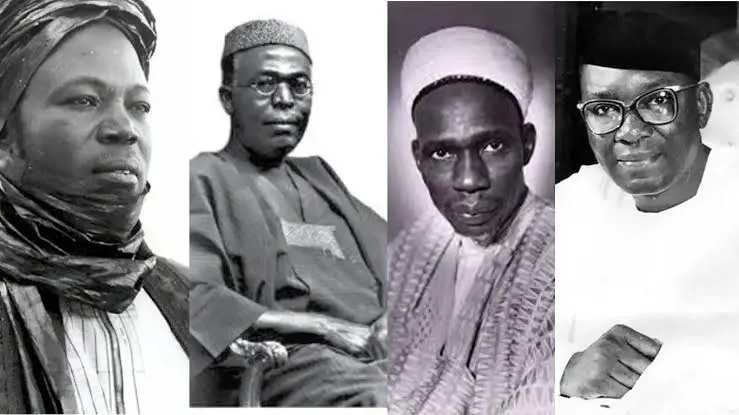
By Ibrahim Bunu
Email: ibrahimbunu2520@gmail.com
Introduction: The Federation That Created Three Prime Ministers Instead of One Nation
History often remembers the January 15, 1966 military coup as the event that destroyed Nigeria’s First Republic. However, a deeper examination reveals that the coup was not the beginning of Nigeria’s crisis—it was the consequence of years of unresolved structural contradictions embedded within the constitutional framework inherited at independence.

When Nigeria became independent on 1 October 1960, the country adopted the British Westminster Parliamentary System. While this system had functioned successfully in Britain, it operated very differently in Nigeria because the federation consisted of three enormously powerful regions:
* Northern Region
* Western Region
* Eastern Region
Each region possessed:
* Its own Premier
* Its own legislature
* Its own civil service
* Its own police influence
* Its own economic base
* Its own political party
* Its own regional identity
Although there was a federal government in Lagos headed by a Prime Minister, real political power was largely concentrated inside the regions.
This constitutional arrangement unintentionally created three competing centres of political authority, each believing that controlling the federation was both possible and legitimate.
Nigeria was therefore born with one federal government but three governments powerful enough to aspire to replace it.
This structural contradiction became the defining weakness of the First Republic.
The Fundamental Constitutional Defect
The greatest weakness of the First Republic was not ethnicity alone.
It was institutional design.
The Westminster model assumed:
* mature political institutions,
* long-established democratic traditions,
* high levels of national identity,
* and political actors willing to lose elections without destroying the system.
Nigeria possessed none of these conditions.
Instead, politics was organized around large regional blocs, each with distinct historical experiences, economic interests, and ethnic majorities.
The constitution therefore created what political scientists might describe as a “multiple-centre federation”, where regional authority rivalled federal authority.
Rather than encouraging national integration, the political system rewarded regional consolidation.
Every election became a struggle not merely to govern but to determine which region would dominate the federation.
The Three Premiers and Their Competing National Projects
Although history often simplifies events into ethnic rivalry, each regional leader pursued a distinct strategy for national leadership.
Northern Strategy: Demographic Power
The Northern Region possessed one overwhelming advantage:
Population.
Under parliamentary democracy:
More people meant more parliamentary seats.
More parliamentary seats meant:
* larger legislative influence,
* greater control over federal government formation,
* increased access to federal resources,
* stronger bargaining power.
Northern political leaders therefore emphasized:
* population strength,
* political unity,
* preservation of the federation,
* gradual constitutional change.
Their confidence rested on the belief that demographic superiority would eventually secure permanent influence at the federal level.
Western Strategy: Economic Superiority
The Western Region lacked the North’s numerical advantage.
Instead, it relied upon economic strength.
The region generated enormous wealth through:
* cocoa exports,
* agricultural modernization,
* industrial investments,
* educational expansion,
* infrastructure development.
Its leaders believed that:
economic performance could become political legitimacy.
If one region consistently demonstrated better governance and development, it could persuade Nigerians to support national leadership based upon competence rather than population.
For a period, this appeared achievable.
However, internal political rivalries eventually destroyed the West’s greatest advantage.
The Action Group split into competing factions.
Personal rivalries became constitutional crises.
The region entered prolonged political instability.
Eventually the Federal Government declared a State of Emergency.
Thus the strongest regional model became internally fractured.
Eastern Strategy: Coalition Building
The Eastern Region understood that demographic competition with the North was difficult.
Instead, Eastern political leaders developed a different approach.
They pursued:
* alliances with minority ethnic communities,
* partnerships across regional boundaries,
* coalition politics,
* federal negotiations.
The objective was straightforward:
If population alone could not win federal power, alliances might.
This strategy reflected sophisticated political thinking but also depended upon maintaining fragile relationships among diverse groups whose interests were not always identical.
The Centre Became the Ultimate Prize
The federation increasingly resembled three competitors approaching the same destination through different roads.
Each believed:
* history favoured them,
* constitutional mechanisms would eventually deliver victory,
* compromise could wait.
Consequently:
Federal politics became a zero-sum competition.
Winning meant controlling:
* federal appointments,
* national revenue,
* defence,
* foreign policy,
* economic planning,
* constitutional amendments.
Losing meant exclusion.
This transformed ordinary democratic competition into an existential struggle.
The Census Crisis: When Numbers Became Weapons
Few events demonstrate the structural weakness of the First Republic more clearly than the 1962–1963 census controversy.
Population figures determined:
* parliamentary seats,
* revenue allocation,
* political legitimacy,
* regional prestige,
* future constitutional influence.
Every region therefore possessed enormous incentives to challenge unfavourable results.
Instead of functioning as neutral statistics,
population became political ammunition.
The census evolved into a battle over power rather than people.
Public trust in federal institutions declined dramatically.
Many Nigerians concluded that national institutions could no longer act impartially.
The Minority Question
Another unresolved constitutional issue involved minority ethnic communities.
Many feared permanent domination by larger regional majorities.
The Willink Commission (1957–1958)—often mistakenly referred to as the Wing Commission—was established to examine these concerns.
Although it acknowledged genuine fears, it largely recommended safeguards rather than creating additional states.
This decision temporarily postponed rather than resolved minority grievances.
The result was continued anxiety over representation and political inclusion.
Regional Economic Competition and Revenue Hoarding
Each region controlled significant internally generated resources.
Instead of strengthening national integration,
economic success encouraged regional self-confidence.
Regions increasingly prioritised:
* protecting local revenues,
* financing regional development,
* competing economically,
* expanding regional institutions.
This weakened national fiscal cohesion.
Rather than asking,
“How can Nigeria become stronger?”
politicians increasingly asked,
“How can my region become stronger than the others?”
Western Region Crisis: The Federation Begins to Break
The Western Region eventually descended into severe political conflict.
Legislative chaos,
party fragmentation,
public violence,
and constitutional disputes undermined confidence in civilian government.
The crisis demonstrated an important lesson:
A region could collapse internally even without external attack.
The instability further convinced many Nigerians that democratic institutions were becoming incapable of resolving political disputes peacefully.
Identity Politics Replaced National Politics
As institutional confidence declined,
political debates increasingly shifted from policy to identity.
Questions changed from:
* Which policies produce development?
to:
* Which region controls government?
* Which ethnic group gains appointments?
* Who controls federal resources?
* Which community benefits most?
This transformation proved deeply damaging.
Identity gradually replaced ideology.
Suspicion replaced cooperation.
Regional loyalty increasingly overshadowed national citizenship.
The Security Vacuum
Political paralysis produced wider consequences.
As civilian institutions struggled,
confidence in constitutional governance weakened.
The military increasingly viewed itself as:
* disciplined,
* national,
* efficient,
* capable of restoring order.
Whether that perception was accurate remains debated.
However,
many officers concluded that politicians had become incapable of governing effectively.
The political crisis therefore created the conditions under which military intervention became imaginable.
January 15, 1966: The Coup
The military officers who struck on 15 January 1966 justified their intervention by pointing to:
* corruption,
* electoral malpractice,
* political violence,
* regional conflict,
* governmental paralysis.
Although the coup quickly generated its own controversies—including the perception that it disproportionately targeted Northern political leaders and thereby deepened ethnic mistrust—it did not arise in a political vacuum.
It emerged from years of institutional strain, declining trust, and escalating constitutional crises.
Thus,
the coup should be understood as a symptom of a collapsing political order rather than its sole cause.
The Structural Lessons
The First Republic teaches several enduring lessons.
First: Institutions shape political behaviour.
Political leaders usually respond to incentives created by constitutional systems.
If institutions reward regional consolidation,
leaders will strengthen regions.
If institutions reward national cooperation,
leaders will pursue broader coalitions.
Second: Ambition is normal.
The problem was never that regional leaders desired national leadership.
The problem was that the constitutional system encouraged competing regional ambitions without creating sufficient incentives for compromise.
Third: Democracy requires trusted national institutions.
When citizens lose confidence in:
* elections,
* census processes,
* courts,
* legislatures,
* constitutional arbitration,
political conflict increasingly shifts outside democratic channels.
Fourth: Economic success alone cannot preserve political stability.
Even prosperous regions remain vulnerable if political institutions deteriorate.
Development without institutional trust cannot sustain democracy indefinitely.
How Modern Nigeria Responded
Many constitutional changes introduced after the First Republic sought to reduce these structural dangers.
Among them were:
* Creation of additional states to weaken the dominance of the original regions.
* Replacement of the Westminster parliamentary model with the presidential system in 1979, creating a single nationally elected executive.
* Federal Character Principle to promote inclusion in public appointments.
* Constitutional requirements for broad geographical electoral support, encouraging presidential candidates to seek votes across multiple states rather than relying on one region.
* Informal zoning and power-sharing arrangements, intended to reduce perceptions of permanent regional exclusion.
These reforms did not eliminate political competition, but they attempted to make it more nationally inclusive and less regionally concentrated.
Contemporary Lessons
The history of the First Republic remains highly relevant.
Whenever:
* regional identity becomes stronger than national identity,
* political power is viewed as something to be captured rather than shared,
* constitutional institutions lose public trust,
* census, elections, or revenue allocation become sources of permanent suspicion,
* compromise disappears from political culture,
the structural dynamics that destabilized the First Republic begin to re-emerge.
History therefore serves not merely as memory but as warning.
Conclusion: Institutions Matter More Than Individuals
The collapse of Nigeria’s First Republic cannot be adequately explained by blaming one region, one ethnic group, one political party, or one individual.
The deeper explanation lies in the interaction between constitutional design, regional political incentives, economic competition, institutional weaknesses, and elite ambition.
The three premiers were not simply rivals.
They were political actors operating within a federation whose structure encouraged regional consolidation while leaving the national centre permanently contested.
Their ambitions were understandable.
The constitutional incentives were powerful.
The tragedy was that the system offered few effective mechanisms for transforming competition into sustainable national cooperation.
The January 1966 coup was therefore not merely the failure of politicians—it was the failure of institutions designed without sufficient safeguards for a deeply diverse federation.
For modern Nigeria, the enduring lesson is unmistakable:
Strong democracies are built not only by good leaders but by constitutional systems that reward cooperation, restrain zero-sum competition, protect minorities, and make national unity more politically rewarding than regional domination.
Only when institutions consistently achieve these goals can democracy become resilient enough to withstand the ambitions of those who seek power.