By Okoi Obono-Obla
Introduction
For decades, the origin of the Yakurr people has been debated in Cross River historiography. In his seminal work Yako Studies (1964), Professor Daryll Forde, who conducted fieldwork in Umor (Ugep) in 1935-36, stated that Yako origin was in Eastern Ejagham. What did he mean? This article, drawing on Forde, on the foremost Yakurr historian Dr. Otu Abam Ubi, and on living spiritual evidence of Ekpe, Nsibidi, Obam and Ojilikpoto, argues that Yakurr came from Ejagham stock. Language shift occurred in a new environment, but the ancestral tongue survives as Lotung.
1. Forde and Eastern Ejagham

In colonial anthropology, Ejagham was divided into Western Ejagham (Ikom, Etung, Akamkpa, Odukpani, Qua in Nigeria) and Eastern Ejagham (Manyu Division, South West Region, Cameroon, around Mamfe, Eyumojock).
Forde recorded the Yakö tradition that their forebears all came from the east together with the people of Okuni, a settlement some fifty miles away up the Cross River. That east, Yakurr call Akpa or Lekanakpakpa.
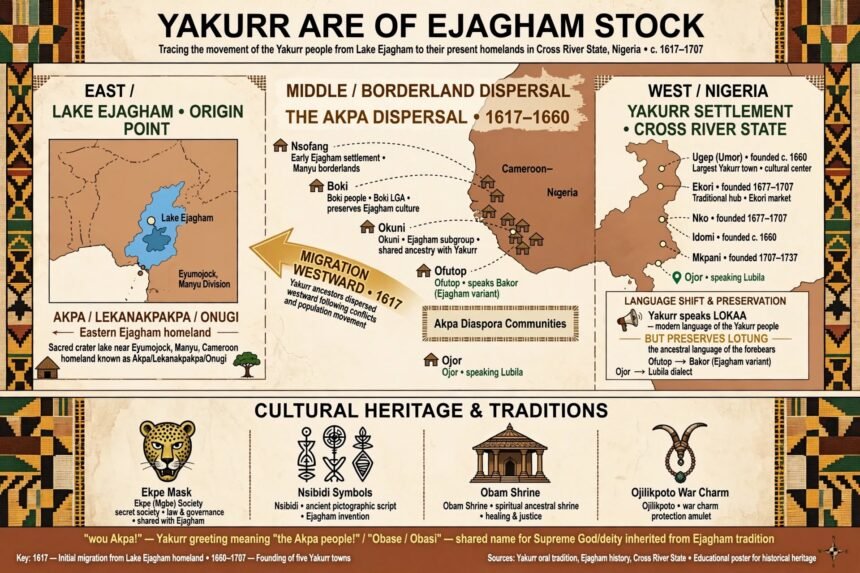
Modern research locates Akpa precisely: it corresponds to the area around Lake Ejagham, near Eyumojock in Manyu Division, South West Region, Cameroon. Lake Ejagham is classified as a sacred lake and is central to Ejagham cosmology. Manyu is widely recognized as the core homeland of the Ejagham people, a group whose communities today straddle both Cameroon and Nigeria.
Thus, Forde’s Eastern Ejagham is a geographic translation of Yakurr oral tradition – the migratory origin lies in the Ejagham heartland.
2. Otu Abam Ubi: Nsofang is the Akpa People
Dr. Otu Abam Ubi, Yakurr historian, PhD History University of Lagos 1978, in his definitive work The Yakurr of the Middle Cross River Region 1600-1950 (International Edition, 2019), provides the link.
Ubi asserts: the ancestral home of Yakurr was at Lekanakpakpa. Ubi further asserted that Ikom people called Lekanakpakpa Onugi, that information gotten from Okuni traditions confirmed that the Yako were their neighbour at Onugi, that they too migrated from the area.
Ubi further records the Ugep tradition: that Yako, Okuni, Boki, Nsofang were living in Akpa country but an internal dissension led to a fight that scattered that country.
Who is Nsofang today? Nsofang is in Etung LGA, classified as Ejagham. Etung is part of Western Ejagham, but its origin is Manyu – Eastern Ejagham. This borderland zone has historically been a cradle and dispersal point for many groups including Nsofang, Ikom and Olulumo, Biase and others.
In Yakurr tradition, as I have argued, the Akpa people are the Ejagham people, and there is little doubt about that. Nsofang is therefore the living remnant of Akpa among us.
3. The Burial Dispute as Evidence of Kinship
Yakurr trace their origins to Akpa, which oral traditions describe as their ancestral homeland. According to these traditions, the Yakurr began leaving Akpa around AD 1617 after a dispute with neighbouring groups over a burial custom led to war and forced them from their homeland.
The critical point is sociological: in African social structure, you cannot share burial rites with a people you do not share kinship with. Burial presupposes shared earth shrine, shared ancestral invocation, shared sacred medicine.
The Yakurr evidence is overwhelming:
When Yakurr chiefs pray, they begin with wou akpa!
Yakurr refer to God as Obase, Ejagham refer to Obasi in Obasi-njom, an Ejagham spiritual, judicial and healing institution whose origin is traced to the Mbinda and Okuri areas within the Ejagham-Manyu landscape.
Njom remains a common personal name among the Yakurr, a linguistic and cultural resonance which Prof. Sandy Ojang Onor notes as evidence of historical contact when he says Yakurr romances Ejagham.
A quarrel over burial therefore proves prior ritual co-residence, not strangeness. It was fission within a kin group.
4. Language Shift and the Survival of Lotung
After their migration from Akpa or Lekanakpakpa, the Yakurr founded five communities: Umor (Ugep), Ekori, Nko, Idomi and Mkpani. This migration occurred over several generations, with Mkpani, Idomi and Ugep founded around 1660 and Ekori and Nko between 1677 and 1707.
In this new Middle Cross River environment, the Yakurr encountered Bahumono, Mbembe and other groups. The language spoken by the Yakurr today is Lokạạ, an Upper Cross River language.
My conclusion: Yakurr came from Ejagham stock but language shift occurred due to new environment.
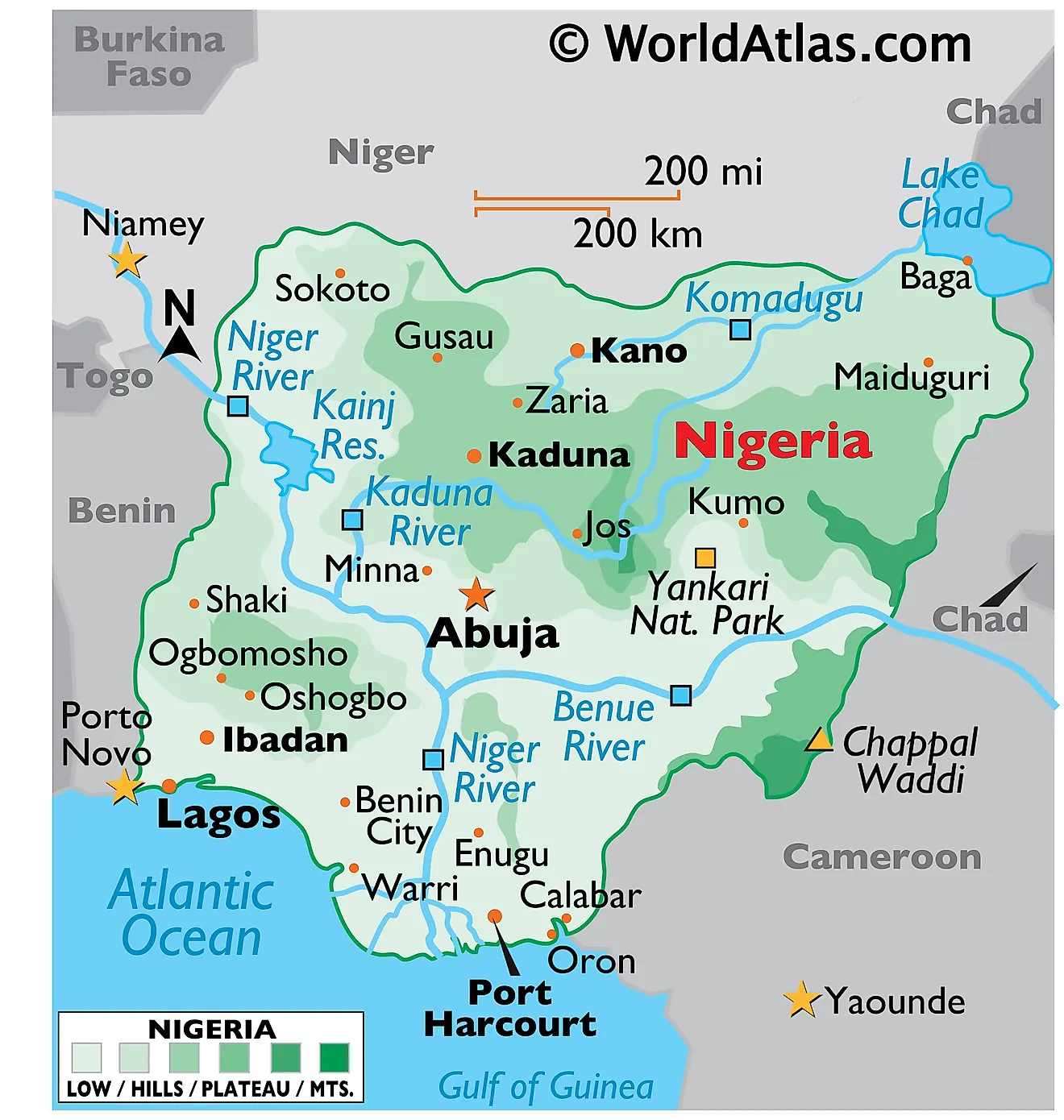
The Ejagham in Cross River State stretch from Qua in Calabar to Odukpani and Bakassi to Akamkpa, Etung and Ikom. In different environments, same stock speaks different languages today.
But we preserved the original. We call it Lotung. When I asked my grand uncle what Lotung is, he told me: It is the language of our ancestors.
Lotung is used in esoteric rites of Ekpe and Obol Lopon. It is not Lokạạ. It is the archive of our Ejagham origin, retained for sacred purposes. This mirrors other Akpa footprints: Abakpa in Ojor-Akamkpa, Akpa-Okoyong in Odukpani, Ikot Akpa in Bakassi, Atakpa (Ata-Akpa, King of Akpa) as former name of Calabar, and Calabar called Akwa Akpa by Efik before Portuguese renamed it.
5. Beyond Ekpe and Nsibidi: Obam and Ojilikpoto – The War Medicine of Akpa
If language can shift, war medicine does not lie.
Yakurr today still share with Ejagham:
Ekpe (Nkpe) – graded in ranks, known in Cross River as instrument of law and governance. Among Ugep (Yakurr), the highest order is Ekpogara, same institution that in Ejagham is the supreme lodge.
Nsibidi – the sacred ideograms. The Ekoi are best known for their Ekpe headdresses and the Nsibidi ideograms. The Ejagham are widely believed to be the creators of the Nsibidi ideograms and still use them as part of their tradition.
Obam – the great Ejagham deity of justice, oath and war. Obam is not a borrowed god. In Etung, Akamkpa, Ikom and Manyu, Obam is the final arbiter. Yakurr also have Obam shrines and swear by Obam in land disputes, same as Ejagham.
But the most telling is Ojilikpoto.
Ojilikpoto is a powerful charm for self-protection in battle – to make the body impenetrable to bullet, machete and arrow. Both Ejagham warriors in Manyu and Yakurr warriors in Ugep, Ekori and Idomi used Ojilikpoto in pre-colonial wars. The incantations for Ojilikpoto are not in Lokạạ. They are in that older tongue – Lotung – which my grand uncle rightly called the language of our ancestors.
In Cross River cosmology, war medicine is never shared with a stranger. You share Ekpe with an ally. You share Obam with a confederate. But you share Ojilikpoto only with blood, because its efficacy comes from the earth shrine of your origin – Akpa.
That is why Nsofang – who Ubi says is Akpa people – also has Ojilikpoto. That is why Ugep, Nsofang and Ikom can sit together and recognize each other’s Ojilikpoto.
Forde did not record Ojilikpoto in 1935 because colonial officers forbade war juju. But had he followed the trail of Ekpe and Nsibidi further, he would have found Ojilikpoto as the third proof.
6. The Final Proof: Ojor, Ofutop, Boki, Okuni – One People, Many Languages After Leaving Akpa
The most powerful evidence that migration from Akpa or Ongui to a new environment resulted in language shifts comes from peoples who lived together as one people in Akpa Kingdom and migrated together.
The Ojor people of Akamkpa Local Government Area of Cross River State were also of Yakurr origin. They lived in Akpa but also migrated together from Akpa together with Ekori in the third wave of migrations. Today Ojor do not speak Lokaa which Yakurr people speak. They speak Lubila.
The Ofutop people of Ikom Local Government Area who were also living in Akpa Kingdom with Yakurr today speak a variant of Ejagham known as Bakor.
Boki, Okuni, Ekpache Nkome also speak various languages which are different from Lokaa.
If Ojor, Ofutop, Boki, Okuni, Ekpache Nkome and Yakurr all lived together in Akpa and left Akpa together, why do they speak different languages today – Lubila, Bakor, Boki, Okuni, Lokaa?
The answer is exactly my thesis: migration from Akpa or Ongui to new different environments resulted in language shifts which affected people that had lived together as one people.
Same stock, same Akpa origin, same burial kinship, same Ekpe, same Obam, same Ojilikpoto – but new ecology, new neighbours, new trade routes caused language to shift.
Yakurr shifted to Lokaa. Ojor shifted to Lubila. Ofutop retained a variant of Ejagham known as Bakor, closest to the original.
This proves that language difference today does not disprove common Ejagham stock. In fact, it proves it. If diverse languages like Lubila, Bakor, Lokaa, Boki can all come from same Akpa dispersal, then Yakurr’s Lokaa is not evidence of non-Ejagham origin. It is evidence of language shift after leaving Ejagham homeland.
And in all these groups, the sacred language – Lotung, or its equivalent – remains Ejagham.
Conclusion: We Are Akpa
Forde was right. Ubi was right. Our elders are right.
Eastern Ejagham was not a transit camp. It was our homeland. Nsofang is not a foreign group we quarreled with; Nsofang is Akpa, Akpa is Ejagham, and we are Akpa who became Yakurr.
We remain autonomous as five towns, each formerly autonomous in its political and ritual organization, yet bound by matriclans that straddle one another, allowing us to borrow an Obol Lopon from a sister town, as in the case of Obol Uket (c.1810-1835) borrowed from Ekori to Ugep.
Ojor who now speaks Lubila, Ofutop who now speaks Bakor, Boki, Okuni, Ekpache Nkome – all are witnesses that one Akpa people can become many languages, yet remain one blood.
We are Yakurr by formation, but Ejagham by stock. Lotung, Obam and Ojilikpoto are the proof.
Footnotes
1. Daryll Forde, Yako Studies (1964).
2. Ejagham in Cameroon, known also as Eastern Ejagham (EE), is part of larger Ejagham community across Nigeria-Cameroon border.
3. Ward Organization among the Yakö; common tradition that forebears all came from Okuni.
4. Akpa/Lekanakpakpa corresponds to area around Lake Ejagham, Eyumojock, Manyu Division.
5. Lake Ejagham is crater lake in Eyumojock Subdivision, classified as sacred lake central to Ejagham cosmology.
6. Manyu is widely recognized as core homeland of Ejagham people.
7. Dr. Otu Abam Ubi, PhD thesis assertion on Lekanakpakpa/Onugi/Okuni neighbour.
8. Ugep tradition: Yako, Okuni, Boki, Nsofang living in Akpa country but internal dissension scattered it.
9. Borderland zone historically cradle and dispersal point for Nsofang, Ikom and Olulumo etc.
10. Okoi Obono-Obla, The Akpa Question (2), ChatAfrik, 2 June 2026.
11. Yakurr trace origins to Akpa, began leaving around AD 1617 after dispute over burial custom.
12. The Yakurr people glowingly talk about Akpa! When Yakurr chiefs pray, they begin with the great wou akpa!
13. Obasi-njom is traditional spiritual institution, origin traced to Mbinda and Okuri areas.
14. Onor, Sandy Ojang. Shared theonyms Obasi/Obase and anthroponyms Njom.
15. After migration from Akpa, Yakurr founded five communities: Umor, Ekori, Nko, Idomi and Mkpani.
16. Language spoken by Yakurr is Lokạạ, an Upper Cross River language.
17. Ejaghams in Cross River stretch from Qua to Odukpani and Bakassi to Akamkpa, Etung and Ikom.
18. Efik called neighbouring Qua Abakpa; Calabar called Akwa Akpa.
19. Ekoi-speaking peoples (Anyang, Boki, Ejagham, Keaka, and Yako) are best known for large skin-covered masks, Ekpe is graded in ranks, and among Ugep highest order is Ekpogara.
20. Ekoi are best known for Ekpe headdresses and Nsibidi ideograms. Ejagham are widely believed to be creators of Nsibidi ideograms.
21. Yakö live in five compact villages, each formerly autonomous.
22. Dr. Otu Abam Ubi, The Yakurr of the Middle Cross River Region 1600-1950, p.279, King-list Ugep No.7: c.1810-1835 UKET.
23. Ojor of Akamkpa LGA, of Yakurr origin, lived in Akpa but migrated together with Ekori in third wave, today speak Lubila not Lokaa.
24. Ofutop of Ikom LGA, living in Akpa Kingdom with Yakurr, today speaks variant of Ejagham known as Bakor.