



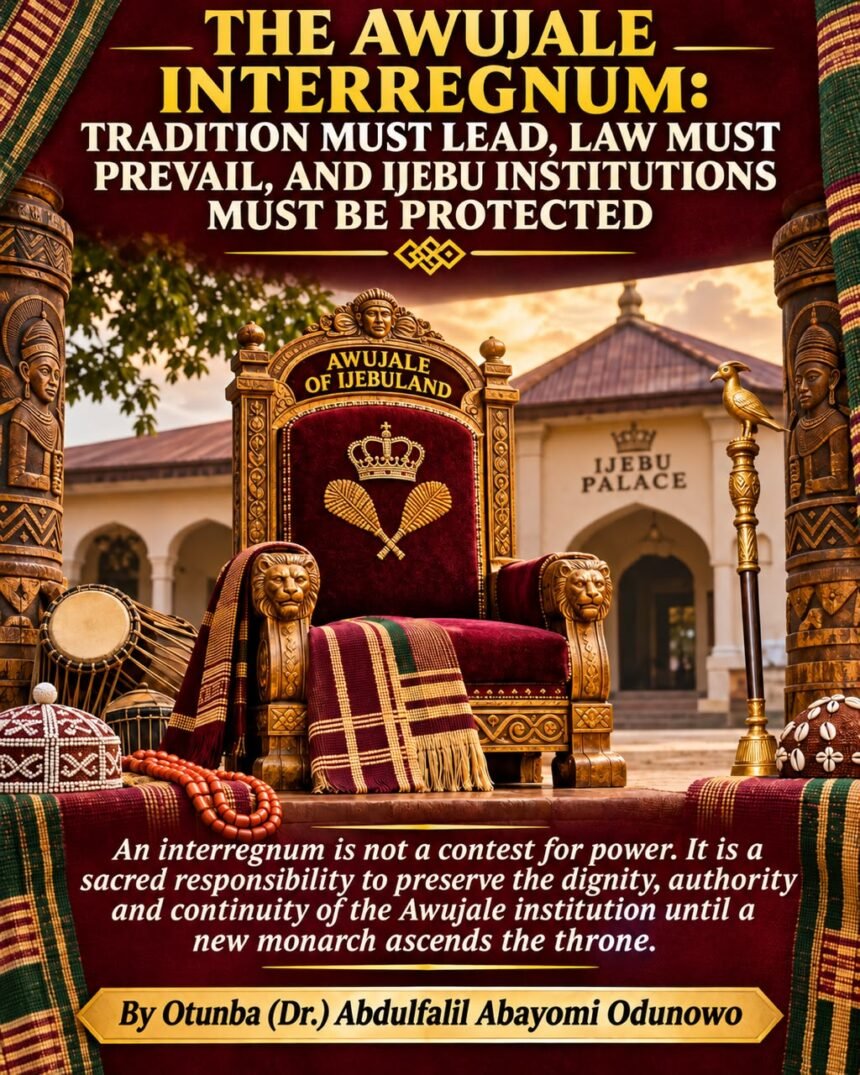
By Otunba (Dr.) Abdulfalil Abayomi Odunowo
An interregnum is not a contest for power. It is a sacred duty to preserve the dignity, authority and continuity of the Awujale institution until a new monarch ascends.
The Awujale stool is not an ordinary traditional office. It embodies centuries of Ijebu history, sovereignty, culture and institutional continuity. It has outlived individual monarchs, colonial interventions and successive constitutional orders. When an Awujale dies, the man departs; the institution must remain intact.
Following the passing of Oba Dr. Sikiru Kayode Adetona, GCON, on 13 July 2025 after a 65-year reign, Ijebuland entered interregnum. The recent decision by senior chiefs to dissolve the Awujale Interregnum Administrative Council (AIAC) and transition its members into an Adele Oba Awujale-in-Council has raised legitimate questions of customary authority, legal competence and institutional legitimacy. These questions must be answered clearly, not dismissed or exploited for division.
History has already spoken
Ijebu does not need to invent precedent. After the death of Oba Daniel Adesanya Gbelegbuwa II in 1959, a Regency Council administered affairs until the installation of Oba Adetona in April 1960. That council was chaired by the then Ogbeni-Oja of Ijebu-Ode, Chief Timothy Adeola Odutola. The arrangement worked. It preserved continuity and facilitated an orderly succession under the 1957 Awujale Chieftaincy Declaration.
This history is important. It shows that interim administration is indigenous to Ijebu political culture and that the Ogbeni-Oja has previously led such a body. It does not, however, convert a single historical instance into an automatic, perpetual right. The Olisa has long held high seniority within the Ilamuren. Both offices command respect. Neither is above the specific customary and legal rules that govern interregnum arrangements.
Authority is not assumed
An interregnum is necessary. An interregnum council is a question of authority. The vacancy of the throne does not confer on any individual or group the power to create a governing body, determine its membership or exercise the functions of the Awujale. That authority must derive from recognised custom, applicable law, or a lawful combination of both.
The Ogun State Obas and Chiefs Law and the 1957 Declaration regulate succession: the four ruling houses (Gbelegbuwa, Anikinaiya, Fusengbuwa and Fidipote), the kingmakers, and the role of government. The Declaration is clear that succession rotates. Oba Adetona came from Anikinaiya; the turn now falls to Fusengbuwa. These instruments do not, however, expressly create a standing regency council or prescribe every detail of interim administration. Customary institutions may operate within the law, but they must be traceable to recognised practice and proper procedure.
If the AIAC rested on governmental instrument, that instrument and its limits must be clear. If the Adele Oba Awujale-in-Council rests on custom, the historical and institutional basis must be demonstrated, not merely announced. Renaming a body does not, by itself, establish its lawfulness or define its powers. Questions of constitution, membership, chairmanship and any required governmental recognition remain valid and should be answered transparently.
A caretaker, not a substitute
An interregnum council is a temporary caretaker. It does not inherit the kingship. Its chairman does not become the Awujale. Its members do not acquire unlimited authority over the institution. Its proper functions are limited: preservation of royal property and records, maintenance of palace administration, coordination of traditional obligations, liaison with government, and facilitation of a peaceful, lawful succession. Permanent decisions that bind a future monarch must be approached with extreme caution. Financial administration must be transparent. The mandate must remain temporary.
Ijebu civilisation has endured because its institutions have been larger than the personalities who occupy them. The Awujale stool is not the private property of any chief, committee or contemporary authority. Disputes over seniority or interim leadership must be resolved by reference to established custom, authenticated records and lawful procedure not by assertion of influence.
What is required now
The appropriate response is documentation, consultation and transparency. The 1957 Declaration, the operative Ogun State chieftaincy legislation, the records of the 1959 Regency Council, the instrument that established the 2025 AIAC, and the resolution that produced the Adele Oba Awujale-in-Council should be examined together. From these sources the lawful and customary foundation of the present arrangement, the proper appointment process, the limits of its authority, and the conditions of its termination can be clarified.
There is no disgrace in correcting procedure where necessary. There is danger in allowing unresolved questions of authority to harden into accepted precedent. An institution of the Awujale’s standing deserves a firmer foundation than administrative assumption.
The interregnum belongs to the institution, not to individuals. The authority to lead must be established by custom and law, not presumed through influence or proclamation. Let tradition speak through authentic history. Let the law speak through its provisions. Let every decision serve one purpose: the preservation of the dignity, continuity and enduring authority of the Awujale throne.
The next Awujale must inherit a respected institution, properly preserved assets, transparent records and a traditional structure that understands the boundaries of its temporary role. He must not inherit avoidable disputes created during the vacancy. History will judge this interregnum not by the titles adopted or the prominence of those who chaired councils, but by whether the custodians of Ijebu tradition preserved the throne faithfully and handed it over intact.
Otunba (Dr.) Abdulfalil Abayomi Odunowo is Convener of the Ijebu Lokan movement, a public affairs commentator, community leader and advocate for institutional accountability, cultural preservation and equitable development.