


By Okoi Obono-Obla
Factional Crisis in ADC and Its Constitutional Implications:
The miasma and confusion that has engulfed the African Democratic Congress (ADC) starkly came to the fore on 12 July 2026. The original deadline for political parties to upload the names, personal particulars, and other relevant documents to the portal of the Independent National Electoral Commission (INEC) was 11 July 2026. However, INEC extended the deadline to 14 July 2026 to accommodate opposition political parties that failed to comply with the original date.
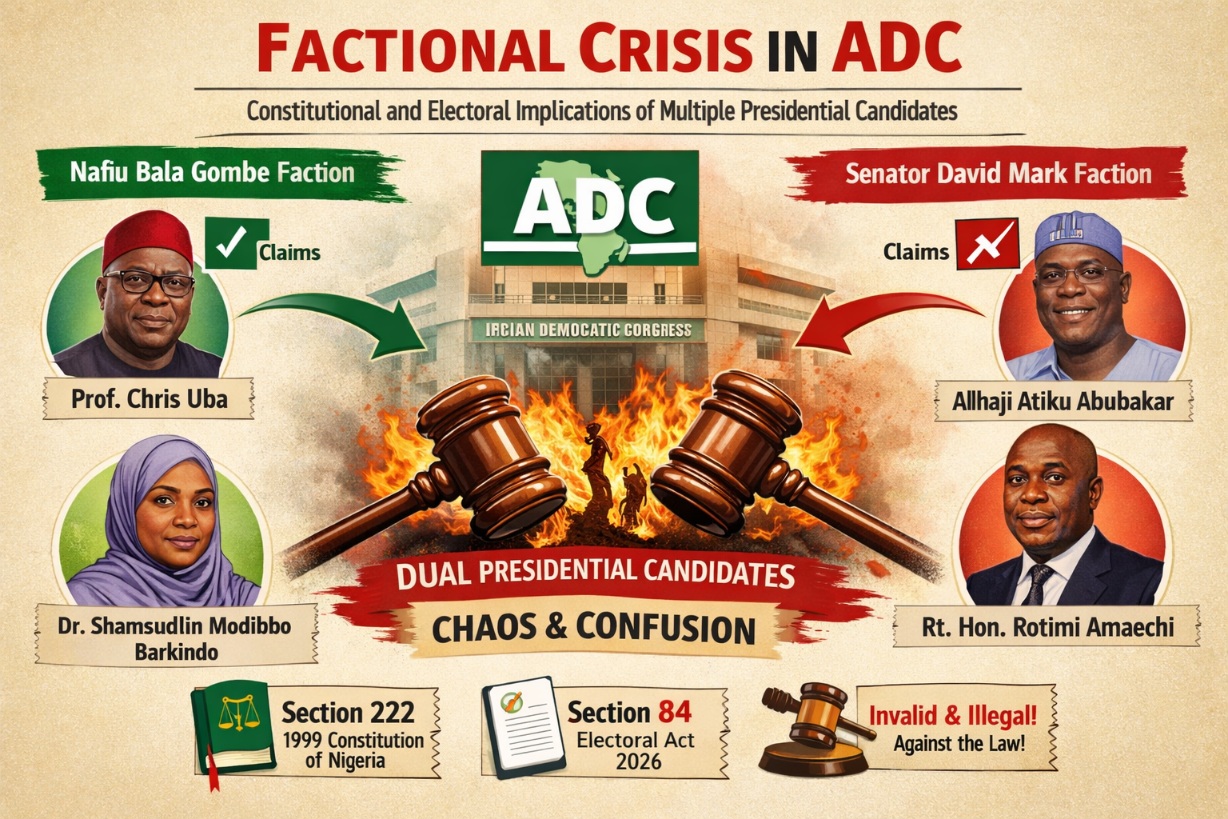
On 12 July 2026, Nafiu Bala Gombe, the factional Chairman of the ADC, issued a statement declaring that the ADC had completed the uploading of its Presidential, Vice Presidential, National Assembly, Governorship, and State House of Assembly candidates for the 2027 general election. According to him, the party’s presidential candidate is Professor Chris Uba, a 71‑year‑old academic from Anambra State, while the vice‑presidential candidate is Dr. Shamsuddin Modibbo Barkindo, a woman from Adamawa State.

The confusion within the ADC deepened when juxtaposed with the announcement made last week by the Senator David Mark faction of the ADC. That faction claimed it had successfully uploaded the names and particulars of its presidential candidate, Alhaji Atiku Abubakar, and vice‑presidential candidate, Rt. Honourable Rotimi Amaechi, on the INEC portal.
It therefore goes without saying that the ADC currently parades multiple presidential candidates, a situation that raises serious constitutional and legal implications.
Constitutional and Legal Context
– Section 222 of the Constitution of the Federal Republic of Nigeria, 1999 (as amended) provides that a political party must be registered with INEC and must conform to democratic principles. Internal democracy requires that candidates emerge through recognized party primaries.
– Section 84 of the Electoral Act, 2022 (as amended to 2026) stipulates that political parties must conduct primaries and submit only one validly nominated candidate per elective office to INEC.
– Section 29(1) of the Electoral Act further mandates that political parties submit the list of candidates not later than 180 days before the election.
– Section 29(5) allows any aspirant who participated in the primaries to challenge the submission of another candidate’s name in court.
Thus, the existence of multiple presidential candidates within one political party is unconstitutional and unlawful. It undermines the principle of internal democracy, violates the Electoral Act, and renders the party’s submissions susceptible to litigation. INEC, by law, can only recognize one set of candidates duly nominated through valid primaries. Any parallel submission is null and void.
Conclusion
The ADC’s factional crisis, manifesting in the submission of multiple presidential candidates, is a direct breach of both the Constitution and the Electoral Act. Unless resolved internally or through judicial intervention, the party risks disqualification of its candidates and exclusion from the 2027 general election.