By Okoi Obono-Obla
Social Poverty and Democratic Consciousness in Nigeria:
I enjoy teaching the Nigerian public civic lessons so that they may understand their rights and gain a deeper appreciation of the democracy our country has practiced for the past 27 years. When citizens know their rights and grasp the workings of democracy and its institutions — the executive, legislature, judiciary, electoral commission, political parties, local government, and both Federal and State governments — they become empowered, aware, enlightened, and conscientious. A conscientious citizenry ensures good governance. Conversely, a citizenry that is ignorant and unenlightened becomes benighted, suffering from social poverty — one of the greatest weapons bad leaders use to suppress the people.
What is Social Poverty?
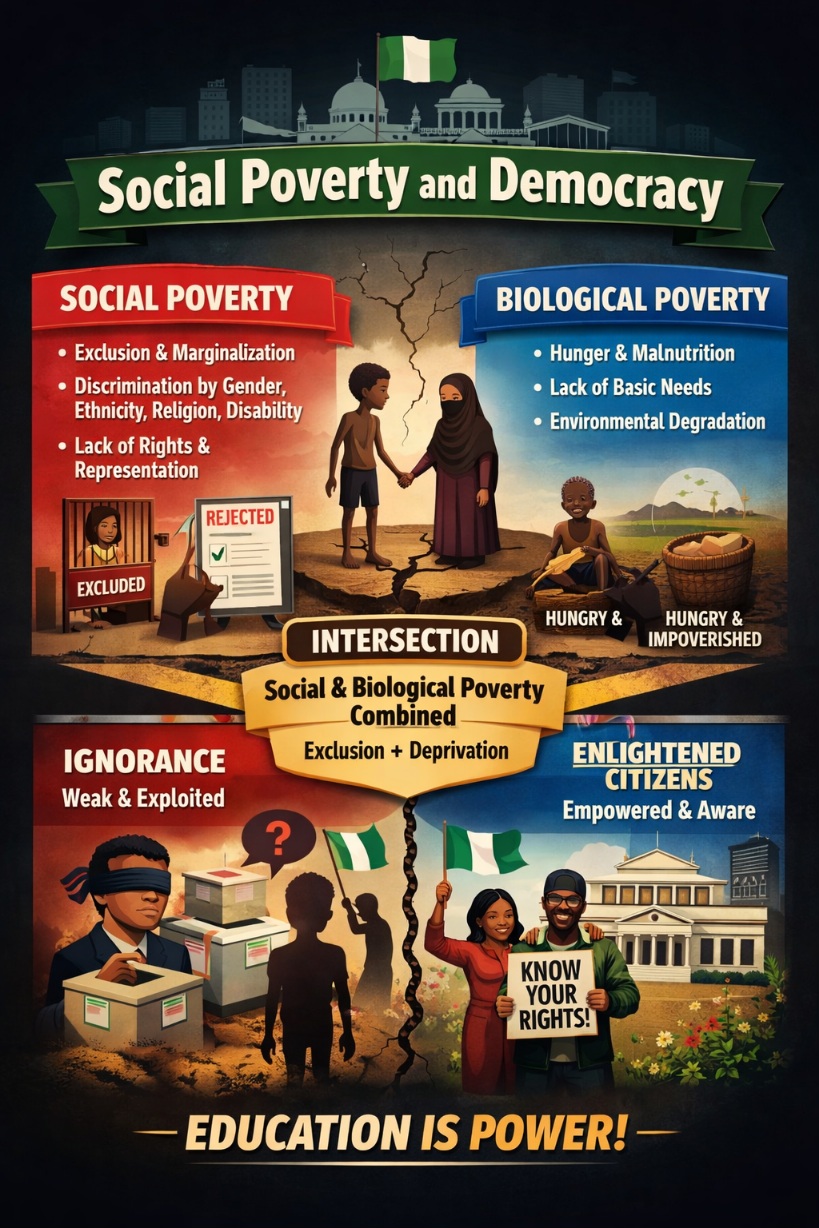
Social poverty is the poverty of exclusion. It is not about the body but about belonging. A person may have enough food and income yet still be poor in social terms if denied rights, dignity, or participation.
– Marginalization keeps entire groups undervalued.
– Discrimination based on race, gender, religion, or disability denies equal opportunity.
– Social exclusion isolates individuals from mainstream society, leaving them vulnerable to exploitation.

Social poverty is about being silenced, unseen, and unrepresented. It is the poverty of invisibility.
Biological Poverty
Biological poverty, by contrast, describes deprivation rooted in the body’s basic needs. It is the poverty of malnutrition, hunger, and ecological scarcity.
– A farmer who cannot eat enough to work productively,
– A child stunted by lack of protein,
– A community stripped of fertile land — all embody biological poverty.
It is not only about calories but about the sustainability of life itself.
Intersection of Social and Biological Poverty
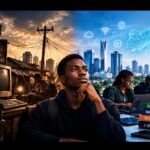
Biological and social poverty often overlap. A malnourished child from a marginalized ethnic group suffers both forms simultaneously: their body is deprived, and their identity is devalued. Communities facing environmental collapse may also face political exclusion, leaving them powerless to defend their land. In Nigeria, biological poverty manifests in malnutrition and environmental stress, while social poverty emerges through ethnic tensions, gender inequality, and youth unemployment.
A Civic Example
A typical example of social poverty is when citizens do not understand how the Electoral Act works or how candidates are nominated by political parties. They may believe that a powerful politician can maneuver his way to secure a ticket without passing through the crucible of a primary election as stipulated by law.
Recently, a reader of my Facebook page asked:
“In 2023 Akpabio didn’t participate in Senate primaries in Akwa Ibom State, but he was smuggled to INEC and today he’s the Senate President. What can you say about that?”
This reader overlooked that we are now in 2026, not 2023. The 2023 pre‑election procedures were regulated by the 2022 Electoral Act, which was repealed in February 2026 when the Electoral Act 2026 came into force. Therefore, the primaries conducted in 2026 are regulated by the Electoral Act 2026, not by the 2022 Act. By alluding to outdated procedures, the reader demonstrated social poverty — a lack of civic awareness.
The Way Forward
The only way to fight social poverty — which, when intersecting with biological poverty, results in social anomie and a “community of the blind” — is to continually educate and enlighten the people. When citizens become conscientious and conscious, they see the light. And where there is illumination, the people are empowered to resist bad leadership and institutional decay.
Conclusion:
Social poverty is as dangerous as biological poverty, for it robs people of dignity, participation, and awareness. A nation that fails to educate its citizens risks producing a population that is silenced and exploited. But a nation that enlightens its people creates a citizenry capable of demanding accountability and ensuring good governance.