


By Okoi Obono-Obla
Governors, Constitutional Authority, and Security Governance in Nigeria:
Introduction:
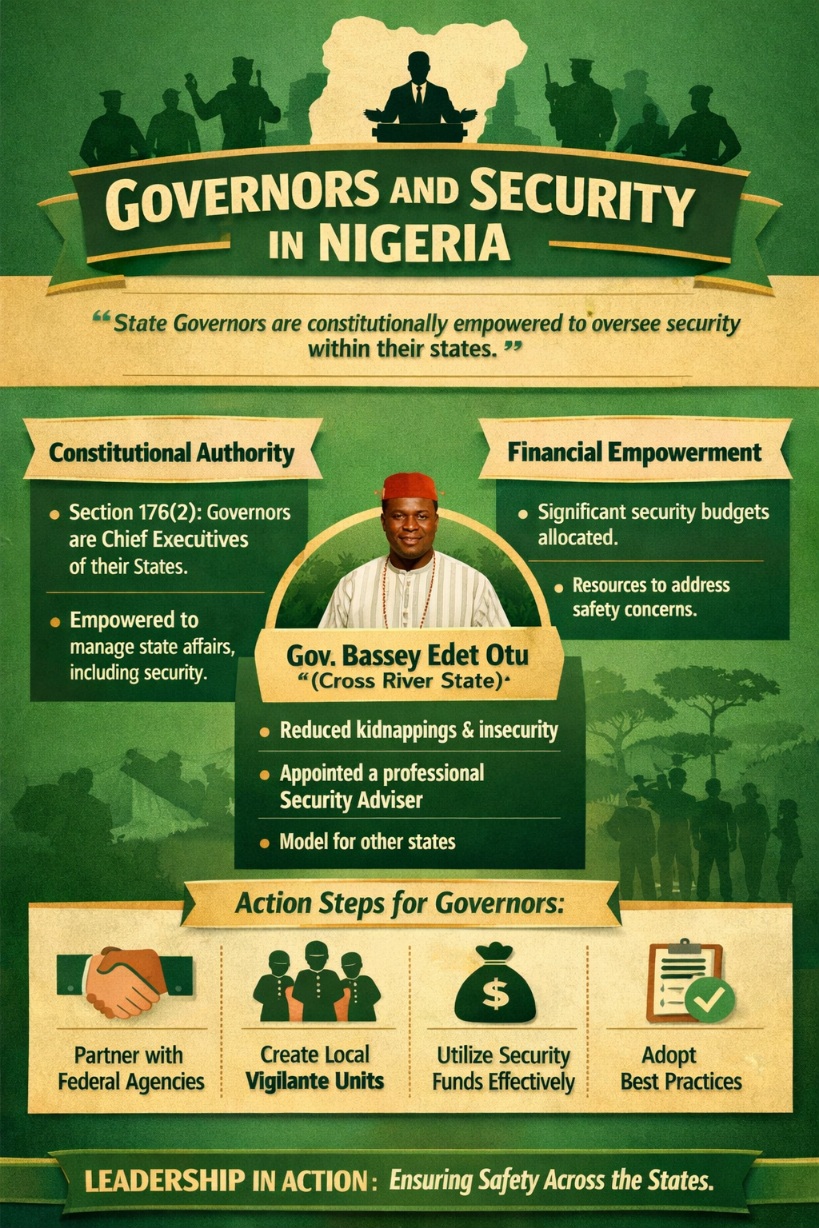
The Nigerian Constitution provides a clear framework for State leadership. Section 176(1) establishes the office of the Governor, while Section 176(2) defines the Governor as the Chief Executive of the State. This designation confers broad executive powers to manage State affairs, implement policies, and oversee governance.
Despite this constitutional clarity, debates persist about whether Governors are empowered to oversee security. This commentary argues that Governors not only possess constitutional authority but also enjoy financial empowerment through substantial security budgetary allocations. The real challenge lies in how Governors exercise these powers to deliver security outcomes.

Constitutional and Financial Empowerment:
Section 176(2) empowers Governors to manage State affairs comprehensively. Security, being central to governance, falls within this mandate. Moreover, Governors receive significant security budgetary allocations, often outside the scope of audit oversight. This financial capacity underscores their ability to influence security outcomes.
The question, therefore, is not whether Governors are empowered, but whether they are willing to deploy their authority and resources effectively.
The Cross River Model:
Cross River State under Governor Senator Bassey Edet Otu offers a practical example of how gubernatorial leadership can transform security outcomes. Since assuming office in 2023, Governor Otu has tackled insecurity and kidnapping through the appointment of a professionally trained, intelligent, committed, and decisive Security Adviser.
This strategic decision has drastically reduced kidnapping incidents and insecurity to the barest minimum. The “Cross River model” demonstrates that constitutional authority, financial empowerment, and strategic appointments can combine to produce effective security governance. Other Governors facing similar challenges should emulate this approach.
Policy Pathways:
To strengthen State security governance, Governors should:
– Leverage constitutional authority to assert their role in managing State security.
– Utilize financial allocations transparently and strategically to support security initiatives.
– Collaborate with federal agencies to ensure coordinated responses to threats.
– Establish local vigilante units that complement federal deployments.
– Adopt best practices from successful States like Cross River to replicate effective outcomes.
Conclusion:
Governors are constitutionally empowered as Chief Executives of their States, with both authority and financial capacity to oversee security. The Cross River experience under Governor Otu illustrates that decisive leadership and strategic appointments can drastically reduce insecurity.
The policy lesson is clear: Governors must move beyond debates about authority and focus on practical collaboration, resource deployment, and innovative local initiatives. The Cross River model should serve as a blueprint for States grappling with insecurity across Nigeria.