

By Okoi Obono-Obla
Constitutional Limitations and the Distortion of Nigerian Federalism:
Constitutional Governors are the Chief Executives of their respective States, vested with the executive authority of those States. Section 176(2) of the 1999 Constitution of the Federal Republic of Nigeria (as amended) specifically designates the governor of a state as the Chief Executive. Furthermore, Section 5(2) of the Constitution vests the executive powers of the state in the governor, which may be exercised directly or through the deputy governor, commissioners, or other officers in the state’s public service. As Chief Executives of their respective States, they also serve as the Chief Security Officers of their States.
Constitutional Limitations on Governors

Despite these powers, governors face clear constitutional limitations:
– Supremacy of the Constitution: Section 1(3) declares that any law inconsistent with the Constitution is void. Governors cannot act outside constitutional boundaries.
– Exclusive Legislative List: Matters such as aviation, defense, immigration, and federal highways fall under federal jurisdiction. Governors cannot legislate or enforce laws in these areas.
– Tenure Limits: Section 182(3) restricts governors to a maximum of two terms.
– Removal Procedures: Governors can only be removed through impeachment or judicial proceedings, not by arbitrary presidential action.
– Emergency Powers: Section 305 empowers the President to declare a state of emergency, which may temporarily suspend state authority.
While Section 176 serves as a bulwark for governors’ executive authority, it cannot override constitutional provisions that vest certain powers exclusively in the Federal Government. The Supreme Court remains the ultimate arbiter of such disputes.
The Problem of Dependency:
Unfortunately, many governors appear content to live in the shadow of the Federal Government, relying heavily on monthly revenue allocations rather than asserting their constitutional responsibilities.
On 26 June 2022, I stated on my Facebook page what I would do if elected to the Senate:
“I WILL SPEARHEAD THE REFORM OF LAWS THAT INFRINGE ON STATES AND LOCAL GOVERNMENT RESPONSIBILITIES.”
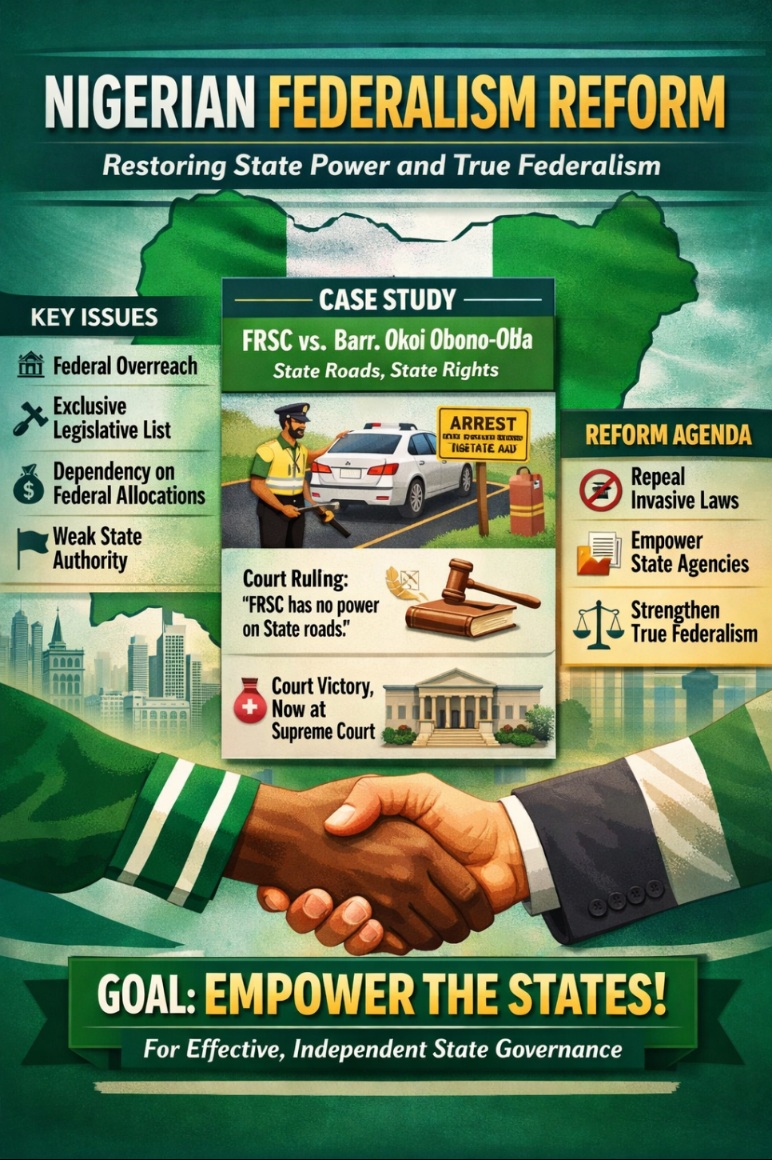
Case Study: FRSC v. Obono-Obla:
In 2005, my driver was arrested along Marian Road, Calabar, Cross River State, on an alleged traffic offence and fined by officers of the Federal Road Safety Corps (FRSC). The vehicle was impounded and taken to the FRSC office.
I filed an action in the Federal High Court of Calabar seeking a declaration that the FRSC had no power to operate, arrest, and prosecute traffic offenders on a State road maintained by the Cross River State Government. I also sought a declaration that FRSC could only operate along Federal Highways.
The Federal High Court found in my favour, declaring the arrest and impoundment of my vehicle illegal and unconstitutional. The Court awarded general damages of ₦500,000 against the FRSC. Dissatisfied, the FRSC appealed to the Court of Appeal, which dismissed the appeal and upheld the lower court’s judgment. The case is reported in the Nigerian Weekly Law Report (2010) as FRSC v. Barrister Okoi Obono-Obla. The FRSC has further appealed to the Supreme Court.
This case is of immense importance to Nigerian constitutional development because it touches on the vexed question of devolution of powers in a federal system. Why should the FRSC, an agency of the Federal Government, enforce traffic laws on State roads and collect revenue from traffic offenders on roads constructed and maintained by State Governments?
The case underscores the distortion of federalism in Nigeria and the overbearing influence of the Federal Government on the States. Nothing prevents State Governments from establishing their own Road Safety Commissions to enforce traffic laws within their jurisdiction.
Reform Agenda:
Ensuring the proper working of Nigerian federalism is one of my focal points when I become a Senator. The FRSC Act is not the only legislation that infringes on the powers and responsibilities of States and Local Governments. Numerous such laws must be repealed or reformed to make the country function optimally. I will work to reform all current laws that distort federalism so that the Federal Government can concentrate on areas within its legislative competence, while States and Local Governments exercise their constitutional responsibilities without encroachment.
One would expect Governors to take advantage of this precedent to establish their own Road Safety Commissions, but sadly, they have not.
Conclusion:
The Nigerian federal system is structurally tilted toward the Federal Government, limiting governors’ autonomy despite Section 176. For true federalism, States must assert their constitutional powers, establish agencies within their competence, and push for legislative reforms to restore balance. Governors must rise above dependency on federal allocations and embrace their constitutional responsibilities. Only then can Nigeria achieve a functional federal system that empowers States and Local Governments to serve their people effectively.