By Idowu Ephraim Faleye +2348132100608
When I established a WhatsApp platform named *Ekiti Agenda* some five years ago, comprising Ekiti sons and daughters across party lines who are stakeholders in every walk of life—political, traditional, public service, unions, and associations—I did not know it was a calling that would culminate in what we are witnessing today.
What started as a simple space for conversation has, in many ways, become a mirror of a deeper truth now unfolding before our eyes. Back then, it was just about dialogue—people sharing ideas, debating issues, and expressing hopes for Ekiti State. Today, that same spirit has taken physical form, louder than words, stronger than arguments, and clearer than any campaign message.
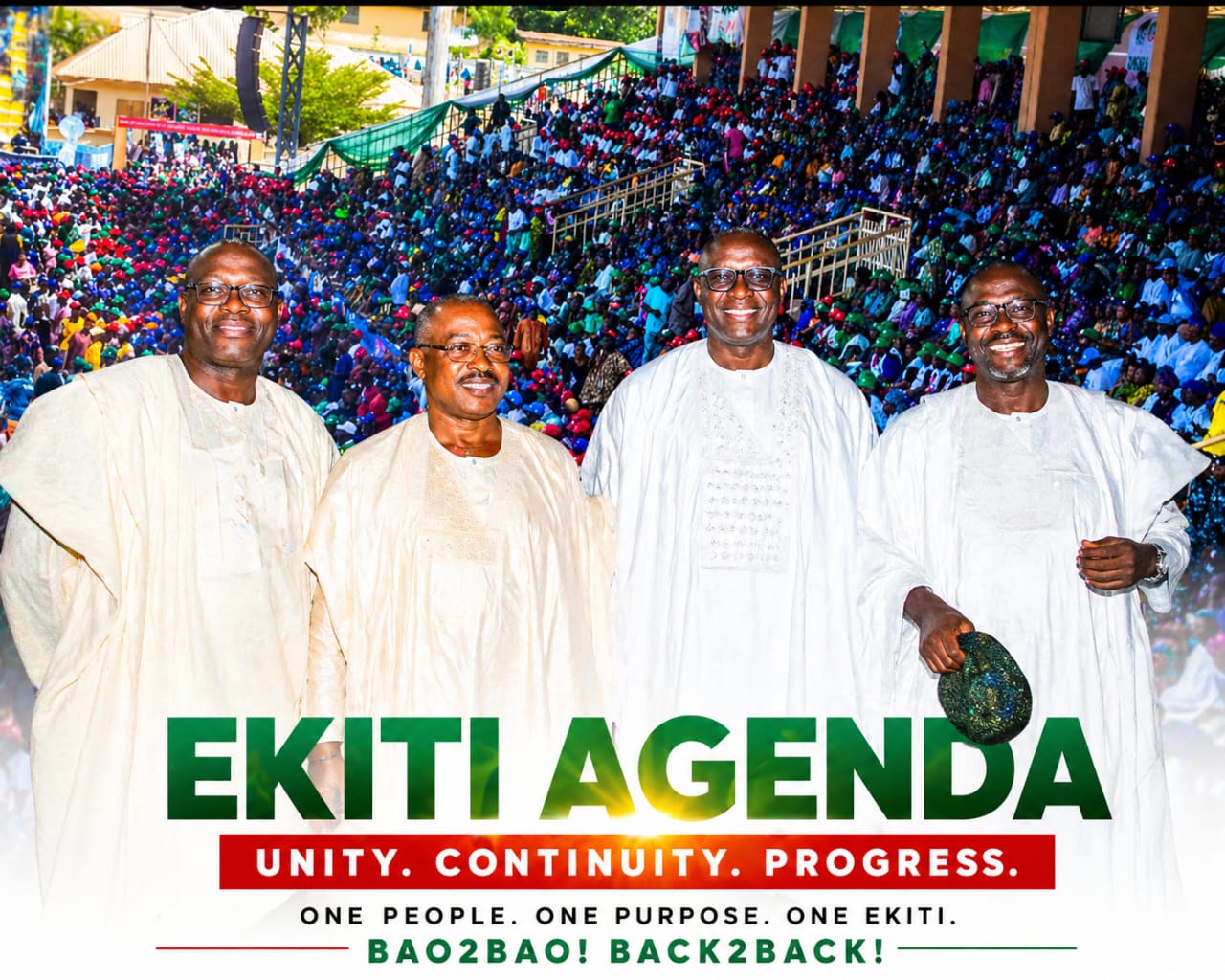
On Monday, April 27, 2026, at the Ekiti Parapo Pavilion in Ado-Ekiti, that idea- *Ekiti Agenda* —was no longer just a concept. It became a movement you could see, hear, and feel. It was in the crowd. It was in the speeches. It was in the energy that refused to be ignored. And more importantly, it was in the unity that cut across political lines and personal interests.

This was not a typical campaign flag-off. It did not carry the usual tension of political competition. It felt different. It felt like something had already been settled in the hearts of the people. What remained was not persuasion, but affirmation.
At the center of this moment stood Governor Biodun Oyebanji. Not merely as a candidate seeking re-election, but as a symbol around which a broader consensus had quietly formed. This was not about what he intended to do. It was about what he has already done—and whether that journey should continue.
What made the moment truly remarkable was not just the crowd, but the voices that rose to speak. These were not ordinary voices. These were men who have walked the corridors of power, who understand governance not from theory but from experience. And yet, despite their different histories and political paths, they spoke in one direction.
When Chief Isaacs Kekemeke, an APC zonal leader from a Ondo-state declared that Ekiti cannot have it better than it is now and insisted that the state must return Oyebanji back to office, it was more than endorsement. It was a statement of conviction because the chief understood the history of Ekiti people before their exodus. It was a call to preserve what many believe is already working for the state.
Senator Opeyemi Bamidele, the Senate Leader added another layer, speaking not just about development, but about character. He described Gov. Oyebanji as a leader who understands the language of progress, who unites rather than divides, and who chooses to build without bitterness. In a time where politics often feeds on division, that message stood out.
Then came Dr. Kayode Fayemi, a former governor who knows the weight of leadership. His words carried the calm authority of someone who has seen the inside of governance. When he said Governor Oyebanji has not disappointed the people, the party, or the leadership, it was not a casual remark. It was validation from experience.
Former Gov. Segun Oni took it further, not just speaking of victory, but of scale. His call for a record-breaking mandate was not just ambition—it was confidence. Confidence that what is on ground can translate into overwhelming support.
And then, perhaps the most striking moment of all, came from Former Gov. Ayodele Fayose. A known opposition figure, a man who openly declared he remains the leader in his party, yet stood before the people and said his presence was a statement. That he is here not for the party, but for Ekiti. That for now, the focus is not opposition, but continuity. That moment captured the true meaning of *Ekiti Agenda.*
Because *Ekiti Agenda* is not about APC. It is not about PDP. Neither is it about ADC. It is not about political camps or historical rivalries. It is about a shared belief that the progress of Ekiti State must come before every other consideration.
When a known opposition voice aligns with the direction of the incumbent, it tells you something deeper is at play. It tells you that beyond politics, there is recognition. Recognition of effort. Recognition of impact. Recognition of a leadership style that has found acceptance across divides.
This is where the power of the moment lies. It is easy to gather a crowd. It is easy to organize an event. But it is not easy to create genuine alignment. It is not easy to bring together voices that history would normally keep apart. That kind of unity is not forced. It is built. And it is built over time.
It is built when policies begin to touch real lives. When roads improve and movement becomes easier. When schools improve and children learn better. When young people find direction and purpose. When civil servants feel respected. When pensioners regain dignity. When farmers see results from their labour.
These are not abstract ideas. They are lived experiences. And when people carry these experiences into a political moment, their presence means more than attendance. It becomes testimony.
That is why the crowd in Ado-Ekiti mattered. It was not just about numbers. It was about composition. It was about the young and the old, the trader and the teacher, the artisan and the civil servant, all standing in one place with a shared expression. That kind of gathering sends a message no speech can fully capture. It says: we have seen enough to form an opinion. And that opinion, from all indications, is leaning toward continuity.
The repeated call for “back to back” leadership is not just a slogan. It is a reflection of a deeper desire—not to disrupt a process that many believe is already delivering results. It is a call to protect progress, to build on it, and to avoid the uncertainty that often comes with starting afresh.
In this sense, *Ekiti Agenda* becomes a bridge. A bridge between past experiences and future expectations. A bridge between political actors and ordinary citizens. A bridge between what has been achieved and what is yet to come. It is also a reminder that democracy, at its core, is about choice. Not a forced choice. Not a manipulated choice. But a decision shaped by experience, understanding, and belief.
What we saw at the flag-off was not just support for a candidate. It was an expression of belief in a direction. A direction that many feel should not be interrupted. As the June 20 election approaches, there will be more campaigns, more arguments, and more attempts to influence opinion. But moments like this stand apart. They do not rely on persuasion alone. They draw strength from lived reality. And when reality speaks, people listen.
As the event came to a close, there was a feeling—a quiet but powerful conviction that something important had been affirmed. People walked away not just as spectators, but as participants in a shared understanding that *Ekiti Agenda* is no longer just an idea discussed in conversations or platforms. It is now a lived expression of collective will.
And as they moved away, one chant rose again, carried not by instruction, but by emotion. It echoed across the grounds, steady and unforced, like a voice that had found its rhythm:
“Ora BAO! Ajoo sise!”,
an Ekiti dialetic expression meaning, “All Hail BAO! Your leadership will go smoothly”.
The chant echoed through the streets like a collective prayer, capturing the people’s joy and faith in his leadership. It was more than a chant. It was a statement. A belief. A choice already forming—one that speaks to the heart of democracy, where power does not begin with politicians, but ends with the people.
*Idowu Ephraim Faleye writes again from Ado-Ekiti +2348132100608*