🇳🇬 Nigeria’s Economy Is Growing — But Is Life Getting Better?
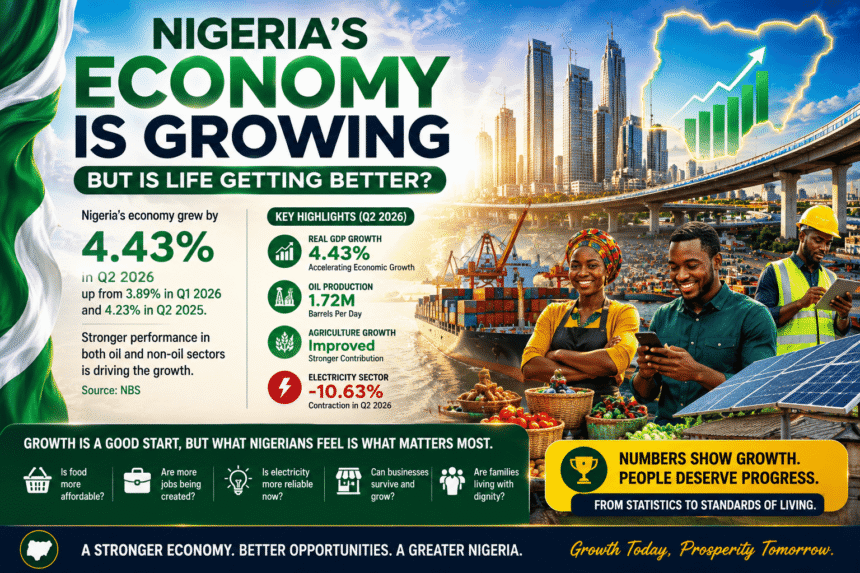
Nigeria has received a piece of economic news worth paying attention to. The country’s economy grew by 4.43% in real terms in the second quarter of 2026, accelerating from 3.89% in the first quarter and 4.23% in the same period of 2025. The improvement was supported by stronger performances in both the oil and non-oil sectors.
At first glance, that sounds like exactly what Nigerians want to hear: the economy is growing.
But GDP numbers can sometimes tell only part of the story.
The services sector remained the largest contributor to economic output, while agriculture also recorded stronger growth. Oil production increased to an average of 1.72 million barrels per day, compared with 1.55 million barrels per day in Q1.
Yet there is an interesting contradiction. While the wider economy expanded, Nigeria’s electricity sector contracted by 10.63% in Q2, showing that some of the country’s fundamental economic challenges remain unresolved.
And this brings us to the question ordinary Nigerians are more interested in:
What does 4.43% growth actually mean for everyday life?
Does it mean cheaper food?
More jobs?
More reliable electricity?
Better purchasing power?
More opportunities for young Nigerians?
A stronger environment for small businesses?
Economic growth becomes meaningful when it moves beyond government reports and financial markets and begins to show up in the lives of ordinary people.
Nigeria’s recent numbers suggest that the economy is moving in a better direction. But the recovery remains uneven, with industrial growth slowing compared with a year earlier and major structural challenges still limiting productivity.
So perhaps the real story isn’t simply “Nigeria’s economy is growing.”
It is:
Nigeria is growing—but can that growth become prosperity?
That is the challenge facing policymakers, businesses and the Nigerian people. The next stage should be about turning economic momentum into better jobs, stronger businesses, reliable infrastructure and a higher standard of living.
Because ultimately, Nigerians don’t live inside GDP figures.
They live in the real economy.