By Engr. Ajibola Abiola PhD
WHY ARE MILLIONS OF NIGERIANS STILL SUFFERING DESPITE NIGERIA’S ENORMOUS NATURAL RESOURCES ?
Nigeria is blessed with crude oil, natural gas, solid minerals, vast agricultural resources and an enormous human population.
Yet, for millions of Nigerians, this wealth has not translated into prosperity.
Instead, we are witnessing a painful paradox:
A nation rich in resources, but with citizens increasingly struggling to afford the basics of life.

THE SUBSIDY REMOVAL: A NECESSARY REFORM?
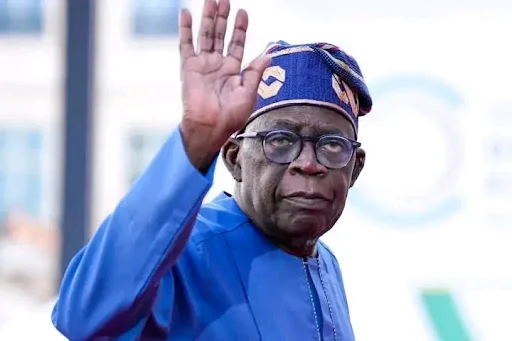
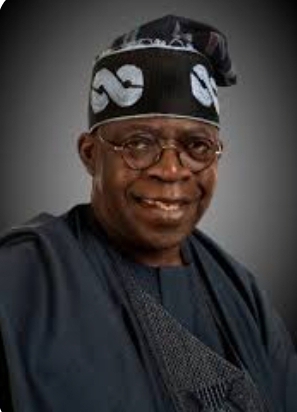
In 2023, President Bola Ahmed Tinubu removed the petrol subsidy, arguing that the subsidy regime was financially unsustainable and that the resources could be better deployed for national development.
The argument was compelling:
Stop subsidising consumption.
Free public resources.
Invest the savings in development.
Build a stronger economy.
It was presented as a difficult decision that would ultimately benefit Nigerians.
But three years later, millions of Nigerians are asking:
WHERE IS THE BENEFIT?
Imagine a nation sitting on billions of barrels of crude oil, blessed with gas, solid minerals, fertile land and a vibrant population, yet millions of its citizens go to bed wondering where the next meal will come from. Imagine a worker whose salary disappears almost immediately after it arrives—not because the worker is extravagant, but because food, transportation, rent, electricity and other basic necessities have become overwhelmingly expensive. Imagine the small business owner who once employed others now struggling to keep the doors open, while young Nigerians watch their hopes and opportunities disappear. This is the painful contradiction of Nigeria: a country enormously rich in natural resources, yet millions of her people are being forced to live from one day to the next. The greatest tragedy is not that Nigeria lacks wealth; it is that the wealth of Nigeria has not translated into the well-being of Nigerians.”
💰 ₦15.8 TRILLION: WHAT HAS CHANGED?
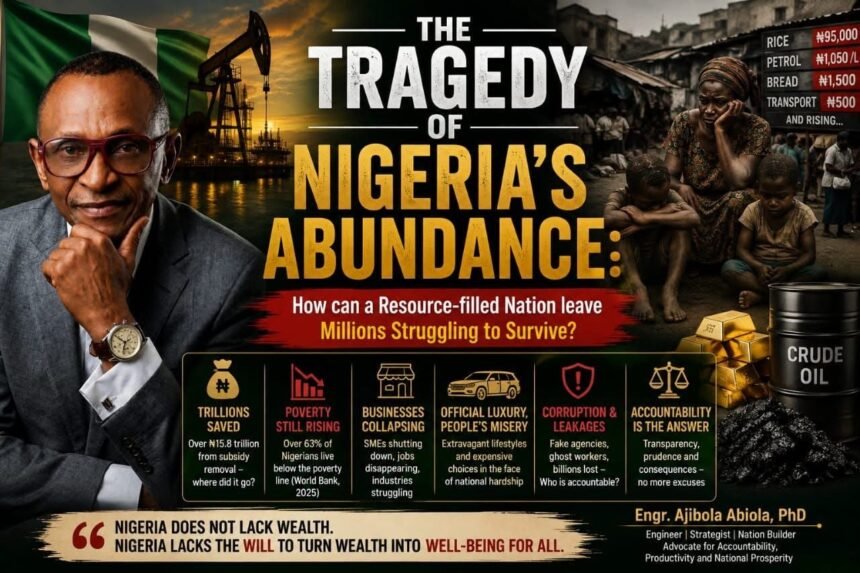
According to the Federal Government, the removal of the petrol subsidy mobilised approximately ₦15.8 trillion in resources for the Federation between June 2023 and December 2025.
The Federal Government says the resources were shared among the different tiers of government.
Its figures indicate approximately:
₦5.43 trillion — Federal Government
₦6.52 trillion — States
₦3.88 trillion — Local Governments
The Government has also provided explanations of how the Federal Government’s resources were utilised, including spending on wages, debt servicing, infrastructure, electricity support and social programmes.
But here is where the conversation should become more serious.
The question is not simply whether
“The government spent the money?”
The bigger question is:
“DID THE MONEY PRODUCE VALUE COMMENSURATE WITH THE SACRIFICES MADE BY THE NIGERIAN PEOPLE?”
*THE PEOPLE ARE PAYING THE PRICE*
While government finances are being discussed in billions and trillions of Naira, ordinary Nigerians are experiencing the economy at a completely different level.
They experience it at the:
🍚 Market
🚌 Bus stop
🏠 Rent office
⚡ Electricity meter
🏥 Hospital
🎓 School
🏪 Small shop
🏭 Factory floor
💼 Job interview
The average Nigerian is asking:
How do I feed my family?
How do I pay my children’s school fees?
How do I pay my rent?
How do I transport myself to work?
How do I pay my electricity bill?
How do I keep my business alive?
How do I survive until the next income?
These are no longer abstract economic questions.
They are questions of daily survival.
POVERTY IS STILL A MAJOR REALITY
The World Bank estimates that approximately 63% of Nigerians were living below the national poverty line in 2025, up from about 61% in 2024.
It also estimates that approximately seven million additional Nigerians fell into poverty in 2025.
That should make every policymaker uncomfortable.
Because behind every statistic is:
A family struggling to eat.
A young person unable to find meaningful employment.
A parent unable to meet school expenses.
A small business owner contemplating closure.
A household cutting down on healthcare.
A worker whose salary disappears before the month ends.
Poverty is not merely a statistic.
It is a human experience.
🏭 WHILE BUSINESSES ARE COLLAPSING
Nigeria’s productive sector is also under enormous pressure.
Many SMEs are struggling with:
High energy costs.
Expensive transportation.
High interest rates.
Rising raw-material costs.
Foreign-exchange instability.
Increasing rents.
Multiple taxes and levies.
Weak consumer purchasing power.
When businesses close:
Jobs disappear.
When jobs disappear:
Families suffer.
When families suffer:
Poverty deepens.
And when productive businesses continuously struggle, government eventually loses the very tax base required to sustain development.
BUT THEN CAME THE “FAKE AGENCY” REVELATIONS
This is where Nigerians have legitimate reasons to demand stronger institutional accountability.
In 2026, the ICPC uncovered a purported federal agency known as the Presidential Foreign Intervention Promotion Council (PFIPC) which the Presidency said did not legally exist.
Yet the alleged organisation had:
An office within the Federal Secretariat.
Government-looking documentation.
Bank accounts reportedly opened in its name.
A presence in the 2026 national budget.
And a ₦1.3 billion budget allocation.
The ICPC investigation subsequently identified other fictitious agencies allegedly created as ICPC later announced another purported fake agency — the National Brands Development and Made in Nigeria Special Project Office — and reported suspected collaboration involving senior public servants. President Tinubu ordered the arrest of the alleged promoter and suspension of three permanent secretaries pending investigation.
And on August 28, 2026, the Presidency announced a comprehensive forensic audit of federal government systems, including IPPIS, federal agencies and internal controls, following concerns about fake agencies, ghost workers and other control failures.
❓ THE BIGGER QUESTION
If a fictitious organisation could allegedly find its way into the Federal Government’s administrative and budgetary systems, Nigerians are entitled to ask:
HOW MANY OTHER LEAKAGES EXIST WITHIN THE PUBLIC FINANCIAL SYSTEM?
We must be careful not to accuse specific people or agencies without evidence.
But the revelations demonstrate something important:
Public financial controls can fail.
And when controls fail, public resources can potentially be diverted, wasted or improperly utilised.
Therefore, Nigerians deserve a comprehensive examination of:
Government agencies.
Government accounts.
Payroll systems.
Budgetary allocations.
Procurement.
Government vehicles and official residences.
Foreign travels.
Consultancy contracts.
Security votes.
Public-private partnerships.
Grants and intervention programmes.
Government-owned enterprises.
And all channels through which public money leaves government coffers.
*GOVERNMENT LUXURY IN A COUNTRY OF MASS POVERTY*
There is also a troubling perception among Nigerians that government officials continue to enjoy lifestyles that appear completely disconnected from the economic reality confronting ordinary citizens.
When citizens struggle to afford public transportation while public officials operate expensive official vehicles…
When families struggle to pay school fees while government spending appears extravagant…
When small businesses are shutting down while official expenditure continues to grow…
Nigerians naturally begin to question the priorities of government.
The issue is not that public officials should be denied legitimate working tools.
The issue is:
SHOULDN’T GOVERNMENT EXPENDITURE REFLECT THE ECONOMIC REALITY OF THE PEOPLE IT SERVES?
⚠️ THE REAL DANGER
The greatest danger is not merely that government may spend too much.
It is that:
THE PEOPLE MAY CONTINUE TO MAKE THE SACRIFICES WHILE OTHERS ENJOY THE BENEFITS OF THE REFORMS.
That would defeat the fundamental justification for subsidy removal.
If Nigerians were told:
“Make this sacrifice today so that tomorrow will be better,”
then government must be able to demonstrate:
WHAT WAS SACRIFICED?
WHAT WAS SAVED?
WHERE WAS IT SPENT?
WHO BENEFITED?
WHAT HAS CHANGED?
AND WHEN WILL THE PEOPLE SEE THE FULL BENEFIT?
🇳🇬 NIGERIA DOES NOT HAVE A REVENUE PROBLEM ALONE
Nigeria’s deeper problem is the conversion of public resources into public value.
We need:
✅ Transparent government accounting.
✅ Independent auditing of subsidy savings and other major revenues.
✅ Full forensic examination of government agencies and payroll systems.
✅ Stronger procurement controls.
✅ Public disclosure of major government contracts.
✅ Serious reduction of wasteful government expenditure.
✅ Greater investment in electricity and productive infrastructure.
✅ Better support for SMEs and industries.
✅ Effective social protection for the poorest Nigerians.
✅ Consequences for proven corruption and financial misconduct.
💡 THE QUESTION IS NOT WHETHER GOVERNMENT HAS SPENT MONEY.
THE QUESTION IS WHETHER GOVERNMENT HAS SPENT IT WISELY.
Because a government can spend trillions of Naira…
And yet the people can remain poor.
A government can build projects…
And yet the productive economy can remain weak.
A government can increase revenue…
And yet households can become poorer.
A government can announce reforms…
And yet the benefits can remain invisible to the people.
🛢️ FROM OIL WEALTH TO HUMAN WEALTH
Nigeria’s crude oil should not become a curse.
Our natural resources should not merely finance government.
THEY SHOULD FINANCE THE FUTURE OF THE NIGERIAN PEOPLE.
They should produce:
FOOD.
JOBS.
ELECTRICITY.
QUALITY EDUCATION.
AFFORDABLE HEALTHCARE.
INDUSTRIAL GROWTH.
SMALL BUSINESS SURVIVAL.
SECURITY.
DIGNITY.
AND HOPE.
🇳🇬 THE PEOPLE HAVE MADE THEIR SACRIFICE.
NOW LET THE PEOPLE SEE THE VALUE.
The ultimate measure of economic reform should not be the size of government revenue.
It should not even be the rate of GDP growth alone.
*THE ULTIMATE TEST IS THE QUALITY OF LIFE OF THE ORDINARY NIGERIAN.*
If the people remain hungry, businesses continue to collapse, unemployment remains widespread, electricity remains unreliable and families continue to struggle to survive…
THEN WE MUST HAVE THE COURAGE TO ASK HARD QUESTIONS.
Not to destroy government.
Not to oppose every reform.
But to ensure that:
NIGERIA’S WEALTH WORKS FOR NIGERIANS.
That is the accountability Nigerians deserve.
Engr. Ajibola Abiola, PhD
Advocate for Accountability, Productivity and National Prosperity