
By Okoi Obono-Obla
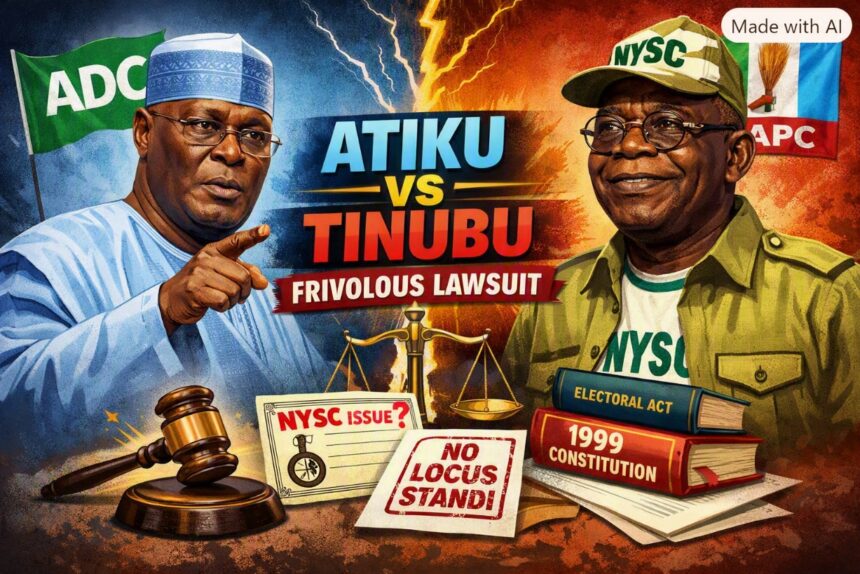
I am extremely surprised and flummoxed that Alhaji Atiku Abubakar will file such a frivolous and extremely weak case challenging the eligibility of President Bola Ahmed Tinubu on the alleged ground that he now bears a name different from the one stated in his NYSC discharge certificate.
First, Atiku Abubakar has no locus standi. Atiku Abubakar belongs to the African Democratic Congress (ADC) while President Bola Ahmed Tinubu is a member of the All Progressives Congress (APC). It goes without saying that the two of them do not belong to the same political party and did not square against each other in their respective political parties’ nomination exercises or primaries.
Therefore, Atiku Abubakar has no locus standi to challenge President Bola Ahmed Tinubu in court seeking his disqualification on the ground that he supplied false information in the affidavit sworn to accompany his personal particulars submitted to INEC.
That is the clear import of Section 29(5) of the Electoral Act 2026 [not Section 29(6)]. The section provides that only “An aspirant who participated in the primaries of his political party who has reasonable grounds to believe that any information given by the political party’s candidate in the affidavit or any document submitted by that candidate in relation to his constitutional requirements to contest the election is false, may file a suit…”
This restrictive locus has been consistently upheld. In PDP & Anor v. APC & Ors (Benue Governorship case), the Federal High Court held that there is no word or phrase in Section 29(5) that gives any political party or member of another party locus to challenge the candidate of another political party. The Court of Appeal in Appeal No. CA/MK/124/2022 affirmed that by whatever canon of interpretation, Section 285(14)(c) of the Constitution cannot confer locus on one political party to challenge the internal affairs or primaries of another party.
Under the 2026 Act, this is even more fatal. Section 83(5) of the Electoral Act 2026 now ousts the jurisdiction of any court over matters pertaining to the internal affairs of a political party, and imposes a mandatory cost of not less than N10,000,000 on the plaintiff and his counsel who files such a suit. Nomination of a candidate is an internal affair of the party.
Secondly, NYSC is not a constitutional requirement to contest any election in Nigeria.
The qualifications to be eligible to contest the presidential election are exhaustively spelt out in Sections 131 and 137 of the Constitution of the Federal Republic of Nigeria, 1999 (as amended) – namely, citizenship by birth, attainment of 35 years, membership of a political party and sponsorship by that party, and education up to at least School Certificate level or its equivalent. An NYSC discharge certificate is not listed.
This point is now judicially settled. In 2019, the Federal High Court in Abuja in the pre-election suit against Governor Dapo Abiodun of Ogun State, filed by Sen. Iyabo Anisulowo, held that a candidate cannot be disqualified for failure to participate in NYSC, and that NYSC certificate is a requirement for employment in the formal sector, not for contesting election under Section 177 of the Constitution.
Similarly, in Kemi Adeosun v. AGF (FHC/ABJ/CS/303/2021), Justice Taiwo Taiwo held that Adeosun or anyone did not require an NYSC discharge or exemption certificate to qualify to contest election to the House of Representatives or to be appointed a Minister, as the Constitution does not mandate it.
It is clear that to take umbrage under Section 29 of the Electoral Act 2026, the alleged false information must be in relation to the constitutional requirements for eligibility. This is expressly reinforced by the new Section 29(6) of the Electoral Act 2026 which states: “Where the Court determines that any of the information contained in the affidavit is false only as it relates to constitutional requirements of eligibility, the Court shall issue an order disqualifying the candidate…”
Since NYSC is not one of the constitutional requirements, the legal challenge cannot succeed on that ground. At best, a name variance on a voluntarily submitted NYSC certificate raises an issue of explainable discrepancy, not false information touching on Section 131, and where properly explained by Deed Poll and affidavit linking the names, it is not forgery.
Conclusion: The suit is demonstrably frivolous, an abuse of court process, and will likely fail on a robust preliminary objection on locus standi under Section 29(5) and jurisdiction under Section 83(5) of the Electoral Act 2026, and on the merits, for disclosing no constitutional disqualification under Sections 131 and 137 of the 1999 Constitution.