By Okoi Obono-Obla
I have observed with dismay a reckless, malicious, vicious and sponsored series of personal attacks on some political figures, including the Chief Executive of Cross River State and the debonair Oden Ewa, on social media as the campaign for the 2027 general elections looms. This is a sad commentary on our politics. Instead of demanding accountability, some people take what they consider the easy option: smear campaigns. At the end of the day, such campaigns do not stop the electorate from voting for those they have chosen. They rather popularize the victims and draw sympathy to them, as the electorate sees through them and dismisses them as victimization and witch-hunt.
A case in point is the post on the Facebook page of Cross River State Political Network – CRPN on 12 August 2026, written by one Micah Matthew, where he brazenly, recklessly and maliciously wrote concerning Oden Ewa, the APC senatorial candidate for Cross River Central District in 2027, thus:
“Hon. Oden Ewa, a suspended and exposed alleged thi£f who was exposed to misappropriating public funds during his three-month tenure as a commissioner, suddenly became Governor Bassey Otu’s favourite candidate for the Cross River Central Senatorial District. What an agony… The recent judgment of the High Court of Cross River State against the then Commissioner for Science and Innovation, Oden Ewa, in a ₦208 million Diamond Bank fraud case has once again brought to the fore the moral crisis afflicting public service in Nigeria.”
How can any rational person write so recklessly about another over allegations that are unproven, based on rumours woven in beer parlours in Calabar? How can a reasonable person sit in his house and convert a judgment of the High Court hinged on civil breach of contract into an imaginary fraud-related one? It beats my imagination hollow.
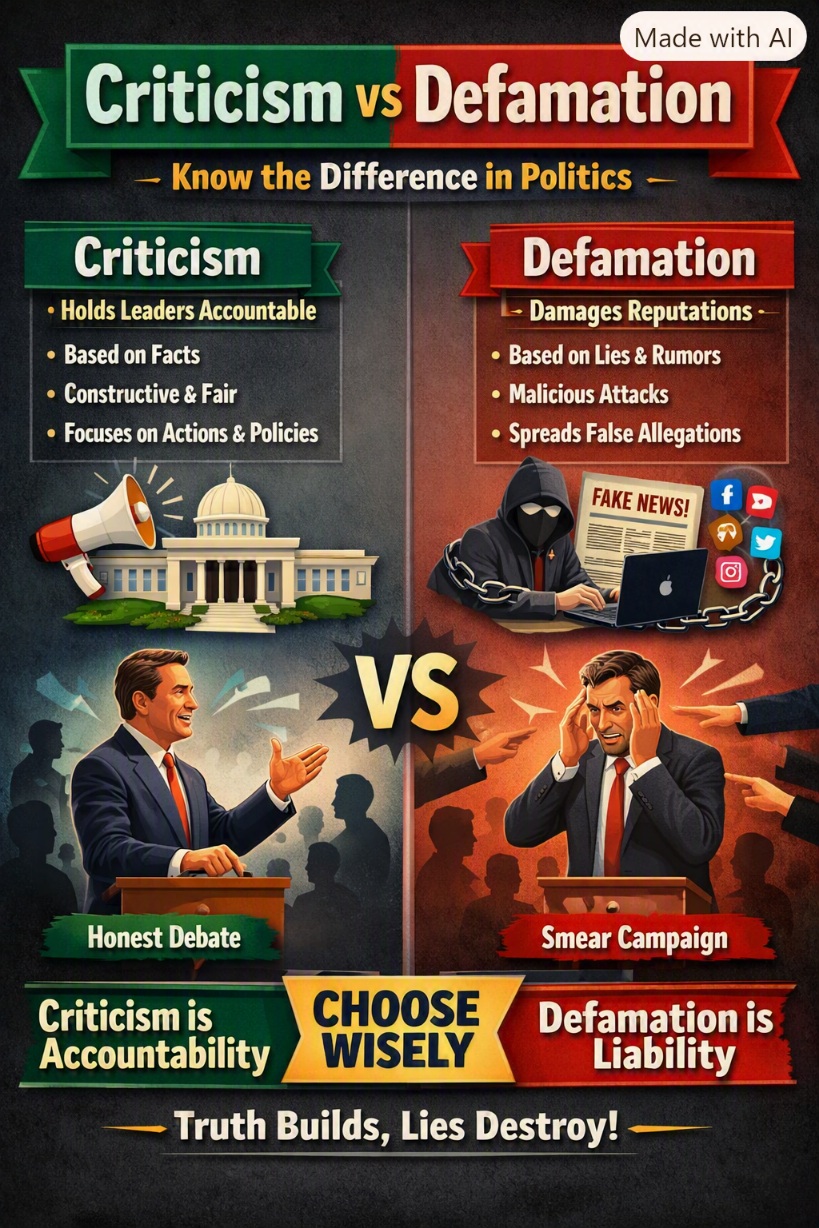
This brings us to a fundamental distinction that many social media commentators fail to grasp: The Difference Between Criticism and Defamation.
When you criticize government officials, it should be done in a measured, mature, and constructive manner. But when you descend into making unproven allegations, or say something that in its natural and ordinary meaning can be construed as defamatory, then you become liable for civil or criminal defamation.
Where Do We Draw The Line?
Criticism focuses on actions, policies and performance. It is based on verifiable facts, it is fair and constructive, and its aim is to correct and hold leaders accountable.
Defamation focuses on personality. It is based on falsehood, rumour or unproven allegations published to a third party, including on social media, which injures a person’s reputation and lowers him in the estimation of right-thinking members of society.
In law, truth, fair comment on a matter of public interest, and privilege will defend you. Insults and unverified allegations will not.
I was an activist from 1992 until I became a veteran and had to step aside for the younger generation to take over. In all those years, I was never sued for defamation. I criticized military administrations and the civilian administrations of Donald Duke, Senator Liyel Imoke, and Professor Ben Ayade, yet I was never accused of defaming anyone. That is because criticism judges what a person DOES; defamation attacks who a person IS.
In Summary: Criticism is protected. Defamation is punishable.
As electioneering campaigns kick off, I have seen a lot of outright defamation on social media. We should campaign on issues and leave out smear campaigns calculated to impugn the character and reputation of opponents or perceived opponents.
If you cannot prove it, don’t publish it. Campaign vigorously on issues and avoid smear campaigns.