
By Idowu Ephraim Faleye +2348132100608
As Nigeria moves towards the 2027 election, a political pattern is beginning to emerge around President Bola Ahmed Tinubu. Different voices are criticising the administration from different directions, but some of the narratives appear capable of leading to the same political destination: weakening Tinubu’s support and making his return to power more difficult. One route appeals to religious identity, while another is now appealing to regional identity. The important question is not simply who is criticising Tinubu, but what political strategy lies behind these narratives and which interests are driving them.
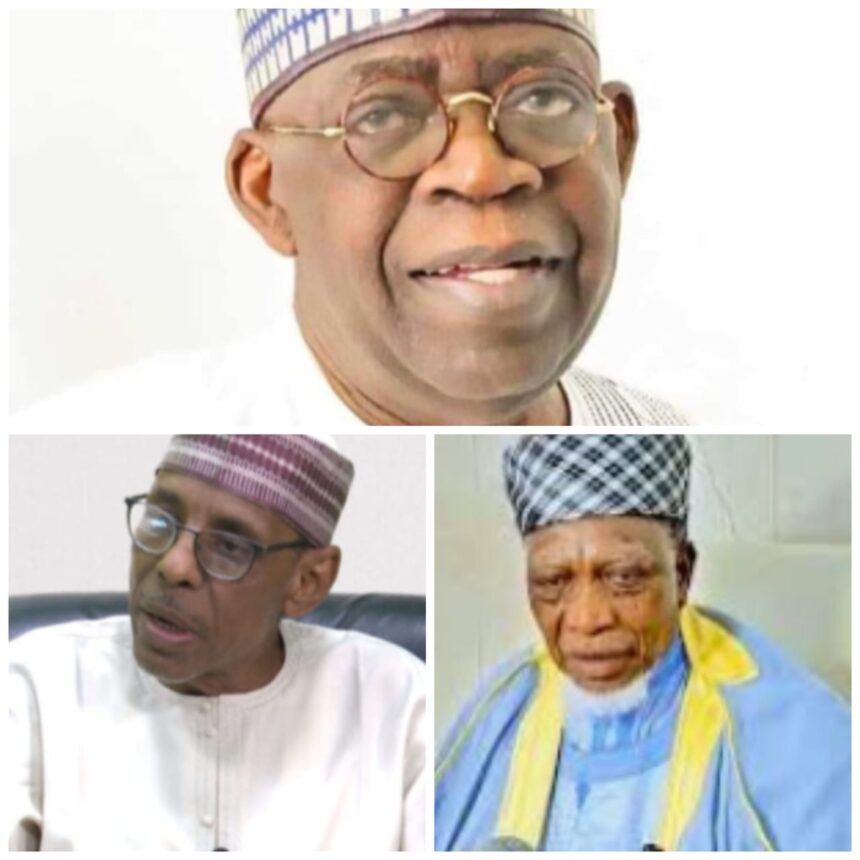
I have written extensively about Sheikh Sanni Jingir and his controversial religious messaging around the Tinubu administration, so there is no need to repeat that argument here. His relevance to this discussion is that he represents one route to political mobilisation: using religion as a lens through which people are encouraged to view Tinubu’s government. Hakeem Baba-Ahmed is now presenting a different route. His latest argument is not primarily about Christianity and Islam but about the North and the South. The language has therefore shifted from religion to region.
Baba-Ahmed claims that Tinubu is taking what belongs to the North and transferring it to the South because northern political leaders are not resisting him. This is a serious allegation, but before accepting it, one question must be answered: what exactly does the North own that Tinubu is taking away?
The North does not legally own the Federal Government, federal ministries, national resources, government agencies or political appointments. These belong to Nigeria. Therefore, if Baba-Ahmed is not referring to legally owned assets, then he must be talking about something else: access to power, patronage, economic opportunities, bargaining strength or the ability of northern political leaders to influence decisions at the centre.
That distinction matters. Political power can be lost without anybody losing a physical possession. A politician can lose access to the President. A political network can lose influence over appointments. A business interest can lose access to government contracts. A group can lose its bargaining power without losing a single naira directly. When an administration changes the old political arrangement, those who benefited from that arrangement may find themselves less powerful.
This is where we should examine Baba-Ahmed’s argument more closely. Instead of simply asking whether the North is losing, we should ask who has lost, what have they lost, when did they lose it, and who gained from the change?
That is also why Baba-Ahmed’s political journey matters. He is not an outsider who suddenly entered the political conversation because of the 2027 election. He served as Special Adviser on Political Matters in the Office of Vice President Kashim Shettima after the 2023 election. He therefore had direct access to power and patronage under the Tinubu administration before leaving government and subsequently becoming increasingly critical of the administration.
His departure does not prove that his present criticism is motivated by loss of patronage. That would be an unfair conclusion without evidence. But it gives us reason to examine the evolution of his political position. What did he say about Tinubu before joining government? What did he say while serving in government? What changed after his departure? Has his criticism moved from policy and governance to political and regional grievances?
Those questions are more useful than simply accusing him of hypocrisy or personal interest. His current political involvement with the anti-Tinubu coalition also means that his statements now exist within a political environment where opposition to Tinubu has an obvious electoral dimension.
His latest argument is particularly significant because he is not merely complaining about economic hardship or poor governance. He is telling the North that something belonging to it is being taken away and that northern leaders have failed to resist. That changes the character of the argument. It takes a political disagreement with the Federal Government and gives it a regional identity.
This is where Baba-Ahmed’s message connects with the earlier religious strategic messaging associated with Jingir. The two men are not necessarily working together, and there is no evidence here to establish coordination between them. But their messages represent two different routes through which dissatisfaction can be converted into political mobilisation.
Jingir’s message appeals to religious identity. Baba-Ahmed’s message appeals to northern political identity. One encourages people to interpret Tinubu through the lens of religion; the other encourages them to interpret his administration through the lens of regional interest. They are different narratives, but both have the potential to produce the same political effect: turning dissatisfaction with Tinubu into collective opposition.
This is where the issue becomes sensitive. Religious and ethnic identities are powerful political tools because they can turn a policy disagreement into an identity conflict. A complaint about fuel prices is an economic argument. A complaint about appointments is a political argument. A complaint that one region is losing influence is a regional argument. But when people are told that “our people” are being displaced or cheated by “their people,” the argument becomes much more emotional and potentially more divisive.
We should therefore ask whether these narratives are volatile enough to create animosity against Tinubu along religious or regional lines. That does not mean assuming that every critic of the government is trying to create hatred. Nor should we assume that every grievance has been manufactured for political purposes. Nigerians are experiencing genuine economic and social difficulties, and people have every right to complain about them. The question is what happens after the complaint.
A person may begin by saying, “This policy is hurting me.” A political actor may broaden it to, “This government is hurting people like us.” The message can then become, “This government is hurting our region.” At that point, an individual economic grievance has been transformed into a collective political grievance.
Religion can follow a similar path. A political or economic complaint can be presented through religious identity until people begin to see government actions as a threat to their religious community. Again, this should not be assumed. It must be demonstrated by examining what was said, who said it, how it was amplified and what political purpose it served.
This gives us a useful chain for understanding the politics around 2027: Tinubu reform, affected interest, expected loss, political reaction, regional or religious framing, mobilisation and electoral consequence.
The first part of this chain is important because Tinubu’s reforms have disrupted existing arrangements. Fuel subsidy removal, exchange-rate reforms and other economic changes have produced both winners and losers. Some old economic arrangements have disappeared. At the same time, other businesses and interests have benefited from the new environment.
The same applies to political power. When an administration changes, some networks gain access while others lose influence. Some people may not have lost money but may have lost proximity to power. Others may have expected appointments, contracts or political influence and found that the new administration had different priorities.
This is why the source of the emerging anti-Tinubu narratives deserves investigation. Are they coming mainly from ordinary citizens suffering from economic hardship? Are they being amplified by opposition parties? Are former political actors who lost influence giving them political direction? Are religious figures and regional organisations providing the emotional language? Are social media influencers spreading the narratives? Or are different actors independently arriving at the same political conclusion?
The question is not necessarily “Who is behind Baba-Ahmed?” The better question is “Who benefits politically when Nigerians begin to see Tinubu’s government as a threat to their religion or region?” That question takes us beyond personalities and into political strategy.
We must also resist the temptation to describe the North as one political bloc. The region contains different ethnic groups, religions, classes, economic interests and political loyalties. Not every northerner supports the same party, and not every northern voter will interpret Tinubu’s policies in the same way.
The political contest, therefore, may not simply be about whether the North is angry with Tinubu. It may be about who succeeds in inciting the North against the Tinunbu government. This is where the two narratives become politically relevant. Jingir’s religious framing that intend to incite the Christians against Tinunbu government, and Baba-Ahmed’s regional framing may be independent of each other, but they demonstrate how the same government can be attacked through different identities. One route is religion. The other is region. Both can potentially transform economic and political grievances into a wider anti-Tinubu sentiment.
But political claims must be tested. If Baba-Ahmed says Tinubu is taking something from the North, we should ask what exactly was taken, who previously controlled it, when the change occurred and who benefited. If someone claims that a religious group is being deliberately disadvantaged, we should demand evidence. If someone says a region is being marginalised, we should identify the specific appointments, projects, resources or political rights that have allegedly been lost. Without these questions, political slogans can become more powerful than facts.
The 2027 election will not be fought only through manifestos and policy documents. It will also be fought through stories about who has been cheated, who has been excluded, who has gained and who has lost. The political actors who successfully connect people’s genuine frustrations to a powerful religious, regional or ethnic narrative may be able to convert private anxiety into collective electoral action.
That is why the movement from Jingir’s religious narrative to Baba-Ahmed’s regional narrative deserves attention. The issue is not whether either man has the right to criticise Tinubu. They do. The issue is whether different grievances are being deliberately or gradually transformed into identity-based narratives capable of producing a broader anti-Tinubu coalition ahead of 2027.
If that is happening, then the real political contest is no longer simply about Tinubu’s policies. It is about who gets to define the meaning of those policies in the minds of Nigerians—and whether religion and regional identity will become the roads through which public dissatisfaction is taken to the ballot box.
*Idowu Ephraim Faleye is a freelance political writer based in Ado-Ekiti, Nigeria +2348132100608*