By Okoi Obono-Obla
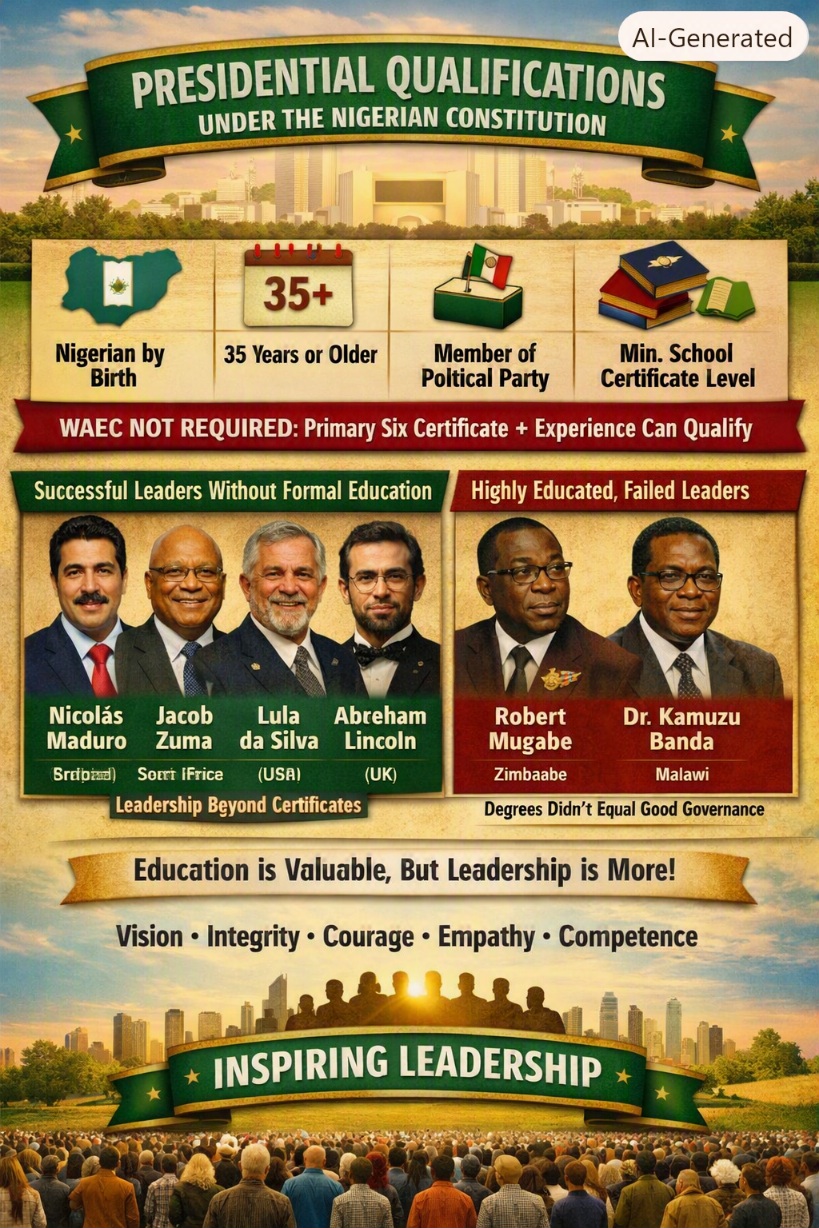
Under Section 131 of the Constitution of the Federal Republic of Nigeria, 1999 (as amended), a person is qualified for election to the office of President if:
(a) he is a citizen of Nigeria by birth;
(b) he has attained the age of thirty-five years [originally 40 years, altered to 35 years by the Fourth Alteration Act, 2017];
(c) he is a member of a political party and is sponsored by that political party; and
(d) he has been educated up to at least School Certificate level or its equivalent.
What “School Certificate Level or its Equivalent” Means
The phrase is defined by the Constitution itself in Section 318(1) – Interpretation Section. It does NOT mean that a candidate must produce a WAEC certificate.
It means any of the following:
(a) A Secondary School Certificate or its equivalent, or Grade II Teacher’s Certificate, the City and Guilds Certificate; or
(b) Education up to Secondary School Certificate level; or
(c) Primary Six School Leaving Certificate or its equivalent and –
(i) service in the public or private sector in the Federation in any capacity acceptable to the Independent National Electoral Commission [INEC] for a minimum of ten years, and
(ii) attendance at courses and training in such institutions as may be acceptable to INEC for periods totalling up to a minimum of one year, and
(iii) the ability to read, write, understand and communicate in the English language to the satisfaction of INEC, and
(iv) any other qualification acceptable to INEC.
This is why legal analysts have correctly noted that even a Primary Six Certificate, coupled with the conditions above, can satisfy the constitutional threshold. Under the current law, a First School Leaving Certificate plus evidence of ability to read and write and other conditions acceptable to INEC can qualify a person. The Constitution deliberately sets a very low educational threshold.
Leadership Beyond Certificates: Lessons from Around the World
Leadership is not determined by certificates alone. History is replete with examples of transformative leaders who had little or no formal education, as well as leaders with intimidating academic credentials.
1. World Leaders Who Excelled Without Formal Education:
Nicolás Maduro – Venezuela: President since 2013, he has no university education. He completed only secondary school at the José Ávalos High School in Caracas and never attended university. He worked as a bus driver for the Caracas Metro and rose through trade union activism to become Foreign Minister, Vice President and President.
Jacob Zuma – South Africa: President from 2009 to 2018, he had no formal schooling and described himself as self-educated.
Luiz Inácio Lula da Silva – Brazil: One of Brazil’s most successful presidents, he left school after the 4th grade and worked as a shoeshine boy and factory worker before becoming a trade union leader and three-time President.
Abraham Lincoln – United States: The 16th President, widely regarded as America’s greatest President, had less than one year of formal schooling. He was largely self-taught.
George Washington, Andrew Johnson and Harry S. Truman – United States: Washington had no college education; Andrew Johnson never attended school and was taught to read by his wife; Truman, the 33rd President, is the last American President without a college degree.
Winston Churchill – United Kingdom: The wartime Prime Minister who led Britain to victory in World War II, left formal education early and never attended university.
2. Leaders With Numerous Degrees Where Certificates Did Not Translate to Good Governance:
Robert Mugabe – Zimbabwe: Held seven academic degrees, including two Master’s degrees and multiple Bachelor’s degrees earned while in detention, yet his long rule ended in economic collapse.
Dr. Hastings Kamuzu Banda – Malawi: A medical doctor with degrees from the United States and Scotland, but his regime became one of Africa’s most authoritarian.
The lesson is clear: While education is desirable, effective leadership rests on vision, courage, character, empathy, administrative capacity, and the ability to inspire and unite a people – qualities that no certificate can confer.